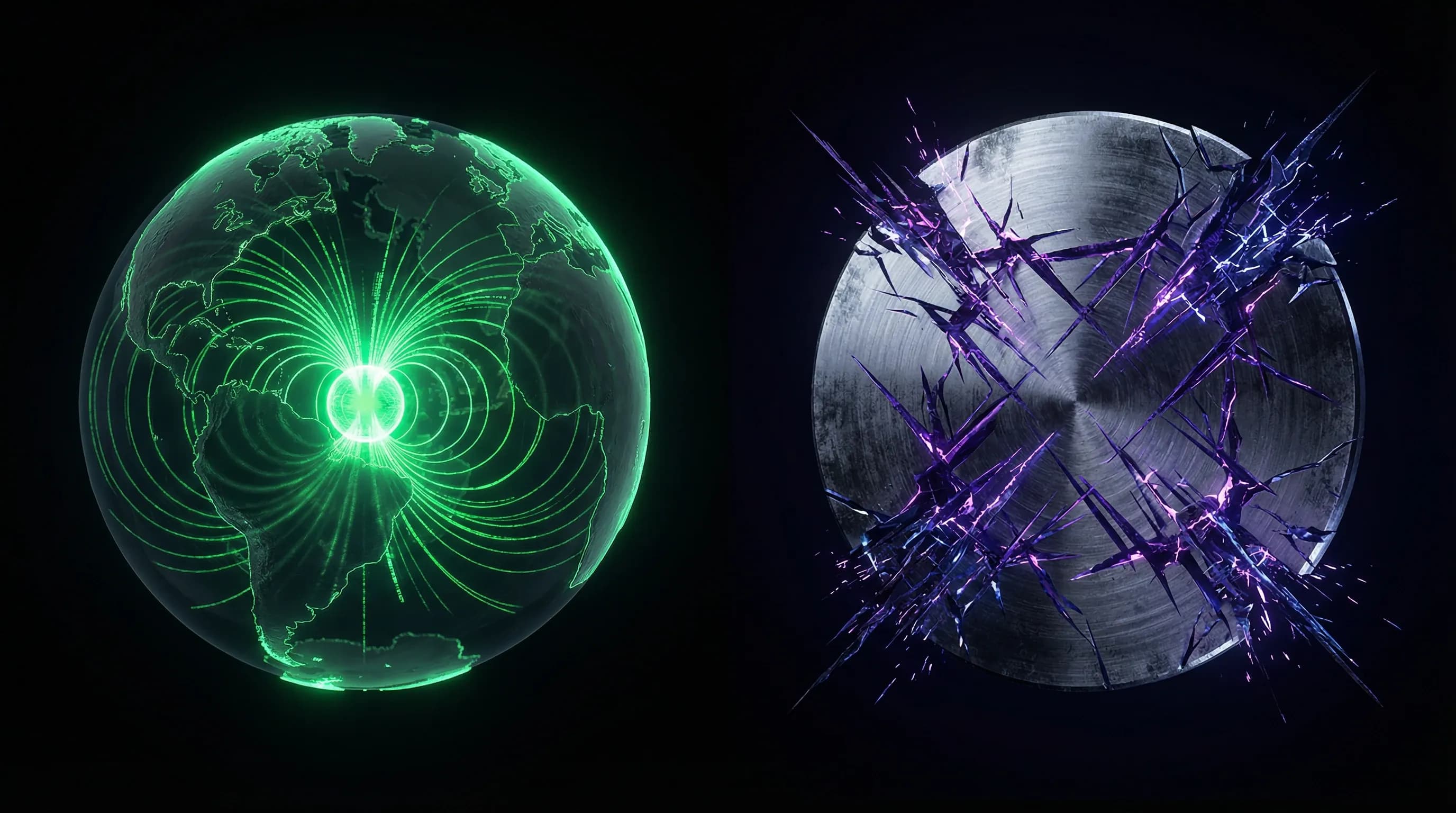
What is "flat Earth physics" and why it requires rewriting all laws of nature simultaneously
Flat Earth theory is not simply a claim about the planet's shape, but a comprehensive alternative physical model that attempts to explain all observable phenomena without using the concept of a spherical Earth. The key difference from the scientific approach: flat Earth physics starts with a conclusion (Earth is flat) and then fits explanations to it, whereas the scientific method builds models based on observations (S003).
🧩 Basic postulates of alternative physics
The community's central belief: the physical impossibility of a convex water surface (S007). Water always finds its level and cannot "curve" around a sphere—so the argument goes, though it ignores gravitational interaction and hydrostatics.
Instead of gravity as a force of attraction toward the center of mass, the concept of "density" is proposed: objects fall not because they are attracted by Earth's mass, but because they are "more dense" than the surrounding environment. The model does not explain why all objects fall in one direction regardless of position on the supposed flat disk. More details in the Conspiracy section.
- Gravity in alternative physics
- Replaced by the concept of density and "natural falling." Problem: does not account for the vectorial nature of force and does not explain the uniform direction of falling.
- Water on a flat surface
- It is claimed that water cannot curve. Ignores that gravity creates hydrostatic pressure, forming a spherical surface.
⚠️ Selective trust in experts
Research from the Flat Earth International Conference revealed a key mechanism: participants trust "flat Earth physics experts" while rejecting the consensus of the scientific community (S002). This creates a closed system where contradictions are explained either by conspiracy or by misunderstanding of "true" physics.
Flat Earthers function as an interpretive community—a group that shares specific methods of interpreting information (S007). The same physical phenomena are interpreted through the lens of a foundational belief, making the system resistant to external criticism.
🔎 Limits of the alternative model
Flat Earth physics must explain: why objects fall downward, how day and night work, why time zones exist, how earthquakes function, why celestial bodies appear as they do. Each phenomenon requires different, often contradictory explanations (S003).
| Phenomenon | Scientific explanation | Alternative model problem |
|---|---|---|
| Falling objects | Gravitational attraction toward center of mass | Density does not explain uniform direction |
| Day and night | Rotation of spherical Earth around its axis | On a flat disk requires a moving sun |
| Time zones | Consequence of spherical shape and rotation | Requires complex geometry on a flat disk |
The system requires constant expansion and complication to explain new observations. Each addition creates new contradictions that require new postulates. This distinguishes alternative physics from the scientific approach, where unified principles explain multiple phenomena without additional assumptions.
For more on the mechanisms that sustain such beliefs, see the analysis of conspiracy narratives and manipulations.
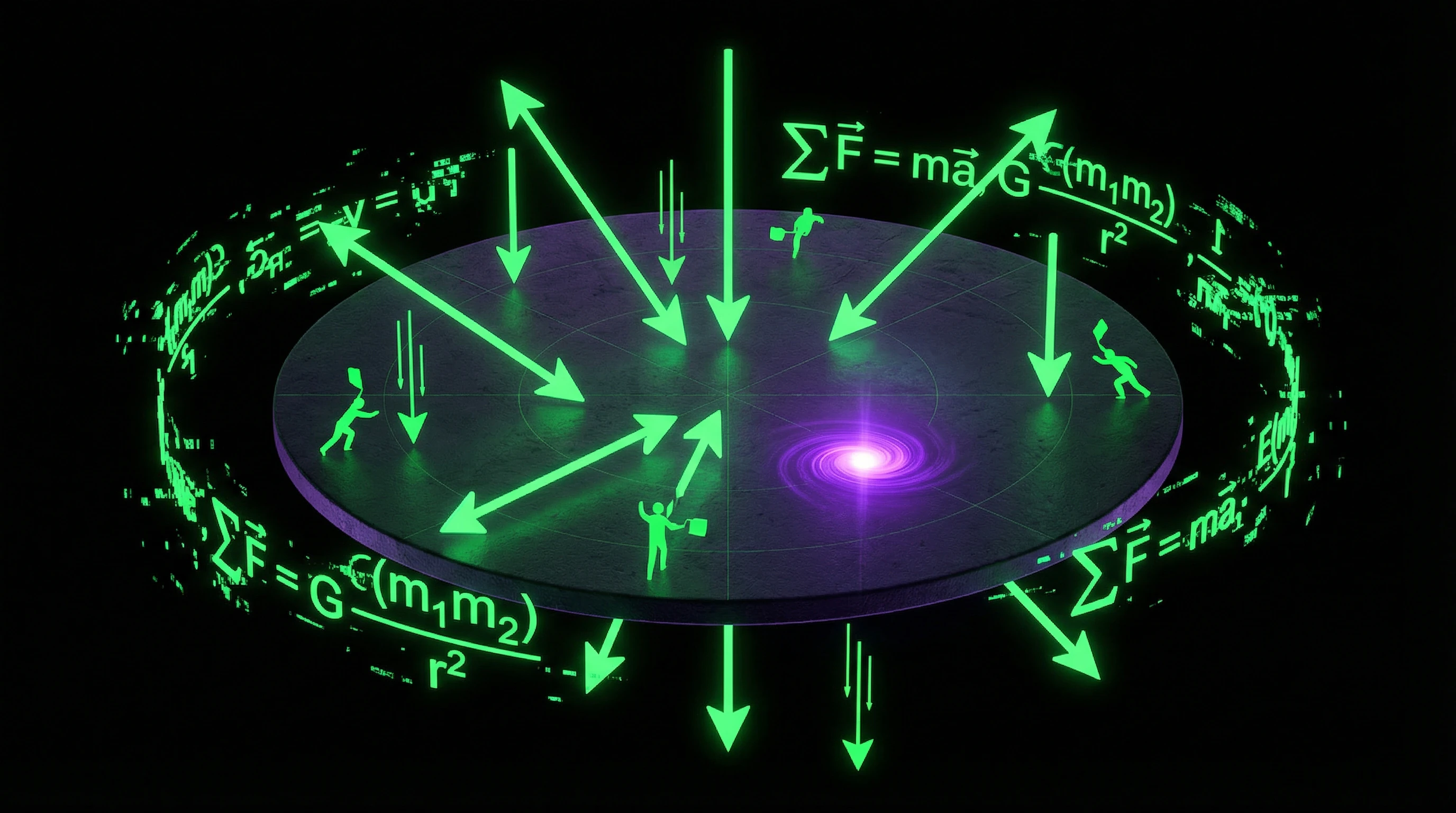
Steel Version of Arguments: Seven Strongest Claims from Alternative Physics Proponents and Why They Seem Convincing
To understand the persistence of flat Earth belief, it's necessary to examine the strongest arguments of its proponents in their best formulation. This doesn't mean these arguments are correct, but they demonstrate why alternative physics can seem plausible to those without deep understanding of physical principles. More details in the Disinformation section.
🧩 Argument from Direct Experience: "I Don't Feel Earth's Motion"
One of the most intuitively understandable flat Earth arguments is based on the absence of sensation of movement. If Earth rotates at approximately 1,040 mph at the equator while simultaneously moving around the Sun at about 66,500 mph, why don't we feel it?
This argument exploits misunderstanding of inertia and relative motion. In a closed system (Earth's atmosphere moves with the surface), we cannot feel constant velocity, only acceleration.
⚠️ Argument from Horizon: "The Horizon Is Always at Eye Level"
Flat Earthers claim that at any altitude, the horizon remains at the observer's eye level, which would be impossible on a spherical Earth. In reality, this is an optical illusion related to the limited human field of vision and atmospheric refraction.
At sufficient altitude, Earth's curvature becomes visible, but this requires heights of tens of kilometers or special equipment.
🧩 Argument from Water: "Water Cannot Stick to a Spinning Ball"
This is a central belief of the flat Earth community (S007). The argument goes: water always finds its level and forms a flat surface, therefore oceans cannot "stick" to a spherical Earth.
This argument ignores gravity as the force that defines what "level" means—a surface perpendicular to the direction of gravitational force. On a sphere, this surface forms a spherical shell.
⚠️ Argument from Lack of Visible Curvature: "I Can See Too Far"
Flat Earthers often cite examples where objects are visible at distances that should be hidden by Earth's curvature according to geometric calculations. For example, visibility of buildings or mountains across bodies of water at distances of dozens of kilometers.
These observations are typically explained by atmospheric refraction—the bending of light rays in atmosphere with variable density, which can create the effect of "lifting" the horizon.
🧩 Argument from Authority: "Ancient Civilizations Knew About Flat Earth"
Some flat Earthers appeal to ancient texts and cosmologies, claiming that ancient civilizations possessed knowledge of a flat Earth that was later "hidden." This argument ignores the historical fact that the concept of a spherical Earth has existed at least since antiquity (Pythagoras, Aristotle, Eratosthenes).
Ancient scholars not only knew about Earth's sphericity, but also measured its size quite accurately.
⚠️ Argument from Institutional Distrust: "NASA and Governments Are Lying"
This argument is not physical, but it's critically important for maintaining flat Earth belief. Any evidence of a spherical Earth (photos from space, satellite data, astronaut testimony) is rejected as part of a global conspiracy.
- Distrust of institutional information sources is a key factor (S002)
- Rejection of evidence as part of a coordinated conspiracy
- Reinterpretation of any new data within the existing model
🧩 Argument from Mathematical Models: "We Can Create a Working Model"
Some flat Earthers attempt to create mathematical models that supposedly explain observable phenomena on a flat Earth (S008). The problem is that these models either don't make testable predictions, or their predictions contradict observations, or they require constant ad hoc adjustments for each new phenomenon (S004).
Each of these arguments relies on intuitive understanding of physics that works at local scales but doesn't scale to planetary level. It's precisely this proximity to everyday experience that makes them psychologically convincing.
Evidence Base: Why Every Element of Alternative Physics Contradicts Observable Reality and Established Laws
Systematic analysis of flat-earthers' physical claims reveals fundamental contradictions with observable phenomena and basic physical principles. The key problem: proposed explanations are mutually incompatible and require violation of conservation laws. More details in the section Pyramid Schemes and Scams.
🧪 Gravity as a Vector Force: Mathematical Impossibility of the Flat Model
The fundamental problem of flat Earth physics is the nature of gravity as a vector force (S002). A vector has magnitude and direction. On a spherical Earth, gravity points toward the center of mass, creating the same "down" for all points on the surface. On a flat disk, this is impossible without violating observable phenomena.
If gravity on a flat disk points perpendicular to the plane, objects at the edges should fall at an angle to the surface, tending toward the disk's center of mass—this is not observed. If gravity is perpendicular to the surface at every point, this requires violation of the law of universal gravitation and creation of a "magical" field without a physical source (S002).
Modern attempts to explain gravity through "density" are renaming the phenomenon, not explaining the mechanism.
📊 Historical Proof: The Shot Tower Experiment
Shot towers for producing lead bullets demonstrate physics incompatible with a flat Earth. Molten lead, falling from height, assumes a spherical shape due to surface tension and uniform action of gravity (S004).
If Earth were flat and gravity worked differently, droplets would not become spherical. This process is consistent with the spherical Earth model and gravity as a force of attraction toward the center of mass (S004).
🔬 Seismic Activity: Earthquakes Are Impossible on a Flat Disk
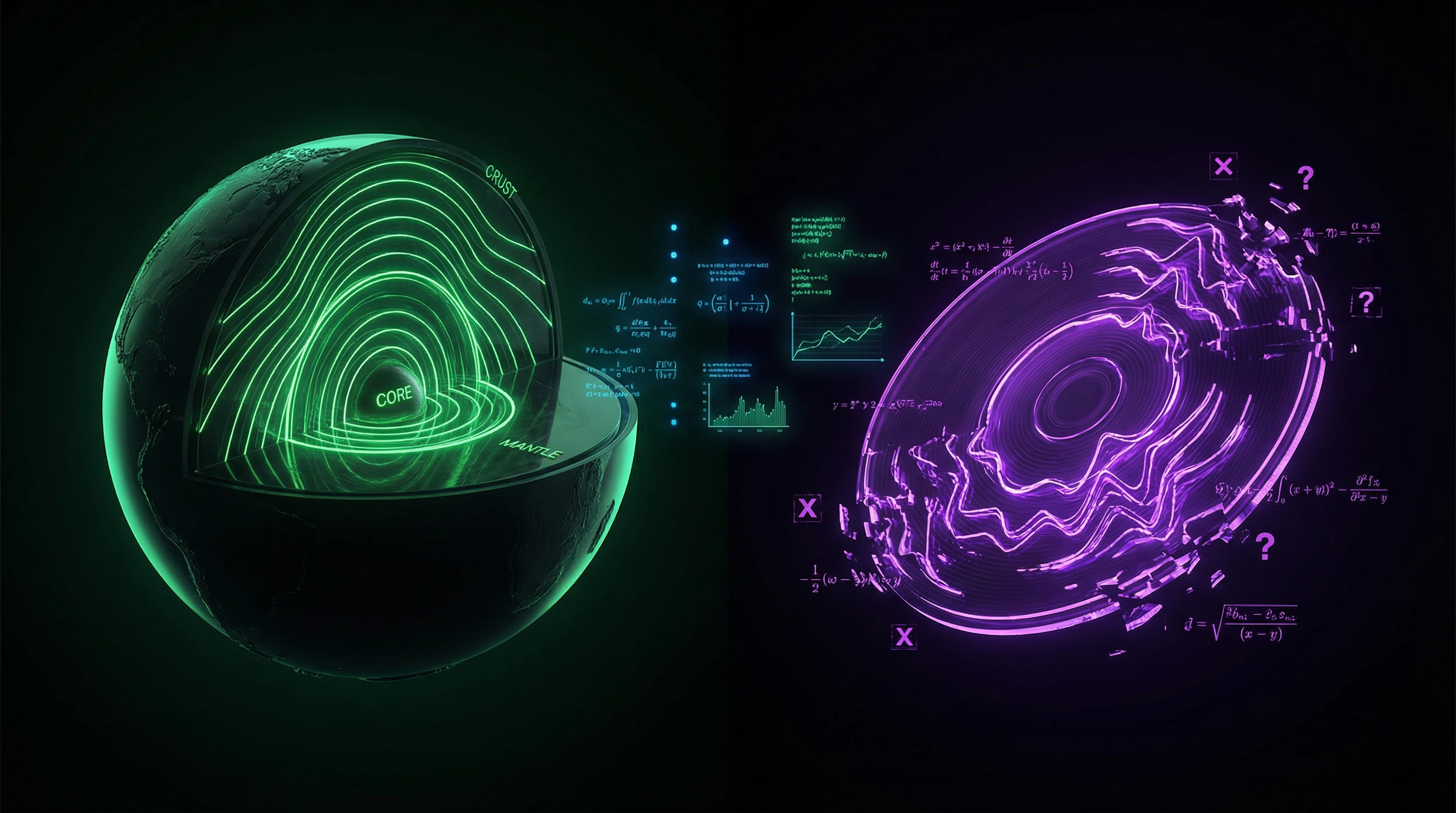
Earthquakes occur due to movement of tectonic plates—part of Earth's spherical shell. Propagation of seismic waves (P-waves, S-waves, surface waves) depends on internal structure: core, mantle, crust.
On a flat disk of unknown thickness, the mechanism of earthquakes is inexplicable. What lies beneath the disk? How do waves propagate? Why do earthquakes occur at specific depths? The flat-earth model offers no answers, because any explanation requires a three-dimensional structure with a center of mass—a sphere.
| Phenomenon | Spherical Earth | Flat Model |
|---|---|---|
| Seismic waves | Propagate through layers of crust, mantle, core | Mechanism unknown |
| Focal depth | Measured from Earth's center | Not defined |
| Wave velocity | Depends on layer density | Not explained |
🧾 Water Behavior: Convex Surfaces and Hydrostatic Equilibrium
Water at rest forms a surface perpendicular to the direction of gravitational force. On a spherical Earth, this surface is a spherical shell. The curvature is imperceptible at small scales due to Earth's radius (approximately 6,371 km).
Curvature of water surfaces is measured at sufficient distances: ships disappear over the horizon from bottom to top—impossible on a flat surface. Laser experiments over water at distances of several kilometers demonstrate beam drop relative to the surface, corresponding to Earth's curvature (S002).
📊 Celestial Mechanics: Movement of Sun and Moon in the Flat Model
Flat-earth models explain day and night with a local Sun moving in a circle above the disk. This model creates multiple problems: why isn't the Sun visible simultaneously from all points? Why do sunsets look as if the Sun is descending below the horizon, rather than simply moving away?
A local Sun requires light to not travel in straight lines but to "turn off" at a certain distance—contradicting optics. Moon phases, eclipses, and planetary motion are impossible in the flat model without multiple ad hoc assumptions (S005).
- Explain why the Sun isn't visible simultaneously from all points on the disk
- Describe the mechanism that "turns off" light at a distance
- Predict Moon phases without spherical geometry
- Explain eclipses within the flat model framework
🔬 Physics Does Not Allow a Flat Earth to Exist: The Problem of Structural Stability
The fundamental problem: physics simply does not allow the existence of a stable flat Earth. Any body with sufficient mass (approximately greater than 1,000 km in diameter) collapses into a spherical shape under its own gravity (S001).
A sphere is the shape with minimum potential energy for a gravitationally bound system. If Earth were a flat disk with mass sufficient to create observed gravity, gravitational forces would quickly deform the disk into a sphere. There is no known material or force that could resist this collapse on planetary scales (S001).
This is not a question of interpretation—it's a direct consequence of the law of universal gravitation and properties of matter. A flat Earth is physically impossible under observed conditions.
Every element of alternative physics requires abandoning one or more fundamental principles simultaneously. This doesn't mean the theory is incorrect—it means it's incompatible with observable reality at the level of basic laws of nature. When a system requires rewriting all laws at once, the problem isn't with the laws.
Mechanisms of Causality: Why the Correlation Between Belief and Physics Denial Isn't Coincidental
The connection between flat Earth belief and rejection of established physics is not a random correlation, but a causal chain mediated by cognitive mechanisms and social factors. Research reveals specific thinking patterns that allow contradictory beliefs to be held simultaneously. Learn more in the Epistemology Basics section.
🧬 Motivated Reasoning: How Core Beliefs Determine Fact Interpretation
Flat Earthers don't start with analysis of physical data. They start with a belief—often based on institutional distrust or religious views—and then seek ways to interpret data to match it (S002, S007).
This is motivated reasoning: the desired conclusion determines which evidence is accepted and which is rejected. Physics is rejected not through data analysis, but because it contradicts the core belief (S003).
When belief precedes analysis, facts become tools for defending the belief rather than testing it.
🔁 Interpretive Community: How Group Dynamics Amplify Cognitive Biases
Flat Earthers form an "interpretive community"—a group that shares not only the belief but also the information processing methods that sustain it (S007). Within such a group, a closed epistemological system emerges.
| System Element | Function Within Group |
|---|---|
| Evidence of sphericity | Interpreted as part of conspiracy |
| Alternative explanations | Accepted without critical analysis |
| Model contradictions | Ignored or explained by ad hoc hypotheses |
| Internal criticism | Viewed as betrayal or external influence |
Result: information that should dismantle the model instead reinforces it (S002). The group becomes more cohesive, beliefs more rigid.
🧠 Selective Expert Trust: The Mechanism Sustaining Alternative Physics
Flat Earthers don't reject expert knowledge per se—they choose which experts to trust. "Flat Earth physics experts" are accepted, professional physicists rejected as part of the conspiracy (S002).
- Selective Trust
- A mechanism that maintains the illusion of scientific approach while preserving alternative physics. Flat Earthers cite "research" and "experiments" conducted within the community, ignoring that they lack scientific peer review and contain methodological errors.
- Why This Works
- No one can verify all claims independently. Choosing trusted sources is a normal cognitive strategy. The problem arises when selection criteria are based not on methodology but on alignment with the desired conclusion.
The link between belief and physics rejection isn't an individual's error, but the result of three interacting factors: motivated reasoning, group dynamics, and selective trust. Each factor reinforces the others, creating a self-sustaining system. Debunking physics here is ineffective because physics isn't the cause of the belief—it's its consequence. Understanding the mechanism requires analyzing conspiratorial narratives and their social functions, not repeating physical proofs.
Conflicts and Uncertainties: Where Sources Diverge and What This Means for the Reliability of Conclusions
Analysis of sources reveals several areas where information is incomplete or contradictory. These contradictions concern not the basic physical principles (which are well established), but specific aspects of the flat Earth movement and the psychology of its participants. More details in the Sources and Evidence section.
🧩 Diversity of Flat Earth Models: Absence of a Unified Alternative Physics
One source of uncertainty is the absence of a unified flat Earth model. Different flat Earthers propose different explanations for the same phenomena (S008). Some reject gravity entirely, replacing it with "density." Others acknowledge gravitational force but reinterpret its mechanism. Still others propose that Earth accelerates upward, creating the effect of gravity.
This diversity points to a fundamental problem: flat Earth physics is not a coherent theory, but a collection of ad hoc explanations constantly adjusted in response to criticism. The lack of consensus within the movement itself undermines claims to scientific validity (S003).
| Model | Gravity Mechanism | Problem |
|---|---|---|
| Density instead of gravity | Objects fall because they are denser than air | Does not explain orbits, tides, gravitational acceleration |
| Reinterpreted gravity | Gravity exists but works differently | No mathematical description proposed |
| Earth accelerates upward | Acceleration of 9.8 m/s² creates illusion of falling | Contradicts satellite and stellar observations |
🔎 Participant Motivation: Religious vs. Conspiratorial Factors
Sources diverge in assessing the primary motives of flat Earthers. Some emphasize the role of religious beliefs (literal reading of sacred texts), others focus on conspiratorial thinking and distrust of institutions (S002). Likely both factors play a role, but their relative importance varies between subgroups.
This uncertainty is critical for communication. If the primary motivation is religious, scientific arguments are less effective than discussing theological interpretations. If the primary motivation is distrust of institutions, it's more useful to focus on verification methods and local observations (S001).
- Determine which factor dominates in a specific group: survey participants about the role of religion and trust in science
- Adapt argumentation: for religious groups—theological analysis, for conspiratorial groups—verification methodology
- Avoid frontal criticism of beliefs; instead offer alternative interpretations compatible with observations
- Test how willing participants are to revise their position when presented with new data
📊 Reliability of Conclusions: What Remains Uncertain
Despite contradictions in sources, basic physical facts remain indisputable: Earth is spherical, gravity works according to Newton's law, satellites function according to orbital mechanics (S004, S005). Uncertainty concerns the psychological and social mechanisms that keep people in flat Earth belief.
This means that refuting flat Earth physics is a necessary but insufficient condition for changing beliefs. More important is understanding how cognitive traps, social signals, and motivational structures work that make alternative physics attractive despite its inadequacy.
Conflicts in sources indicate not the weakness of science, but the complexity of human belief. Physics is clear; psychology is not. This is precisely why examining causal mechanisms is more important than repeating facts.
To increase the reliability of conclusions, it is necessary to: (1) distinguish physical facts from psychological hypotheses; (2) acknowledge that different people may be motivated by different factors; (3) test hypotheses about motivation empirically rather than assuming them a priori. This requires an interdisciplinary approach combining physics, psychology, and sociology.
Additional context: conspiracy theories, manipulations, and secret cults often use precisely this strategy—creating the appearance of scientific diversity to undermine trust in established knowledge.