The flat Earth phenomenon in the 21st century is not merely a curiosity, but a symptom of systemic failure in scientific knowledge transmission. Despite absolute scientific consensus and multiple independent proofs of the planet's spherical shape, millions accept a physically impossible model. This material examines the mechanisms of cognitive vulnerability, the role of social media in spreading pseudoscience, and proposes a protocol for protection against conspiratorial thinking.
🖤 In an era when satellites transmit real-time images of Earth, when GPS functions thanks to relativistic corrections accounting for planetary curvature, when anyone can purchase a ticket for a flight crossing the ocean along a great circle arc — millions are convinced the Earth is flat. This is neither a historical anomaly nor a marginal delusion: this is a mass movement of the 21st century, spreading through YouTube, social networks, and online communities at the speed of viral infection. The flat Earth phenomenon is not a question about the shape of the planet. It is a diagnostic test revealing critical vulnerabilities in the system of scientific knowledge transmission, in society's ability to distinguish evidence from manipulation, in the resilience of rational thinking against conspiratorial propaganda.
What exactly flat Earth proponents claim — and why this isn't an "alternative theory," but a denial of physics
Flat Earth is an archaic and scientifically refuted conception of Earth's shape as a plane or disk (S013). Many ancient societies adhered to flat cosmography, but empirical observations revealed Earth's spherical shape centuries ago (S015). The model experienced a revival as a conspiracy theory in the 21st century.
⚠️ This is not a scientific theory, but a pseudoscientific doctrine
Flat Earth doctrine is not a "theory" in the scientific sense and represents pure pseudoscience (S004). In science, a theory is a systematic explanation of phenomena based on testable hypotheses, empirical data, and capable of making accurate predictions.
Flat Earth claims satisfy none of these criteria (S008). They are not based on scientific methodology, offer no testable predictions, fail to explain observable phenomena, and contradict all known laws of physics.
| Scientific theory criterion | Theory of relativity | Flat Earth |
|---|---|---|
| Testable hypotheses | ✓ Yes | ✗ No |
| Empirical data | ✓ Yes | ✗ No |
| Accurate predictions | ✓ Yes | ✗ No |
| Consistency with observations | ✓ Yes | ✗ Contradicts |
🧩 What must be rejected to believe in a flat Earth
To maintain this belief, people must abandon an enormous body of well-established physics (S012). This includes Galilean mechanics, Newtonian gravitation, orbital mechanics, and special relativity.
Each of these branches of physics is confirmed by thousands of independent experiments, used in technologies that work daily, and forms the foundation of modern civilization. To reject them is to reject not merely abstract ideas, but working tools for understanding reality.
🔬 The gravitational impossibility of a flat disk
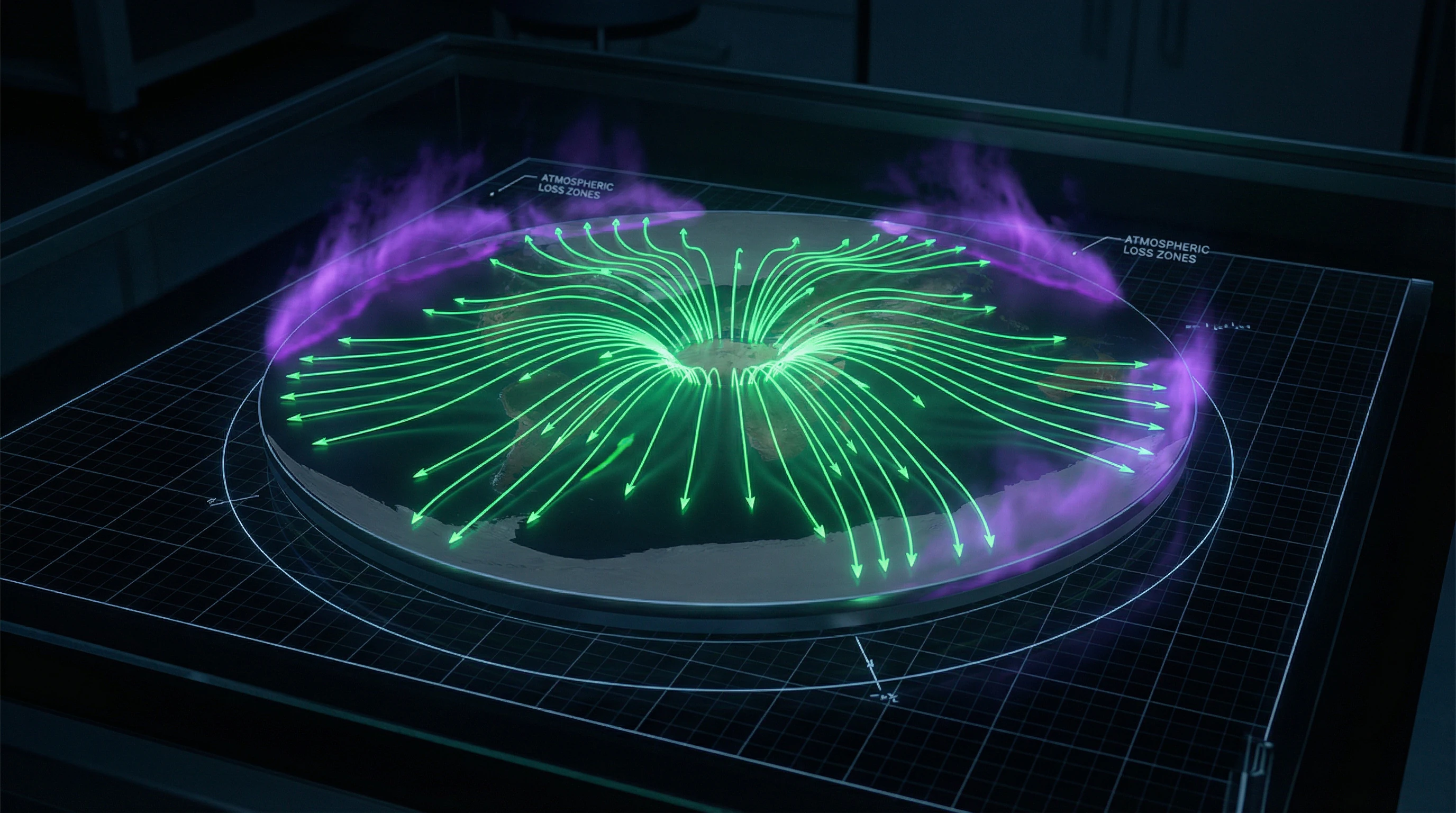
The gravitational field of a disk-shaped mass — the model corresponding to flat Earth — would create entirely different effects from those we experience (S014). Objects would not fall vertically downward across the entire surface: gravity would pull them toward the disk's center, creating angled attraction at the periphery.
- The atmosphere could not be held uniformly
- Satellite orbital mechanics would be impossible
- Each of these consequences contradicts the daily experience of billions of people
This is not a matter of interpretation or philosophical debate — this is a question of physical reality that can be independently verified. Analyzing the mechanisms behind flat Earth belief requires understanding not physics, but cognitive and social factors.
Five of the Strongest Arguments Used by Flat Earth Proponents — and Why They Seem Convincing
To understand why millions of people accept a physically impossible model, we must honestly examine the arguments they find convincing. This doesn't mean agreeing with them — it means understanding the mechanisms of persuasion. More details in the Disinformation section.
Steelmanning (presenting the opponent's position in its strongest form) is the only intellectually honest method of analysis. Each of the five arguments below works because it exploits a real limitation of human cognition or a gap in education, not because it is logically valid.
⚠️ The Argument from Direct Experience: "I See a Flat Surface"
The most intuitively powerful argument: when you look around, Earth appears flat. The horizon looks like a straight line, water in a lake appears level, buildings aren't tilted.
This argument exploits a fundamental property of human cognition: we trust direct sensory experience more than abstract explanations. Our senses evolved for navigation at local scales, not for determining the shape of a planet 7,918 miles in diameter. On the surface of a sphere this size, curvature is imperceptible at distances accessible to the naked eye.
- Mechanism of Persuasiveness
- Direct sensory perception seems more reliable than theory. This isn't sensory deception — it's their limitation by scale.
- Cognitive Trap
- Trusting local experience without accounting for the fact that the scale of observation may be insufficient to reveal global properties.
🧩 The Argument from Distrust of Authorities: "Space Agencies Are Lying to Us"
The second powerful argument builds on distrust of institutional information sources. Flat Earth proponents claim that NASA, SpaceX, and other space agencies falsify images and participate in a global conspiracy.
This argument resonates in an era when trust in institutions is genuinely declining, when real cases of manipulation and disinformation by governments and corporations are being exposed (S002). The problem is that this argument requires coordination of a conspiracy of incredible scale: thousands of scientists, engineers, pilots, sailors, astronomers from dozens of countries with opposing political interests would have to maintain the same lie for centuries.
Distrust of authorities is a rational response to real cases of manipulation. But it becomes a cognitive trap when it requires a greater conspiracy than the truth itself.
🕳️ The Argument from Absence of Visible Curvature in Photographs: "The Horizon Is Always at Eye Level"
The third argument uses photographs taken from airplanes or tall buildings, where the horizon appears flat and sits at the observer's eye level. Flat Earth proponents claim that if Earth were a sphere, the horizon should curve downward.
This argument exploits a misunderstanding of geometry and optics. On a sphere the size of Earth, the horizon is indeed always at the observer's eye level — this is a geometric consequence of standing on a convex surface. Curvature becomes noticeable only at very high altitudes (above 6–9 miles) and requires wide-angle optics without distortion.
⚠️ The Argument from "Impossibility" of Motion: "We Don't Feel Earth's Rotation"
The fourth argument: if Earth rotates at approximately 1,037 mph at the equator and moves around the Sun at approximately 66,500 mph, why don't we feel this motion?
This argument demonstrates a misunderstanding of inertia and relative motion — concepts established by Galileo and Newton. We don't feel uniform motion because we move together with the atmosphere and our entire environment. Only acceleration (change in velocity) is felt, not velocity itself.
🧩 The Argument from "Independent Research": "Laser Tests Show No Curvature"
The fifth argument references experiments conducted by Flat Earth proponents themselves: laser measurements over water surfaces that allegedly don't show the expected drop due to curvature. These experiments appear scientific — equipment is used, measurements are taken, conclusions are drawn.
The problem is that these experiments systematically ignore atmospheric refraction (bending of light in the atmosphere), fail to account for methodological errors, and selectively interpret results. When the same experiments are conducted with proper methodology, they consistently confirm Earth's curvature — as happened in the documentary "Behind the Curve," where Flat Earth proponents' own experiment disproved their hypothesis.
| Argument | Why It Seems Convincing | Actual Problem |
|---|---|---|
| Direct experience | Senses don't lie | Scale of observation is insufficient |
| Distrust of authorities | Real cases of manipulation | Requires impossible scale of conspiracy |
| Horizon at eye level | Photographs look flat | Misunderstanding of sphere geometry |
| Don't feel motion | Sounds intuitively logical | Ignorance of principle of inertia |
| Laser tests | Looks like scientific method | Ignoring atmospheric refraction and methodological errors |
Each of these arguments works because it contains a kernel of truth or exploits a real limitation of human cognition. This makes them dangerous not to scientists, but to people who lack sufficient education in physics, geometry, and scientific research methodology. Understanding these mechanisms is the first step in analyzing how conspiracy theories work.
Evidence Base for a Spherical Earth: Why Scientific Consensus Is Absolute and How It Can Be Independently Verified
Scientific understanding of Earth's shape is not based on authority or dogma, but on multiple independent lines of evidence, each of which can be verified independently. This is the critical distinction between science and belief: scientific claims must be falsifiable and testable. More details in the Pharma Distrust section.
📊 Gravitational Measurements and Orbital Mechanics
Newton's laws, which describe gravity and predict astronomical phenomena, only work when massive bodies are spherical (S016). Isaac Newton in the Principia not only described the laws of gravity but derived Earth's shape—calculating its size and surface.
Satellite navigation works only because it accounts for Earth's curvature and relativistic effects arising from differences in gravitational potential at different altitudes. If Earth were flat, GPS simply wouldn't work—every satellite launch, every space mission, every smartphone navigator confirms this daily.
Satellite navigation is not a theory. It's an engineering system that either works or doesn't. It works because Earth is spherical.
🧪 Satellite Imagery and Space Exploration
Thousands of satellites launched by dozens of countries and private companies transmit images of a spherical Earth daily. Cosmonauts and astronauts from different countries, including political adversaries, independently confirm the planet's spherical shape.
The International Space Station broadcasts real-time video showing a rotating sphere. Private companies like SpaceX regularly publish launch videos showing Earth's curvature. The claim that all of this is fabricated requires a conspiracy of incredible scale—logically impossible to maintain.
| Evidence Source | Independence | Verifiability |
|---|---|---|
| Satellites from different countries | Political adversaries | Daily broadcasts |
| Cosmonauts and astronauts | Different nationalities | Direct observations |
| Private companies | Commercial interests | Public videos |
🧾 Navigation and Circumnavigation
Ships and aircraft successfully complete circumnavigations using navigational calculations based on a spherical Earth model. Long-haul flight routes follow great circle arcs—the shortest paths on a sphere, which would appear absurdly long on a flat map.
A flight from Los Angeles to Tokyo goes over Alaska—a route that only makes sense on a sphere. Maritime navigation uses spherical trigonometry to calculate courses with meter-level accuracy over distances of thousands of kilometers. These methods couldn't work if the underlying model were incorrect.
🔭 Astronomical Observations Available to Anyone
During a lunar eclipse, Earth's shadow on the Moon is always circular—this is only possible if Earth is spherical. A flat disk would cast an elliptical shadow at most angles.
- Ships disappearing over the horizon vanish bottom-up—hull first, then masts
- The altitude of Polaris above the horizon changes depending on the observer's latitude
- Different constellations are visible in the northern and southern hemispheres
- All these observations are accessible without special equipment
📊 Physical Principles: Why Massive Bodies Become Spherical
Gravity pulls mass toward the center. For a sufficiently massive body (roughly greater than 400–600 km in diameter), its own gravity overcomes material strength and shapes the body into a sphere—the form that minimizes gravitational potential energy (S016).
This is not a theory specific to Earth—it's a universal principle observed for all planets, large moons, and stars. Earth cannot be flat for the same reason Mars, Jupiter, the Moon, or the Sun cannot be flat. Gravity does not allow massive bodies to maintain non-spherical shapes.
Scientific consensus about a spherical Earth is not a vote among scientists. It's the result of all independent verification methods giving the same answer. This cannot be a conspiracy because conspiracy requires coordination, and nature does not coordinate.
Mechanisms of Cognitive Vulnerability: Why Intelligence Doesn't Protect Against Pseudoscience and What Factors Increase Susceptibility
A critically important observation: flat Earth supporters are not necessarily unintelligent (S012). Educated, functionally successful people can accept physically impossible models.
This points to systemic vulnerabilities in human cognitive architecture that are independent of IQ or the number of books read. Intelligence is not immunity to pseudoscience. More details in the section Sovereign Citizens Movement.
🧬 Scientific Literacy and Conspiratorial Thinking
A study cited 136 times identified two key risk factors: low levels of scientific intelligence and high levels of conspiratorial thinking increase susceptibility to flat Earth arguments on YouTube (S010).
Scientific literacy is not simply knowing facts, but understanding the scientific method, the ability to evaluate evidence, and distinguishing reliable sources. Conspiratorial thinking is a psychological predisposition to believe in conspiracy theories, characterized by distrust of official explanations and belief in hidden malevolent forces (S010).
| Factor | Vulnerability Mechanism | Outcome |
|---|---|---|
| Low scientific literacy | Inability to assess evidence quality | Any argument appears equally valid |
| High conspiratorial thinking | Systematic distrust of institutions | Official sources automatically discredited |
| Social isolation | Seeking belonging in online communities | Group conviction reinforces belief |
⚠️ Social Media as a Vector of Spread
The flat Earth phenomenon, fueled by social media and YouTube, has become a prominent example of science denial and conspiratorial thinking (S006). Recommendation algorithms are optimized to maximize viewing time, not information accuracy.
Content that triggers strong emotions (shock, outrage, sense of uncovering secrets) receives preferential treatment in recommendations. This creates "rabbit holes"—sequences of increasingly extreme content.
A person who watches one flat Earth video out of curiosity receives recommendations for dozens of similar videos. This creates the illusion that the position is widely held and seriously discussed by the scientific community.
🧩 Erosion of Trust in Scientific Institutions
The flat Earth phenomenon undermines trust in science, amplifies conspiratorial thinking, and contributes to confusion regarding scientific authority (S007). When people see millions supposedly "questioning" the shape of the Earth, it legitimizes doubt in any scientific claims.
If one can doubt the shape of the Earth, why not doubt climate change, vaccine efficacy, or evolution? The flat Earth phenomenon serves as a gateway to broader science denial (S001).
- Initial doubt in one scientific claim
- Search for alternative explanations in online spaces
- Entry into a community of like-minded individuals
- Social reinforcement for adopting group beliefs
- Systematic distrust of all official sources
🔁 Alternative Knowledge Systems
Flat Earth supporters create a parallel epistemological system with its own "experts," "evidence," and criteria for truth (S002). Within this system, they use the language and structure of scientific discourse, creating an illusion of scientificity.
This is not simply ignorance—it is a self-sustaining knowledge system. Community members receive social reinforcement for accepting group beliefs and social punishment for doubting them. Leaving such a community means losing social identity and belonging.
- Epistemic Closure
- The belief system becomes impermeable to external evidence. Any fact contradicting group belief is interpreted as part of a conspiracy.
- Social Validation
- Truth is determined not by logic or evidence, but by consensus within the group. The more people believe, the more "true" the claim appears.
- Authority Inversion
- Official scientists and institutions become enemies, while self-taught individuals and activists become heroes. Lack of credentials is reinterpreted as independence of thought.
Causality vs. Correlation: What Actually Creates a Flat Earth Believer and Which Factors Are Consequences, Not Causes
Understanding the mechanisms of spread requires distinguishing between causes and effects. Not all factors that correlate with flat Earth belief are its causes. More details in the section Cognitive Biases.
🧬 Primary Risk Factors: What Precedes Belief Adoption
Empirical data points to two primary factors: low scientific literacy and high conspiratorial mentality (S004). These factors exist before contact with flat Earth content and predict susceptibility to it.
Scientific literacy is not simply education; many people with formal education have low scientific literacy if their training did not include understanding the scientific method, critical thinking, and evidence evaluation (S006). Conspiratorial mentality is a stable psychological trait associated with distrust of authorities, need for unique knowledge, and tendency to see patterns and intentions where none exist.
| Factor | Status | When It Emerges |
|---|---|---|
| Low scientific literacy | Primary risk | Before content exposure |
| Conspiratorial mentality | Primary risk | Before content exposure |
| Distrust of institutions | Secondary effect | After belief adoption |
| Social identity in community | Secondary effect | After belief adoption |
🔁 Secondary Effects: What Intensifies After Belief Adoption
After adopting flat Earth belief, a cascade of secondary effects occurs. General distrust of scientific institutions intensifies, a broader conspiratorial worldview develops where flat Earth is just one element of a global deception.
Social identity forms around the belief, making abandonment psychologically painful—it would mean losing community and admitting one was deceived (S002). Selective information perception develops: evidence contradicting the belief is rejected or reinterpreted, while any information that can be construed as supportive is amplified.
⚠️ Confounders: Factors That Look Like Causes But Aren't
Social media use correlates with flat Earth belief, but this is not a cause—it's a delivery channel (S007). A person with low scientific literacy and conspiratorial mentality will seek confirmation of their beliefs everywhere, including social media.
Social media does not create flat Earth belief; it amplifies existing vulnerability. Disconnecting from the internet will not change primary risk factors.
Education correlates with flat Earth belief, but not linearly. Formal education without developing critical thinking and understanding the scientific method does not protect (S003). Some people with higher education believe in flat Earth because their education was narrowly specialized and did not include scientific literacy.
Age and gender correlate with belief, but these are markers, not causes. They are associated with the likelihood of developing conspiratorial mentality and access to certain communities, but are not direct causes.
- Check: does the factor precede the belief or emerge after it
- Distinguish: is the factor a cause or a distribution channel
- Assess: does the correlation remain significant when controlling for primary risk factors
- Remember: intervening in secondary effects will not eliminate primary risks
Practical implication: attempts to "shut down" social media or increase education without addressing scientific literacy and conspiratorial mentality will be ineffective. Primary factors must be addressed, not their consequences.
More on manipulation mechanisms and mind control in the analysis of manipulative cults and conspiratorial narratives.
Counter-Position Analysis
⚖️ Critical Counterpoint
The article's position relies on the assumption that scientific literacy and rationality solve the problem. But there are serious objections that complicate the picture.
Risk of Intellectual Arrogance
The diagnostic tone may inadvertently widen the gap between the "scientifically literate" and the "misguided," which is counterproductive. Critics rightly point out that the "cognitive diagnosis" position is perceived as condescending and only reinforces distrust in scientific institutions. Acknowledging legitimate reasons for distrust—historical mistakes in science, corporate influence on research—may be more effective.
Underestimation of Epistemological Critique
The article focuses on psychological factors (conspiratorial thinking, low literacy) but insufficiently addresses philosophical questions about the nature of scientific authority. Critics of science raise valid questions: how is consensus formed, what role does funding play in directing research, why does a replication crisis exist in some fields. Ignoring these nuances creates the impression of defending "science as dogma" rather than "science as method."
Limited Data on Intervention Effectiveness
The proposed strategies for combating pseudoscientific thinking rely on limited empirical data about long-term effectiveness. Studies show correlations but not causal relationships. It's unclear whether improving scientific literacy actually reduces susceptibility to conspiracy theories, or whether these are independent variables with a common cause—for example, educational environment or socioeconomic status.
Overestimation of Social Media's Role
YouTube algorithms do play a role, but their significance may be exaggerated. Conspiratorial thinking existed long before the internet. Perhaps social media simply makes visible what has always existed. An alternative hypothesis: the rise in flat Earth belief correlates with a crisis of trust in institutions caused by real events—the 2008 financial crisis, political scandals, the COVID-19 pandemic.
Insufficient Attention to Social Functions of Communities
The article treats flat Earth belief primarily as a cognitive error but underestimates the social functions of such communities—belonging, identity, meaning. For some people, these communities provide social support and a sense of purpose. Purely rational arguments don't compete with these needs. Effective interventions must offer alternative sources of belonging and meaning.
FAQ
Frequently Asked Questions

Author of the Cognitive Immunology Hub project. Researches mechanisms of disinformation, pseudoscience, and cognitive biases. All materials are based on peer-reviewed sources.