What exactly the flat Earth myth claims — and why it's not one hypothesis, but a spectrum of contradictory models
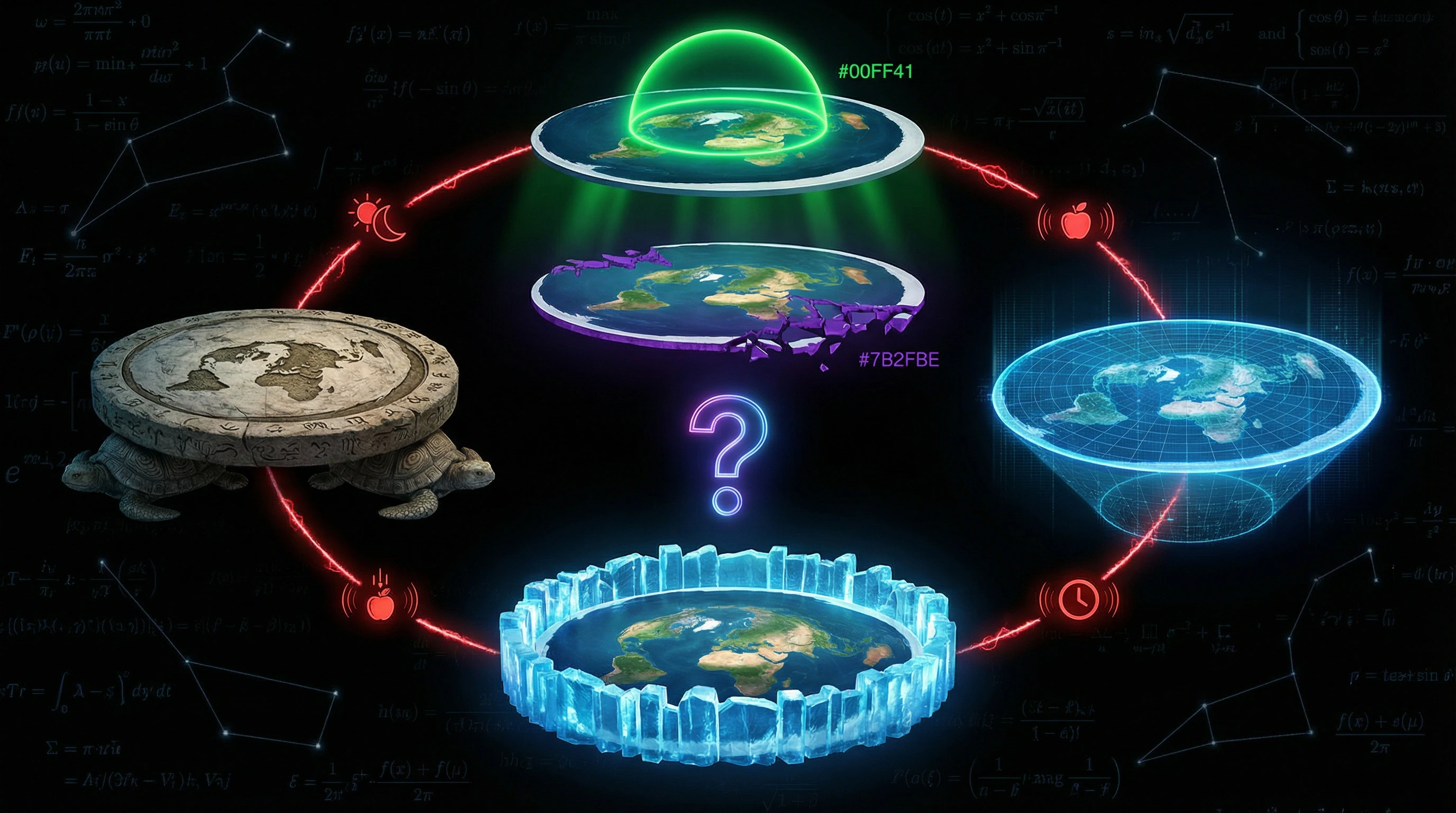
The first trap in analyzing the flat Earth myth is attempting to reduce it to a single model. In reality, there are at least five main versions, each contradicting the others on key points. More details in the section Financial Pyramids and Scams.
The classic disk with dome (Rowbotham's 19th-century model), infinite plane with local Sun, disk on a turtle's back (archaic cosmology), holographic projection, and Antarctica's "ice wall" as the world's boundary diverge in explaining dome height, the nature of gravity, the mechanism of day-night cycles, and time zones.
- Classic Rowbotham disk
- Flat surface under a dome, Sun moves in a circle above the center.
- Infinite plane
- Earth extends infinitely, Sun locally illuminates a limited area.
- Holographic projection
- Reality is a simulation, Earth's shape is part of the program.
- Ice wall
- Antarctica is an ice barrier hiding the edge of the world.
Core of the myth: four basic claims
Despite internal contradictions, all variants share four theses that form the psychological foundation.
- Earth is a flat or nearly flat surface, not a sphere.
- All evidence of sphericity is the result of a conspiracy by NASA, governments, or the "global elite."
- Visual observations (the horizon looks flat, water doesn't drain off a ball) are more important than instrumental measurements.
- Modern science deliberately conceals the "true shape" of Earth.
These four theses are not scientific hypotheses, but social markers of distrust in institutional science. They work regardless of which specific Earth model the myth's adherent chooses.
Where the myth works psychologically
The myth is effective in three cognitive zones: among people with low scientific literacy who don't distinguish between observation and measurement; among those experiencing deep distrust of institutional science and government; among individuals prone to conspiratorial thinking.
The myth doesn't work where a person has professional experience in navigation (sailors, pilots), geodesy or astronomy, or possesses critical thinking and demands reproducible evidence. This indicates we're dealing not with scientific discussion, but with a conspiratorial narrative.
From ancient cosmology to modern conspiratorial narrative
Historically, flat Earth concepts existed in archaic cultures before the development of astronomy. However, the modern myth is not a relic of antiquity, but a product of the 19th–21st centuries.
Samuel Rowbotham in 1849 created "zetetic astronomy," which became the foundation for modern flat Earth communities (S002). In the 21st century, the myth gained new life through YouTube, social media, and recommendation algorithms that create echo chambers. The modern version integrates elements of conspiracy theory, distrust of NASA, and visual "evidence" in the form of amateur videos — this is no longer cosmology, but a social mechanism of conspiratorial thinking.
Steelman Version: Seven Strongest Flat Earth Arguments — and Why They Seem Convincing
To understand the myth's persistence, we must examine its strongest arguments in their most convincing formulation — the "steelman" method (opposite of "straw man"). These arguments genuinely exploit real cognitive features of perception and gaps in scientific literacy. More details in the section Chipization and World Government.
⚠️ Argument 1: The Horizon Always Appears Flat and at Eye Level
When standing on a seashore or ascending to a high point, the horizon appears flat and at eye level. On a spherical Earth, the horizon should curve downward, and the observer should be looking down at it.
Mechanism: Earth's curvature becomes noticeable only at altitudes above 6–9 miles, and the eye's angular resolution is insufficient to detect weak curvature at lower altitudes. Atmospheric refraction distorts the visible horizon line, creating an illusion of flatness.
🧩 Argument 2: Water Always Finds Its Level and Cannot "Curve"
Water at rest forms a horizontal surface (level), which supposedly proves Earth's flatness. Lakes, seas, and oceans appear flat.
Mechanism: At small distances (up to a few miles), curvature is indeed imperceptible, and water behaves as a flat surface. At larger distances, Earth's gravitational field points toward the center of mass, and water's "level" is an equipotential surface of the geoid, which follows a spherical shape. The argument exploits misunderstanding of the difference between local and global scales.
🔎 Argument 3: No Sensation of Movement During Earth's Rotation
If Earth rotates at approximately 1,040 mph at the equator, why don't we feel this movement? Why don't airplanes lag behind the rotation, and why aren't birds swept away by wind?
Mechanism: The atmosphere rotates with Earth, and all objects on the surface move at the same angular velocity. The sensation of movement arises only during acceleration, while uniform rotation creates no perceptible effects for an observer in an inertial reference frame.
| Argument | Apparent Evidence | Actual Mechanism |
|---|---|---|
| Flat horizon | Visible horizon line doesn't curve | Curvature imperceptible below 6–9 miles; atmospheric refraction conceals it |
| Water finds level | Water surface appears horizontal | True at small scales; globally water follows the geoid (spherical shape) |
| No sensation of movement | We don't feel Earth's rotation | Uniform motion creates no acceleration; atmosphere rotates with the planet |
⚠️ Argument 4: Inability to See Earth's Curvature from Commercial Flights
Passengers on commercial flights (altitude 6–7 miles) typically don't see obvious horizon curvature, which is used as proof of flatness.
Mechanism: At this altitude, curvature is barely noticeable and requires wide-angle viewing (more than 60° field of view) and absence of atmospheric distortions. Aircraft windows have limited viewing angles, and atmospheric haze obscures details. Curvature becomes obvious at altitudes from 9 miles and higher, confirmed by photographs from high-altitude balloons and stratospheric aircraft.
🧩 Argument 5: Inconsistency of Earth Photos from Space
Differences in Earth photographs taken by different space agencies at different times (continent sizes, cloud positions, ocean colors) supposedly prove image fabrication.
Mechanism: Different cameras, lenses, orbital altitudes, shooting angles, spectral filters, and post-processing methods yield different results. Earth is a dynamic system with changing cloud cover, seasonal variations in ice caps and vegetation. Image differences result from diverse imaging methods and real planetary changes, not signs of fabrication.
🔎 Argument 6: Absence of Visible Stellar Parallax During Earth's Motion
If Earth moves around the Sun at approximately 18 miles per second, why doesn't the position of stars in the sky change noticeably throughout the year? This supposedly proves Earth's immobility.
Mechanism: Stellar parallax genuinely exists but is extremely small due to enormous distances. The nearest star (Proxima Centauri) has a parallax of only 0.77 arcseconds — an angle impossible for the naked eye to detect. Parallax is measured by high-precision telescopes and is one of the primary methods for determining stellar distances (S002), (S003).
⚠️ Argument 7: Impossibility of Direct Flight Across the South Pole
The absence of regular commercial flights crossing Antarctica through the South Pole is supposedly related to the existence of an "ice wall" or forbidden zone.
- Actual Reasons
- Low population density in the Southern Hemisphere makes trans-Antarctic routes unprofitable. Extreme weather conditions and absence of emergency airports create risks for commercial aviation.
- What Refutes the Argument
- Scientific and research flights across the South Pole are regularly conducted and documented. This contradicts the idea of a forbidden zone.
All seven arguments operate on one principle: they take a real observation (the horizon looks flat, water finds level, we don't feel movement) and extrapolate it to a global scale without accounting for physical laws, instrumental capabilities, and astronomical scales. Each argument exploits a gap in understanding how perception, gravity, or optics work. This is precisely why they seem convincing — they rely on direct experience rather than abstract formulas.
Understanding these mechanisms is critical for analyzing why physics explanations often fail when communicating with myth supporters. The problem isn't the absence of facts, but how they're interpreted through the lens of cognitive limitations and social incentives.
Evidence Base of Modern Astronomy: How X-ray Surveys, Doppler Tomography, and Spectral Analysis Confirm Earth's Sphericity
Modern astronomy employs dozens of independent methods confirming Earth's sphericity. All are based on advanced observational technologies and yield consistent results. More details in the Disinformation section.
🧪 All-Sky X-ray Surveys
The ART-XC telescope aboard the Spektr-RG orbital observatory conducts sky surveys in the X-ray spectrum (S001). Key observation: X-ray sources periodically disappear behind Earth's horizon depending on the telescope's orbital position.
On a flat Earth, all sources would be visible simultaneously from any orbital position. Instead, source visibility depends on observer position—consistent with a spherical Earth model with a radius of approximately 6,371 km.
🔬 Doppler Tomography and Diurnal Rotation
Stellar spectra demonstrate periodic Doppler shifts with a 24-hour period (diurnal rotation) and 365-day period (orbital motion). These shifts precisely match the model of a rotating spherical Earth.
The magnitude of Doppler shift depends on observer latitude: at the equator, rotational velocity is maximal (approximately 465 m/s), at the poles—zero. This distribution corresponds to spherical geometry, not a flat disk.
| Latitude | Linear Rotational Velocity | Doppler Shift |
|---|---|---|
| Equator | ~465 m/s | Maximum |
| 45° | ~330 m/s | Medium |
| Pole | 0 m/s | Zero |
📊 Spectral Analysis of Planetary Atmospheres
M.V. Lomonosov in 1761 discovered Venus's atmosphere by observing the planet's transit across the solar disk (S002). The atmosphere refracts sunlight, creating a luminous ring around the planet at the moment of disk contact—an effect impossible on flat objects.
Modern spectral observations of planets confirm their sphericity through analysis of light distribution across the disk: the center is brighter than the edges (limb darkening). This corresponds to spherical geometry, not a flat disk.
🧪 Magnetohydrodynamic Waves in the Solar Corona
Observations of MHD waves in the solar corona require precise knowledge of Earth's geometry and its orbit (S001). MHD waves propagate along magnetic field lines, and their parameters are measured with accuracy to fractions of km/s, accounting for Doppler shifts caused by Earth's motion.
Such precision would be impossible without accounting for Earth's spherical shape and its orbital motion. Observations from different points on Earth's surface show differences consistent with Earth's curvature.
🔎 Stellar Objects of Extragalactic Origin
Studies of stellar objects of extragalactic origin within the Milky Way require precise knowledge of the Galaxy's three-dimensional structure and Earth's position within it (S003). These objects have anomalous velocities and chemical compositions indicating origin from other galaxies.
Determining their trajectories is possible only when accounting for Earth's motion around the Sun and the Solar System's rotation around the Galactic center. A flat Earth model cannot explain the observed distribution of these objects and their kinematics.
📊 Space-Based and Ground-Based Observations: Mutual Verification
Ground-based telescopes observe atmospheric refraction that depends on Earth's curvature: light from stars near the horizon passes through a thicker atmospheric layer and refracts more strongly. Space telescopes in orbit experience no atmospheric distortions, but their orbits are calculated accounting for Earth's spherical shape and gravitational field.
- Ground-based observations: atmospheric refraction depends on Earth's curvature
- Space-based observations: orbits calculated for a spherical Earth
- Consistency of data from both types confirms the spherical Earth model (S002)
All these methods—from X-ray surveys to spectral analysis—yield consistent results. None requires the assumption of a flat Earth; on the contrary, each independently confirms its sphericity.
The Mechanism of Delusion: Why Visual Illusions Defeat Instrumental Measurements in the Minds of Millions
The persistence of the flat Earth myth is explained not by a lack of evidence, but by the peculiarities of how the human brain works and cognitive biases that make visual illusions more convincing than scientific data. Learn more in the Logical Fallacies section.
🧩 Availability Heuristic: "I See Flatness — Therefore, It's Flat"
The availability heuristic is a cognitive bias in which the brain assesses the probability of an event by how easily examples come to mind. A person sees a flat horizon every day but never sees the Earth's curvature directly (unless ascending to great altitude).
The visual experience of "flatness" is more available and seems more convincing than abstract scientific explanations. The brain prefers a simple explanation ("The Earth is flat because that's what I see") to a complex one ("The Earth is spherical, but the curvature is imperceptible at small scales due to its large radius").
The availability of information in memory is often perceived as its truth — this is not a logical error, but a feature of the brain's evolutionary economy.
🔁 Confirmation Bias: Seeking Confirmation Instead of Refutation
Confirmation bias is the tendency to seek, interpret, and remember information in ways that confirm existing beliefs. Flat Earth proponents actively search for "evidence" of flatness (videos with flat horizons, inconsistencies in NASA photographs) and ignore or reject evidence of sphericity (satellite data, navigation systems, astronomical observations).
This bias is amplified in social media echo chambers, where recommendation algorithms show content matching user interests. Conspiracy narratives mutate and capture mass consciousness precisely through such information filtering mechanisms.
| Cognitive Bias | Mechanism | Result in Context of the Myth |
|---|---|---|
| Availability Heuristic | Probability assessment by ease of recall | Flat horizon seems more real than sphericity |
| Confirmation Bias | Seeking information that confirms belief | Selection of "evidence" for flatness, ignoring refutations |
| Dunning-Kruger Effect | Overestimation of competence at low knowledge levels | Confidence in "debunking" science without understanding fundamentals |
🧠 Dunning-Kruger Effect: Overestimating One's Own Competence
The Dunning-Kruger effect is a cognitive bias in which people with low competence in a field overestimate their knowledge and abilities. Flat Earth proponents often don't understand basic principles of physics, geometry, and astronomy, yet believe themselves capable of "debunking" scientific consensus.
They conduct "experiments" (such as measuring water levels on a lake) without understanding the method's limitations and the phenomenon's scale, and interpret results to favor their beliefs. Analyzing the physics doesn't work — one must analyze the mechanisms of conspiratorial thinking.
⚠️ Distrust of Institutional Science: The Social Context of the Myth
The flat Earth myth thrives in an environment of deep distrust toward scientific and governmental institutions. This distrust has real foundations: the history of science includes examples of errors, falsifications, and abuses (such as eugenics, the Tuskegee experiments) (S006).
However, myth proponents extrapolate these cases to all of science, claiming that "everything is a conspiracy." Critical attitude toward dogma is a necessary part of the scientific method, but it differs from conspiracism in that it relies on verifiable data rather than assumptions about hidden forces.
- Critical Thinking
- Testing hypotheses through experiment, willingness to revise beliefs with new data, acknowledging the limits of one's own knowledge.
- Conspiratorial Thinking
- Searching for hidden enemies, rejecting official explanations without alternative mechanisms, inability to revise beliefs when faced with contradictory data.
Conspiracies, manipulations, and secret cults require understanding their structure, not simply refuting facts. The flat Earth myth is not an error in calculations, but a social phenomenon rooted in distrust, cognitive biases, and the search for meaning in a complex world (S008).
Conflicts and Uncertainties: Where Sources Diverge and What This Means for Myth Assessment
Analysis of sources shows: there is no disagreement in the scientific community about Earth's sphericity — this is an established fact. However, there are areas of uncertainty in related questions that myth proponents use to create the illusion of "scientific debate." More details in the section Statistics and Probability Theory.
⚙️ Precision in Measuring Earth's Shape: Geoid vs Ellipsoid
Earth is not a perfect sphere — it's an oblate ellipsoid (equatorial radius exceeds polar radius by 21 km) with local irregularities. A more precise model is the geoid, an equipotential surface of the gravitational field.
Various geoid models exist (WGS84, EGM96, EGM2008) that differ in details, but all describe an approximately spherical shape. Myth proponents point to these differences as "proof" that scientists "don't know Earth's true shape."
Differences between models amount to tens of meters against Earth's radius of 6,371 km — these are refinements, not refutations of sphericity.
🔬 Limitations of Visual Observations from the ISS
Photographs of Earth from the International Space Station (orbital altitude around 400 km) show horizon curvature. Myth proponents claim this results from lens distortion or panoramic photography.
However, curvature is visible even to the naked eye from 400 km altitude — this is a geometric fact, not a camera artifact. Nevertheless, from 400 km altitude only part of Earth's surface is visible, and viewing the full disk requires observation from at least 3,000 km distance.
| Data Source | Observation Altitude | Visible Curvature | Possible Objections |
|---|---|---|---|
| ISS (photos) | 400 km | Clear | "Lens distortion" |
| GPS Satellites | 20,200 km | Full disk | "Computer graphics" |
| Geostationary Satellites | 35,786 km | Full disk | "Computer graphics" |
📡 Discrepancies in Satellite Data Interpretation
Satellite images of Earth (NOAA, NASA, ESA) show the planet's spherical shape. Myth proponents claim these are computer graphics, not actual photographs.
This objection cannot be logically refuted — it appeals to distrust of information sources rather than physical facts. However, satellite data is used in practical applications: GPS, weather forecasting, aircraft navigation. If Earth were flat, these systems wouldn't work.
- Interpretation Trap
- Myth proponents shift the debate from the level of physical facts to the level of trust in sources. This allows them to dismiss any evidence as "fabrication." The mechanism works because distrust of institutions is a real social phenomenon, not a logical fallacy.
🧠 Where Sources Diverge: Sociology vs Physics
Scientific sources are unanimous on the question of Earth's shape. Divergences appear in related areas: why people believe in flat Earth, how conspiracy narratives spread, what psychological mechanisms support them (S006).
Research shows that belief in conspiracy theories correlates with distrust of institutions, not lack of education (S006). This means that examining the physics is a necessary but insufficient condition for overcoming the myth. We must also analyze the social and psychological factors that make the conspiracy narrative appealing.
For more on the mechanisms of conspiracy thinking, see the article "Conspiracies, Manipulation, and Secret Cults: How to Understand and Verify."
- Physical fact: Earth is a spheroid, established by numerous independent methods.
- Social fact: belief in flat Earth is not a calculation error, but the result of distrust in information sources and the search for alternative identity.
- Practical conclusion: refuting the myth requires working not only with facts, but also with sources of trust and social context.