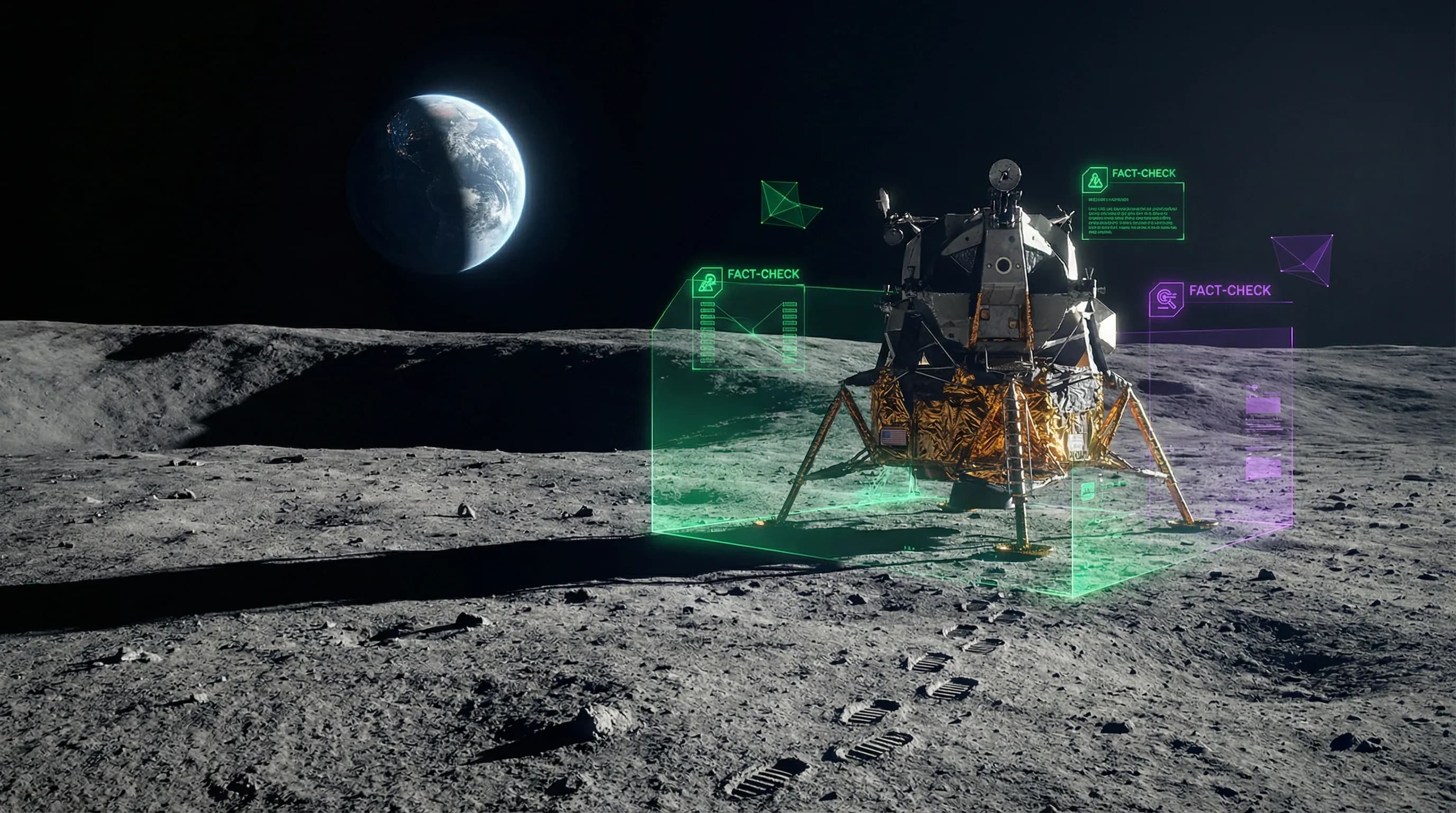
Anatomy of a Myth: What Exactly Conspiracists Claim and Why These Claims Require Systematic Analysis, Not Emotional Counterarguments
The Apollo hoax conspiracy theory is not a monolithic doctrine — it's an ecosystem of interconnected claims, each appealing to different cognitive vulnerabilities. The central thesis: NASA and the U.S. government staged the Moon landing in 1969 in a studio, using cinematic special effects to win the space race against the USSR. More details in the Pseudo-Debunkers section.
Around this core, dozens of "proofs" emerge: from the "waving flag in a vacuum" to "missing stars in photographs" and "strange shadows."
- First Level of Persuasiveness
- Visual "anomalies" accessible to any viewer: flag, shadows, image quality. Require no specialized knowledge and create an illusion of "obvious deception."
- Second Level
- Technical doubts: Van Allen radiation belts, temperature extremes, absence of crater under lunar module. Conspiracists exploit gaps in public understanding of physics and engineering.
- Third Level
- Geopolitical context: Cold War, pressure on NASA, motivation for deception. Gives the theory pseudo-historical legitimacy.
It's critically important to distinguish two types of discourse. Scientific skepticism asks questions: "How exactly was the radiation problem solved?", "What technical solutions enabled overcoming X?".
Conspiracy assertion declares: "This is impossible, therefore it was faked." The first stimulates investigation, the second closes it, replacing analysis with belief.
The methodology of systematic source analysis (S007, S008) requires precisely the first approach: formulate testable hypotheses, not axiomatic accusations. This is especially important in the context of epistemology — the science of how we know what we know.
This article doesn't rehash all arguments "for" and "against" — such compilations often strengthen conspiracy thinking through the "false balance" effect (S001). Instead, we focus on the meta-level: how to assess source reliability, how to distinguish proof from rhetoric, how cognitive biases work that make intelligent people believe absurdities.
- We don't discuss NASA's or USSR's political motives — only epistemology.
- We analyze mechanisms, not labels.
- We test hypotheses, not declare truths.
Understanding these mechanisms is critical for defense against conspiracy thinking in general — from QAnon and Pizzagate to more localized conspiracy theories that use identical cognitive traps.
The Steel Man of Conspiracy: Seven Strongest Arguments of the Hoax Theory in Their Most Convincing Formulation
The "steel man" principle requires presenting an opponent's position in its strongest, most logically consistent form — as opposed to a "straw man" that's easy to refute. This doesn't mean agreeing with the position, but demonstrates intellectual honesty and allows for genuine rather than performative analysis. More details in the Conspiracy section.
Below are seven conspiracy arguments in their most refined version, without caricatured simplifications. Each relies on a real technical difficulty or visual anomaly that requires explanation, not denial.
Argument One: Van Allen Radiation Belts as an Insurmountable Barrier
The Van Allen radiation belts — zones of intense charged particle capture by Earth's magnetic field — create radiation doses potentially lethal to humans. Conspiracists claim: 1960s technology couldn't provide adequate shielding given the spacecraft mass limitations imposed by the Saturn V rocket's payload capacity.
Modern space agencies acknowledge radiation as a serious problem for future Mars missions, which supposedly confirms the impossibility of solving it half a century ago. The argument exploits a real technical challenge and appeals to the principle "if it's difficult now, it was impossible then."
Argument Two: Absence of Crater Under Lunar Module During Landing
The lunar module's engine generated thrust of approximately 45 kN (4.5 tons of force), directed vertically downward onto the Moon's surface. Conspiracists point out: photographs show no visible crater or significant regolith displacement beneath the nozzle, though a jet of superheated gases should have created a noticeable depression.
The physics of the process supposedly requires crater formation, and its absence indicates filming in a studio where the "lunar surface" was solid scenery. The argument is strengthened by comparison with Earth-based rocket engine tests, where ground erosion is obvious.
Argument Three: "Waving" Flag in Vacuum Conditions
In video recordings of the American flag being planted on the Moon, the fabric displays wave-like movements resembling oscillations in wind. Since the Moon has no atmosphere, any flag movement should result from mechanical action by the astronaut and cease instantly after stopping.
Conspiracists claim: the character of oscillations (smoothness, duration) is incompatible with vacuum and indicates the presence of an atmospheric environment in a studio. This argument is particularly effective because it appeals to everyday experience of observing flags on Earth.
| Visual Anomaly | Conspiracy Conclusion | Proposed Mechanism |
|---|---|---|
| Absence of stars in photos | Studio filming | Impossible to realistically recreate starfield in studio |
| Divergent shadow directions | Multiple light sources | Studio lighting instead of single sun |
| No crater under engine | Solid scenery instead of regolith | Rocket exhaust leaves no traces on concrete |
Argument Four: Absence of Stars in Lunar Sky Photographs
Not a single photograph taken by astronauts on the Moon's surface shows stars against the black sky. Conspiracists point out: the absence of atmosphere on the Moon should make stars brighter and more distinct than on Earth.
NASA's explanation (short camera exposure settings configured for bright illuminated surface) is supposedly inadequate, since astronauts in interviews described the starry sky as "magnificent." The argument is strengthened by noting that realistically recreating a starfield in a studio is technically difficult, so it was simply omitted from the set.
Argument Five: Multiple Light Sources and "Incorrect" Shadows
In some photographs, shadows from nearby objects have different directions or lengths, supposedly indicating the use of multiple studio light sources. On the Moon, the only light source — the Sun — should create parallel shadows of identical length for objects at the same elevation.
Conspiracists cite specific images (for example, AS11-40-5863) where shadows of the astronaut and lunar module supposedly don't correspond to the geometry of a single source. This argument exploits intuitive understanding of lighting and creates an impression of "caught in the act."
Argument Six: Technological Non-Reproducibility of Apollo Missions
Since 1972, no country, including the United States, has sent humans beyond low Earth orbit. Conspiracists claim: if the technology was mastered half a century ago, reproducing it today should be trivial given advances in materials science, electronics, and computing power.
The fact of no repeat crewed lunar missions supposedly indicates the original flights were impossible. The argument is strengthened by pointing to the loss of Saturn V blueprints and F-1 engine production technologies, which is supposedly suspicious for such an important achievement.
Argument Seven: Geopolitical Motivation and Soviet Silence
The Cold War created extreme pressure on the United States to demonstrate technological superiority. Conspiracists point out: motivation for falsification was enormous, and risks of exposure were manageable with information control.
Soviet silence, despite possessing means to track the missions, is explained by secret agreements or the USSR's own space program falsifications, creating mutual "hostage-taking." This argument gives the theory pseudo-historical depth and explains the absence of exposure by the main geopolitical adversary.
The strength of these seven arguments lies not in their truth, but in their structural logic: each relies on a real phenomenon (radiation, engine physics, camera optics, geopolitics) and requires not emotional denial, but systematic examination of mechanisms that conspiracists ignore or misinterpret.
Evidence-Based Refutation of the Myth: Systematic Analysis of Physical, Documentary, and Independent Evidence of the Moon Landing
Moving from rhetorical persuasiveness to empirical verifiability requires a methodological shift. Systematic literature review (S007, S008) involves exhaustive search for relevant sources, quality assessment, and synthesis of findings.
The Apollo 11 evidence base includes four categories: physical artifacts, independent third-party observations, technical data, and documentary records. Each requires separate reliability analysis. More details in the section 5G Fears.
🧪 Lunar Regolith and Rock Samples: 382 Kilograms of Physical Evidence
Apollo missions brought back 382 kg of lunar soil to Earth, distributed among laboratories worldwide, including the USSR. Analysis revealed characteristics unreproducible under terrestrial conditions: absence of water-bearing minerals, traces of solar wind in surface layers, microcraters from micrometeorites, isotopic ratios consistent with formation under low gravity and vacuum conditions.
Independent studies by Soviet, European, and Japanese scientists confirmed the extraterrestrial origin of the samples. Fabricating such volume of material with these characteristics is technologically impossible even today.
The conspiracy explanation requires not just faking samples, but reproducing physical processes that were unknown to science in 1969 and remain difficult to synthesize today.
🧪 Laser Retroreflectors: Verifiable Evidence Accessible to Any Observatory
Astronauts installed laser retroreflectors on the Moon — arrays of corner reflectors that return laser beams to their source. Since 1969, observatories worldwide (Soviet, French, American) have regularly conducted lunar laser ranging, measuring distance with millimeter precision.
Experiments continue to this day and are available for independent verification. The conspiracy explanation (reflectors delivered by unmanned probes) is refuted by the mass of the devices — about 100 kg for Apollo 15, exceeding the payload capacity of Soviet automated spacecraft of that era.
🧪 Independent Radio Tracking: Data from British and Australian Observatories
Radio transmissions from Apollo 11 were received not only by NASA, but also by independent observatories: Jodrell Bank in the United Kingdom and Parkes in Australia. British and Australian engineers confirmed that signals originated from cislunar space, based on Doppler frequency shift, time delay (approximately 1.3 seconds one-way), and reception direction.
This data cannot be faked without collusion of dozens of independent specialists from countries not controlled by the United States. Soviet tracking stations also recorded Apollo 11's trajectory, though this data was declassified later.
| Data Source | Country | Verification Method | Result |
|---|---|---|---|
| Jodrell Bank | United Kingdom | Radio tracking, Doppler analysis | Trajectory confirmation |
| Parkes Observatory | Australia | Signal reception, delay analysis | Distance confirmation |
| Soviet stations | USSR | Radio tracking, trajectory analysis | Orbit confirmation |
📊 Photogrammetric Analysis: Three-Dimensional Reconstruction of the Lunar Surface
Modern photogrammetry methods create three-dimensional terrain models from series of photographs. Analysis of thousands of Apollo images revealed complete geometric consistency: shadows, perspective, and terrain correspond to a unified three-dimensional space with illumination from a single distant source.
Independent researchers compared photographs with data from modern lunar orbital spacecraft (Lunar Reconnaissance Orbiter) and confirmed precise topographic matches. Creating such consistency in a studio would have required computer graphics at a level unattainable until the 1990s.
🧾 Technical Documents: 25,000 Pages of Saturn V Engineering Documentation
The Saturn V rocket is described in tens of thousands of pages of technical documentation, available in NASA archives and university libraries. Independent engineers and historians of technology analyzed these documents and confirmed: the design is physically feasible, calculations are correct, technologies correspond to 1960s capabilities.
The conspiracy claim about "lost technologies" is incorrect: blueprints exist, but production chains (tens of thousands of component suppliers) were dismantled, and recreating them is economically impractical given modern alternatives.
🧾 Participant Testimony: 400,000 People in the Apollo Program
Approximately 400,000 people participated in the Apollo program: engineers, technicians, scientists, administrators. Conspiracy theory requires that all of them were either deceived or maintained silence for half a century.
- Research by David Grimes (2016) showed that the probability of maintaining secrecy in a conspiracy of 400,000 participants over 50 years approaches zero.
- Even assuming only 1% of participants "knew the truth," information leakage would have occurred within several years.
- Over half a century, at minimum several dozen exposés would have emerged from participants, their heirs, or archival documents.
- Not a single credible insider testimony about fabrication exists.
A conspiracy theory of this scale is mathematically untenable. The complexity of coordination, number of potential leaks, and time horizon make it less probable than the landing itself.
The scale of a conspiracy is inversely proportional to its probability. The more people who must remain silent, the higher the likelihood of exposure. This isn't opinion — it's statistics.
The connection between conspiratorial thinking and evidence denial is studied in (S004, S005). Research shows that adding new facts often strengthens conspiracy believers' convictions rather than weakening them — this phenomenon is called the "backfire effect."
Mechanisms of Causality: Why Correlation Between "Strange Shadows" and "Fakery" Is Not Proof
The central error of conspiratorial thinking is substituting correlation or coincidence for causal relationship. The methodology of systematic analysis (S008) requires distinguishing three types of connections: causality (A causes B), correlation (A and B occur simultaneously, but the connection is not established), and confounding (A and B are caused by a third factor C).
Conspiracy theorists systematically interpret any anomaly as proof of fakery, ignoring alternative explanations. This is not a perceptual error—it's a methodological error. More details in the section Scientific Method.
The Multiple Hypotheses Problem: Why "Strangeness" Does Not Equal "Fake"
Each visual "anomaly" in Apollo photographs has at least three possible explanations: photographic process artifact, result of unusual lighting/gravity/vacuum conditions, or fakery. Conspiracy theorists choose the third by default, without testing the first two.
Scientific methodology requires the opposite: eliminate trivial explanations before turning to extraordinary ones. Example: the "waving flag" is explained by fabric inertia in vacuum (absence of air resistance prolongs oscillations) and the rigidity of the horizontal rod, creating a wave-like shape.
- Check equipment artifacts (camera, film, lens)
- Check physical conditions (vacuum, low gravity, light reflection)
- Check scene geometry (terrain, position of light sources)
- Only after eliminating points 1–3 consider fakery
Confounders in Shadow Analysis: Terrain as a Hidden Variable
"Wrong shadows" in lunar photographs are explained not by multiple light sources, but by surface irregularity. Lunar regolith is not a perfect plane: hills, craters, rocks create local elevation changes that distort shadow direction.
An additional factor is reflected light from the lunar module surface and spacesuits, creating secondary diffuse illumination. Photogrammetric analysis confirms: all shadows are consistent with a single distant source when accounting for three-dimensional terrain.
Conspiracy theorists analyze shadows as projections onto a plane, ignoring the three-dimensional geometry of the lunar surface. This is not an observational error—it's an error in the model of reality.
Radiation Protection: Dose Versus Exposure Time
The argument about Van Allen radiation belts ignores a key parameter: exposure time. The Apollo 11 trajectory passed through the belts in 1–2 hours, minimizing received dose.
| Scenario | Time in Belts | Total Dose | Equivalent |
|---|---|---|---|
| Apollo 11 (transit) | 1–2 hours | 1–2 mSv | Several X-rays |
| ISS (annual stay) | 365 days | ~150 mSv | Prolonged exposure |
| Mars (hypothetical mission) | Months outside magnetosphere | 500+ mSv | Critical dose |
The aluminum hull of the spacecraft (thickness 1.5–6 mm depending on section) and equipment inside provided sufficient protection for brief transit. Conspiracy theorists compare prolonged stay in a radiation environment with brief passage, substituting the parameters of the problem.
This is a classic example of confounding: exposure time is the hidden variable that explains the apparent contradiction between "belt danger" and "astronaut survival." Without accounting for this parameter, the argument looks convincing. With it—it falls apart.
Conflicts in Sources: Where Experts Disagree and Why This Doesn't Confirm Conspiracy
The presence of discussions among experts is a normal part of the scientific process, but conspiracy theorists interpret any discrepancy as "proof of hidden truth." Systematic review methodology requires distinguishing three types of disagreement: (1) disputes about details while agreeing on the main conclusion, (2) methodological disagreements with identical data, (3) fundamental contradictions in interpreting facts. More details in the Media Literacy section.
In the case of Apollo 11, only the first two types exist. The third—where experts disagree on the actual fact of the landing—is completely absent. This is the key distinction between scientific discussion and conspiratorial noise.
Dosimetry: From 1 to 11 mSv
Different studies provide different estimates of the total radiation dose received by astronauts: from 1 mSv (NASA's conservative estimate) to 11 mSv (independent calculations accounting for solar activity). The variation is explained by differences in radiation environment models, dosimetry methods, and accounting for secondary radiation.
All estimates fall within a range safe for short-term exposure. Conspiracy theorists use the very fact of variation as "proof of uncertainty," ignoring the consensus on mission safety.
Photographs: Film Artifacts or Anomalies?
Some researchers point to artifacts in lunar photographs: crosshair marks sometimes appear "hidden" behind objects. Photography experts explain this as an overexposure effect: bright areas "burn out" the thin crosshair lines on the film.
The discussion concerns technical details of the photographic process but does not question the authenticity of the images. Conspiracy theorists pull these disputes out of context, presenting them as "experts admitting forgery."
When Does Disagreement Become a Signal of Conspiracy?
| Type of Disagreement | Sign of Healthy Science | Sign of Conspiracy |
|---|---|---|
| Disputes about details | Experts agree on main conclusion, differ in methods | Experts disagree on the very fact of the event |
| Methodological disagreements | Different approaches yield similar results | Different approaches yield opposite conclusions |
| Public nature of discussion | Disputes are open, peer-reviewed, archived | Critics are silent, data is classified, witnesses disappear |
In Apollo 11, all three markers point to healthy science. Experts debate details of radiation protection, methods of photograph analysis, lunar module precision—but no competent scientist disputes the fact of the landing itself.
The conspiratorial narrative requires expert silence or their active participation in concealment. Instead, we see open discussion, published data, and the possibility of independent verification. This is the opposite of the mechanisms described in the analysis of conspiratorial narratives.
Why Conspiracy Theorists Confuse Disagreement with Proof
The cognitive error here is called "confirmation bias": the conspiracy theorist sees any discrepancy and interprets it as support for their hypothesis. Research (S001) shows this is not specific to conspiracy theorists—it's a universal cognitive bias that intensifies under conditions of uncertainty and social pressure.
Protection from this error requires a simple protocol: (1) determine whether experts disagree on the fact itself or on details, (2) verify whether data and methodology are public, (3) assess whether there's a mechanism that could silence critics. In Apollo 11, all three points indicate the absence of conspiracy.
For a more detailed analysis of manipulation mechanisms through conspiratorial narratives, see the material on the mutation of conspiratorial narratives.