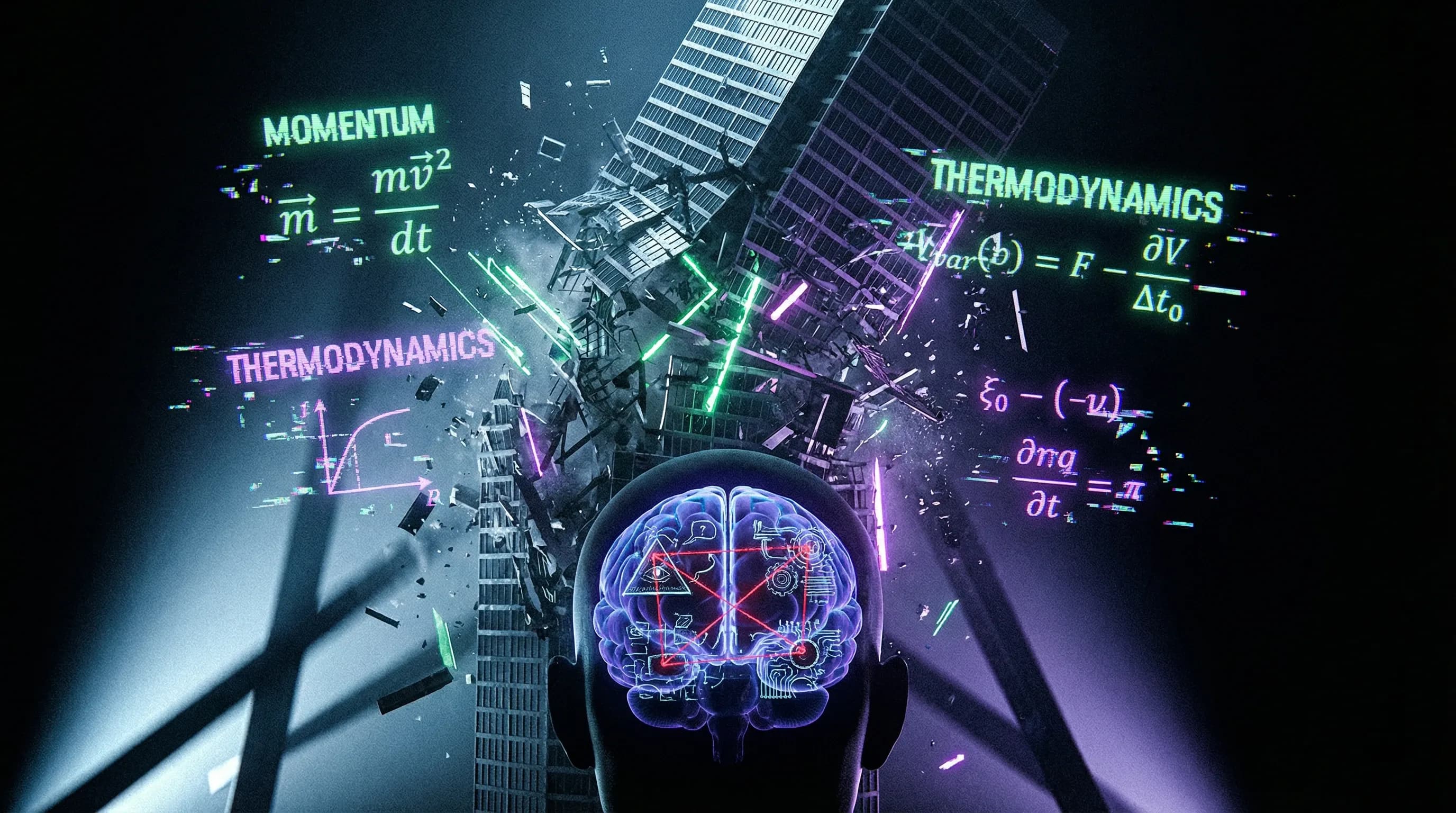
The 9/11 Truth Movement claims that the official account of the September 11, 2001 events contradicts the laws of physics. Research shows: this is less about physics and more about a cognitive mechanism—rejection of official explanations as a worldview stance. Analysis of online discussions revealed: conspiracy theory proponents more frequently propose alternative explanations but less frequently provide evidence. We examine how conspiratorial thinking works, why physical arguments become tools of persuasion, and what cognitive traps make the movement resistant to facts.
��️ When physics becomes a weapon of persuasion rather than a tool of knowledge, we're dealing not with scientific debate but with cognitive warfare. The 9/11 Truth Movement isn't just a group of people doubting the official version of the September 11, 2001 terrorist attacks. It's a laboratory where we can observe how conspiratorial thinking works, what cognitive mechanisms make it resistant to facts, and why physical arguments become mere decoration for a deeper worldview stance. Research shows: it's not about lack of education or logic—it's about rejection of official explanations becoming part of identity (S011).
�� What is the 9/11 Truth Movement and why it's still alive—defining a phenomenon that refuses to die
The 9/11 Truth Movement is a decentralized community claiming that the official account of the September 11, 2001 events is false or incomplete. Conspiracy theories by definition are assertions about secret collusion by powerful individuals or organizations to achieve sinister goals through deception (S011).
The movement's central claim: the World Trade Center towers could not have collapsed the way they did based on the laws of physics, therefore there was controlled demolition or other intervention (S010).
- Conspiratorial worldview
- Not a set of separate theories, but a generalized rejection of official explanations. Details matter less than distrust of the information source.
- Why this matters
- Explains why fact-based refutations don't destroy the movement—the dispute isn't about details, but about whom to trust.
Three core arguments
- Collapse of the Twin Towers (WTC 1 and WTC 2)
- Collapse of Building 7 (WTC 7), which wasn't hit by a plane
- Collapse speed allegedly corresponds to free fall, possible only with controlled demolition (S010)
The 9/11 Truth Movement continues to exist not because new evidence of its correctness emerges, but because it relies on stable cognitive patterns. Research on online discussions revealed trends in persuasive communication reflecting a basic conspiratorial worldview (S011).
The analysis here focuses not on technical expertise of collapse physics—that's the task of engineers and physicists. We investigate the socio-psychological mechanisms making the movement resistant to refutation, argumentation patterns in online discussions, and cognitive traps of conspiratorial thinking (S011).
This is research about how persuasion works, not about what happened on September 11. For understanding the conspiracy phenomenon, see also analysis of conspiratorial narratives and criteria for source verification.
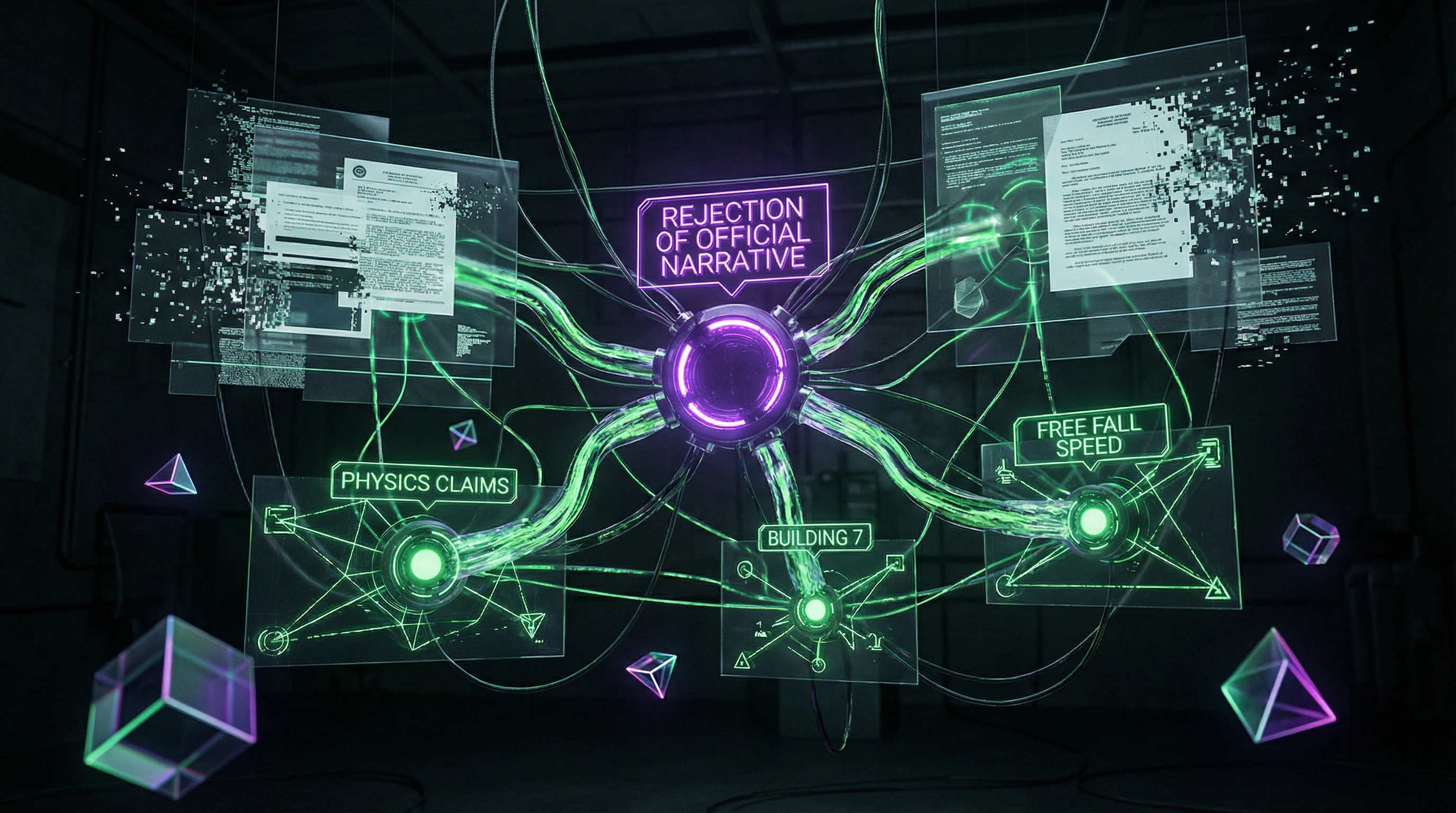
�� Seven Strongest Arguments of the "9/11 Truth" Movement — A Steelman Version of the Conspiracy Position Without Strawmen
To understand why the "9/11 Truth" movement continues to attract supporters, it's necessary to examine its arguments in their most convincing form. The steelman approach requires presenting the opponent's position in its strongest possible form, avoiding simplifications and caricatured interpretations. More details in the section Viral Fakes.
Below are seven key arguments the movement uses to substantiate its claims. Each appeals to physical constants, observable facts, or logical inconsistencies — which is precisely why they work as persuasive narratives.
| Argument | Core Position | Why It Sounds Convincing |
|---|---|---|
| Steel Melting Temperature | Jet fuel burns at 800–1500°C, steel melts at 1510°C. Fire cannot melt structural components. | Appeals to physical constants; appears to refute the official version at the level of basic chemistry. |
| Symmetry of Collapse | The towers fell vertically, within their perimeter. This is characteristic of controlled demolition, not chaotic destruction. | Visual observation; seems logical that localized damage should lead to asymmetric collapse. |
| Free-Fall Speed | The collapse occurred at near free-fall speed. Lower floors offered no resistance. | Mathematically verifiable; absence of resistance seems physically impossible in natural destruction. |
| Building 7 Without Direct Impact | WTC-7 collapsed symmetrically after fire, though no plane hit it. This requires explanation. | The strongest argument: the official version here is less obvious; the question "What about Building 7?" became a movement marker. |
| Thermite Traces in Debris | Chemical analysis allegedly revealed nanothermite — a substance for cutting steel. Direct proof of explosives. | Based on laboratory data; appears to be scientific fact, not interpretation. |
| Eyewitness Testimony About Explosions | Firefighters and police heard explosions. This is confirmation from eyewitnesses at the scene. | Primary sources; appears to be direct testimony, not rumors. |
| Absence of Precedents | Before September 11, no steel high-rise had ever completely collapsed due to fire. This is unique. | Historical fact; creates the impression that the event requires an alternative explanation. |
�� First Argument: Steel Melting Temperature and Jet Fuel
Movement supporters claim that the burning temperature of jet fuel (approximately 800–1500°C depending on conditions) is insufficient to melt steel structures, whose melting point is around 1510°C. Therefore, the collapse could not have occurred solely due to the fire caused by the plane impacts.
This argument appeals to basic physical constants and creates an impression of scientific validity. It works because it relies on real numbers and seems logical: if the burning temperature is below the melting point, then melting shouldn't occur.
��️ Second Argument: Symmetry of Collapse and Analogy to Controlled Demolition
The movement points out that the towers collapsed almost vertically, within their own perimeter, which is characteristic of controlled demolition rather than chaotic destruction. The symmetry of collapse, according to theory supporters, indicates simultaneous destruction of load-bearing structures at all levels.
This seems logical: if the damage is localized (plane impact on upper floors), then the fall should be asymmetric, tilting toward the impact side. Vertical collapse requires explanation.
�� Third Argument: Free-Fall Speed and Absence of Resistance
One of the most frequently repeated arguments: the towers collapsed at near free-fall speed, meaning no resistance from lower floors. Under normal conditions, each floor should have slowed the fall of upper structures.
This is interpreted as proof that load-bearing structures were destroyed in advance. The argument works at the intuitive level: if something falls without resistance, the path must have been prepared.
�� Fourth Argument: Building 7 and Absence of Direct Impact
Building 7 of the World Trade Center collapsed on the evening of September 11, though it was not hit by a plane. The "9/11 Truth" movement considers this the most convincing evidence of controlled demolition: the building collapsed symmetrically, within its perimeter, after several hours of fire.
The question "What about Building 7?" became a kind of marker of movement membership. This is the strongest argument because the official version here is less obvious than for the Twin Towers.
�� Fifth Argument: Thermite Traces and Unusual Chemical Compounds in Debris
Some researchers associated with the movement claim that traces of thermite or nanothermite — substances used for cutting steel structures — were found in dust from the collapse site. These claims are based on chemical analysis of samples and are presented as direct proof of explosive use.
The argument works because it relies on laboratory data. It appears to be scientific fact rather than interpretation or rumors.
��️ Sixth Argument: Eyewitness Testimony About Explosions
The movement cites testimony from firefighters, police, and other eyewitnesses who reported sounds of explosions before and during the tower collapses. These testimonies are interpreted as confirmation that explosive devices were planted in the buildings.
These are primary sources, people at the scene. It appears to be direct testimony, not rumors or speculation. This is precisely why such testimony is so convincing to audiences.
�� Seventh Argument: Absence of Precedents for Steel High-Rise Collapse from Fire
Before September 11, 2001, no steel high-rise building had ever completely collapsed due to fire. The movement uses this fact as proof that fire could not have been the sole cause of the collapse of the towers and Building 7.
The absence of historical precedents creates an impression of event uniqueness requiring alternative explanation. This works at the logic level: if this has never happened before, it requires explanation.
All seven arguments share one common property: they appeal to physical facts, mathematics, or logic rather than emotions. This is precisely why they are so resistant to refutation. Refuting emotion is easy; refuting a number is harder, even if the number is incorrectly interpreted.
Understanding these arguments in their strong form is the first step toward understanding why the "9/11 Truth" movement continues to attract people who are not irrational or ignorant. They see logical inconsistencies and try to resolve them. The problem is not in their logic, but in how they interpret physical data and which sources they consider reliable.
The next step is to understand why these arguments seem convincing despite containing errors in physics and engineering interpretation. This requires not just refutation, but understanding the mechanisms that make these errors attractive to human thinking.
�� What the Data Shows: Evidence Review and Why Physical Arguments Don't Hold Up to Scrutiny
Moving from arguments to evidence requires methodological rigor. Research on the 9/11 Truth movement analyzes not the technical expertise of building collapses, but argumentation patterns and cognitive mechanisms that make conspiracy theories resistant to refutation (S011, S012).
�� Online Discussion Analysis: What YouTube Comments Research Reveals
Analysis of 2,174 comments on 9/11 YouTube videos identified a key difference in argumentation strategies (S011). Conspiracy comments more frequently contained alternative explanations, while defenders of the official version focused on criticizing conspiracy claims without offering their own explanations.
This points to a fundamental difference: conspiracy thinking actively constructs narratives rather than simply critiquing existing ones. It functions as a meaning-production system, not as a fact-checking tool. More details in the section on 5G Fears.
�� The Evidence Problem: Explanations Without Factual Support
Key finding: conspiracy comments more often advanced alternative explanations but less frequently provided supporting evidence (S011). This contradicts the expectation that those challenging the accepted version should provide more facts.
Conspiracy argumentation relies on creating alternative narratives that don't require rigorous evidence. The narrative itself becomes the proof.
�� Conspiracy Worldview as a System
Research showed: details of individual conspiracy theories matter less than generalized rejection of official explanations (S011). The 9/11 Truth movement isn't a debate about building collapse physics, but an expression of a worldview: distrust of authority, media, and official institutions.
This explains why refuting physical arguments doesn't dismantle the movement. Physics is merely the language expressing a deeper need for alternative explanations of reality. More on these resilience mechanisms in the analysis of conspiracy narratives.
�� Methodological Limitations: Internal Validity of Archival Research
Online discussion research has limitations: while external validity benefits from observation in natural settings, there's uncertainty regarding internal validity of conclusions (S011). Findings about cognitive mechanisms require additional verification through experimental methods.
| Research Aspect | Strength | Limitation |
|---|---|---|
| External validity | Natural environment, real behavior | Cannot control variables |
| Internal validity | Controlled conditions | Lab environment may not reflect reality |
| Sample size | 2,174 comments—representative volume | YouTube is a specific platform, not all groups represented |
�� Folkloric Approach: The Movement as Cultural Phenomenon
Folkloric research views 9/11 Truth as a cultural phenomenon where conspiracy narratives function as modern myths (S012). They're transmitted through internet and oral tradition, serving social and psychological functions.
The movement provides alternative explanations for traumatic events and creates a sense of belonging to a community of "truth knowers." This explains why the movement persists despite refutations—it solves a psychological task, not an informational one. Compare with other conspiracy systems in the article on conspiracy narrative mutation.
�� Resilience Mechanisms: Why Conspiracy Theories Don't Die from Refutation — Analysis of Causal Relationships
The resilience of the "9/11 Truth" movement to facts and refutations requires explanation at the level of cognitive mechanisms. This isn't simply a lack of education or critical thinking — it's a systemic feature of how conspiratorial thinking operates. More details in the section Microchipping and World Government.
�� Projection as the Basis of Prediction: Why Conspiracy Theorists Expect from Others What They Do Themselves
People tend to rely on projection to predict others' behavior — they use themselves as a model (S001). If someone distrusts official sources, they expect authorities to act through deception as well.
This creates a self-sustaining cycle: distrust generates interpretation of events through the lens of conspiracy, which reinforces distrust. Conspiracy narratives exploit precisely this feedback loop.
Correlation Versus Causation: Why Coincidences Are Interpreted as Evidence
Temporal or spatial proximity of events is automatically interpreted as causal connection — this isn't a perceptual error, but an error of logical inference.
Building 7 collapsed on the same day as the Twin Towers. Conspiracy theorists see coordinated conspiracy; engineers see consequences of damage and fire. The difference isn't in the data, but in which hypotheses are considered plausible.
�� Confounders and Alternative Explanations: What Gets Ignored
Conspiracy theories systematically ignore confounders — factors that explain phenomena without the conspiracy hypothesis. The symmetry of the towers' collapse is explained by structural features and the nature of the damage. The speed of collapse is explained by progressive failure: each floor loses load-bearing capacity faster than the previous one.
However, these explanations require deep understanding of engineering and physics — less accessible to a broad audience than the simple "controlled demolition" hypothesis.
| Observation | Conspiracy Explanation | Alternative Explanation | Required Knowledge Level |
|---|---|---|---|
| Symmetrical collapse | Controlled demolition | Progressive structural failure | Engineering, physics |
| High speed of fall | Explosives weakened resistance | Cascading failure of load-bearing elements | Materials mechanics |
| Building 7 collapse | Pre-installed charges | Fire, damage, loss of support | Structural physics |
The problem isn't that conspiracy theorists are stupid. The problem is that verifying sources and evidence requires specialized knowledge, while simple explanations always win over complex ones in the battle for attention.
Conflict Zones: Where Sources Diverge and Why This Matters for Understanding the Phenomenon
Analysis of the "9/11 Truth" movement is complicated by the fact that different sources focus on different aspects of the phenomenon: technical expertise, social-psychological mechanisms, cultural functions of conspiracy narratives. For more details, see the section Sources and Evidence.
This creates zones of uncertainty where the conclusions of some studies don't align with the conclusions of others. Understanding these fault lines is more important than choosing the "correct" source.
�� Technical Reports vs. Social-Psychological Research
Engineers and physicists analyze building collapses and conclude that the official version is consistent with the laws of physics. However, social-psychological research shows: these reports don't convince adherents of conspiracy theories (S011).
Technical refutations don't work because they're addressing the wrong problem. The problem lies not in the realm of facts, but in the realm of trust and worldview.
This is a paradox that destroys the naive approach: "more data = less conspiracy thinking." In reality, data and conspiracy theories operate in different registers.
�� Individual Differences vs. Cultural Factors
Questionnaires show: susceptibility to conspiratorial thinking correlates with certain personality traits and cognitive styles (S011). Folkloristic and cultural studies emphasize something else: conspiracy theories serve social functions and spread through cultural mechanisms, regardless of individual characteristics (S012).
| Level of Analysis | What It Explains | What It Misses |
|---|---|---|
| Individual Differences | Why some people are susceptible to conspiracy thinking | Why conspiracy theories spread through entire communities regardless of personalities |
| Cultural Factors | Why conspiracy theories persist in culture and mutate | Why not all members of a culture are equally susceptible |
The phenomenon has both individual and collective dimensions. Neither can be reduced to the other.
�� Quantitative vs. Qualitative Methods
Quantitative studies of online discussions provide statistical data on argumentation patterns (S011). Qualitative research allows deeper understanding of the meanings and functions of conspiracy narratives.
- Quantitative Approach
- Strength: scalability and objectivity. Weakness: interpretation of motives and context remains off-screen.
- Qualitative Approach
- Strength: depth of understanding meanings. Weakness: limited generalizability of results.
A complete picture of the phenomenon requires integration of different approaches. This isn't a compromise—it's a necessity.
For practical analysis of conspiracy movements, see the overview of conspiracy mechanisms and source verification criteria.
�� The Cognitive Anatomy of Conspiracy Theories: What Mental Traps the 9/11 Truth Movement Exploits and Why They Work
Understanding the cognitive mechanisms that make conspiracy theories convincing is critical for developing effective strategies to counter disinformation. The 9/11 Truth movement exploits several universal cognitive traps that make it resistant to facts. Learn more in the Scientific Method section.
��️ Trap One: The Illusion of Understanding Complex Systems
Conspiracy theories offer simple explanations for complex events. The collapse of skyscrapers results from the interaction of multiple factors: structural characteristics of buildings, nature of damage, fire temperature, load distribution.
The conspiracy version—"it was a controlled demolition"—offers a simple, intuitively understandable explanation that doesn't require deep knowledge. This creates an illusion of understanding that is psychologically more comfortable than acknowledging one's own incompetence in complex matters (S001).
�� Trap Two: Pattern Matching and False Analogies
The human brain is evolutionarily wired to seek patterns. When movement supporters see the symmetrical collapse of the towers, they compare it with videos of controlled building demolitions and find visual similarity.
Visual similarity does not mean identical causes. A collapse can appear symmetrical for many reasons unrelated to controlled demolition.
This triggers the pattern-matching mechanism: if two events look similar, they must have the same cause. However, this is a false analogy that ignores the physical differences between phenomena.
Trap Three: Confirmation Bias and Selective Attention
Confirmation bias is the tendency to seek, interpret, and remember information in ways that confirm existing beliefs (S008). Movement supporters focus on facts that seem anomalous (such as reports of explosions) and ignore facts that align with the official version.
| Type of Information | Conspiracy Theorist's Response | Cognitive Mechanism |
|---|---|---|
| Anomalies and contradictions | Active search and memorization | Belief confirmation |
| Engineering reports and explanations | Ignoring or discrediting | Protection from cognitive dissonance |
| Expert opinions (official) | Interpretation as conspiracy | Reinforcement of conspiracy model |
This creates a distorted picture of reality where anomalies seem to be the rule and explanations the exception.
�� Trap Four: The Backfire Effect
Paradoxically, attempts to debunk conspiracy theories can strengthen them. When a person encounters information that contradicts their deeply held beliefs, it can trigger a defensive reaction.
Instead of revising beliefs, the person begins seeking ways to discredit the source of the refutation. The more effort is put into debunking a conspiracy theory, the more strongly its supporters become convinced that "the system" is trying to hide the truth.
��️ Trap Five: The Illusion of Control and the Need for Agency
Conspiracy theories provide an illusion of control over a chaotic world. Acknowledging that a terrorist attack could occur due to a complex interaction of geopolitical factors means accepting that the world is unpredictable and uncontrollable.
The conspiracy version offers an alternative: there is an agent (government, elite) that controls events. This is psychologically more comfortable than living with a sense of helplessness in the face of chaos (S007).
�� Trap Six: Narrative Identity and Social Belonging
Participation in the 9/11 Truth movement becomes part of a person's identity. They don't just believe in a conspiracy theory—they become a "true truth seeker" opposing a system of lies.
- Narrative identity is reinforced through repeated retelling of the conspiracy story
- Social belonging to a community of like-minded individuals creates psychological reward
- Abandoning the theory means losing identity and social status within the group
- This makes conspiracy beliefs resistant to factual refutations
A person defends not so much the theory as their identity and place in the community.
Why These Traps Work Together
Each trap reinforces the others. The illusion of understanding (trap 1) creates confidence in pattern matching (trap 2). Confirmation bias (trap 3) selects only those patterns that confirm the belief. The backfire effect (trap 4) protects the belief from refutations. The illusion of control (trap 5) and narrative identity (trap 6) make the belief psychologically and socially significant.
The result: the conspiracy theory becomes a self-sustaining system that not only resists facts but uses them as fuel to strengthen beliefs. This explains why debunking the physics often doesn't work—the problem isn't a lack of information, but how that information is processed by the cognitive system.
Effective countermeasures require not so much better arguments as an understanding that conspiracy beliefs serve deep psychological and social functions. Without accounting for these functions, attempts to debunk the theory will only strengthen it.
Counter-Position Analysis
⚖️ Critical Counterpoint
The article relies on psychological analysis but leaves several blind spots. Here's what should be considered when evaluating its conclusions.
Risk of Overgeneralization
The research is based predominantly on analysis of online comments (S011), which may not capture the full complexity of the movement. Among "9/11 Truth" supporters there are people with engineering backgrounds whose arguments require detailed technical examination, not just psychological explanation through cognitive biases.
Insufficient Experimental Data
Most conspiracy research is based on questionnaires and observations rather than controlled experiments (S011). This makes it difficult to establish causal relationships between cognitive biases and belief in conspiracy theories—reverse causation or influence of a third factor are possible.
Ignoring Legitimate Questions
The focus on conspiracy theorists' psychology may overshadow the fact that some questions (for example, about investigation details) were raised legitimately but poorly covered by official sources. Refusal to engage in dialogue with critics often amplifies distrust rather than reducing it.
Evolution of Theories as Adaptability
The article mentions that conspiracy theories evolve in response to refutations (S011), but does not consider this as potentially rational belief updating with new information. The boundary between "theory immunization" and "hypothesis revision" may be blurred.
Temporal Limitations of Conclusions
The research is based on data from the 2010s. Changes in social media algorithms, emergence of new platforms and fact-checking methods may significantly alter the dynamics of conspiracy theory spread, making the conclusions partially outdated.
FAQ
Frequently Asked Questions

Author of the Cognitive Immunology Hub project. Researches mechanisms of disinformation, pseudoscience, and cognitive biases. All materials are based on peer-reviewed sources.