 🧠 Mind Control
Conspiracy Thinking: The Psychology of Belief in Conspiracy Theoriesλ
Scientific analysis of conspiracy theories as a social phenomenon: cognitive mechanisms, psychological factors, and cultural functions of conspiracy beliefs in contemporary society
Overview
Conspiracy thinking — not a diagnosis, but an explanatory model: events are attributed to secret plots by influential groups. Research shows 🧩: the link is not with education, but with distrust, suspiciousness, and narcissistic traits. Conspiracy theories serve social functions — coping with uncertainty, creating an illusion of understanding, political mobilization, especially during crises.
🛡️
Laplace Protocol: This section is based on peer-reviewed academic research from HSE, RSUH, European University at St. Petersburg, and international scientific publications. Materials cover psychological, sociological, anthropological, and media studies of conspiratorial thinking, providing an interdisciplinary scientific perspective.
Reference Protocol
Scientific Foundation
Evidence-based framework for critical analysis
Navigation Matrix
Subsections
[cults-control]
Cults and Control
Scientific analysis of manipulation tactics, social control, and recovery after involvement in cults and destructive organizations
Explore
📰
[E-8]
Misinformation
Everything About Disinformation: Complete guide, facts and myth-busting.
Explore
[finance-scams]
Financial Scams
Crypto pyramids, phishing, and investment schemes on Telegram — a study of modern financial fraud methods and how to protect yourself from them
Explore
[global-control]
Global Control
Research on international coordination strategies in public health, information management, and global resource allocation
Explore
[pharma-distrust]
Pharma Distrust
A study of pharmaceutical industry distrust in American society: from historical skepticism to post-pandemic reality
Explore
[pseudo-debunkers]
Pseudo-Debunkers
A study of the false debunker phenomenon, where individuals spread disinformation and conspiracy narratives under the guise of critical thinking
Explore
[pseudo-legal]
Pseudo-legal Practices
Systematic analysis of pseudo-legal ideologies, fraudulent legal services, and organized pseudo-legal commercial arguments that mimic legal language but lack legal validity
Explore
[tech-fears]
Tech Anxiety
From the 1895 Montparnasse train wreck to artificial intelligence: how fear of technology shapes media culture and influences the perception of progress
Explore
Protocol: Evaluation
Test Yourself
Sector L1
Articles
Research materials, essays, and deep dives into critical thinking mechanisms.
🧠 Mind Control 🏢 Pharmaceutical Company Data Concealment
 💉 Microchipping and World Government
 🧠 Mind Control
 🧠 Mind Control
 🧠 Mind Control
 📊 Financial Pyramids and Scams
 ✈️ Chemtrails
 ✈️ Chemtrails
 📜 Sovereign Citizen Movement
 🧠 Mind Control
 ✈️ Chemtrails
⚡
Deep Dive
Psychological Mechanisms of Conspiratorial Thinking
Conspiratorial thinking is a persistent cognitive pattern that interprets events through the lens of secret conspiracies by influential groups. This is not irrationality, but rather a psychological mechanism that provides a sense of understanding the hidden workings of the world.
Belief in conspiracy theories serves an important function: it reduces anxiety in the face of uncertainty by offering a simplified causal model with clearly identifiable agents and intentions.
Cognitive Biases and Perception Patterns
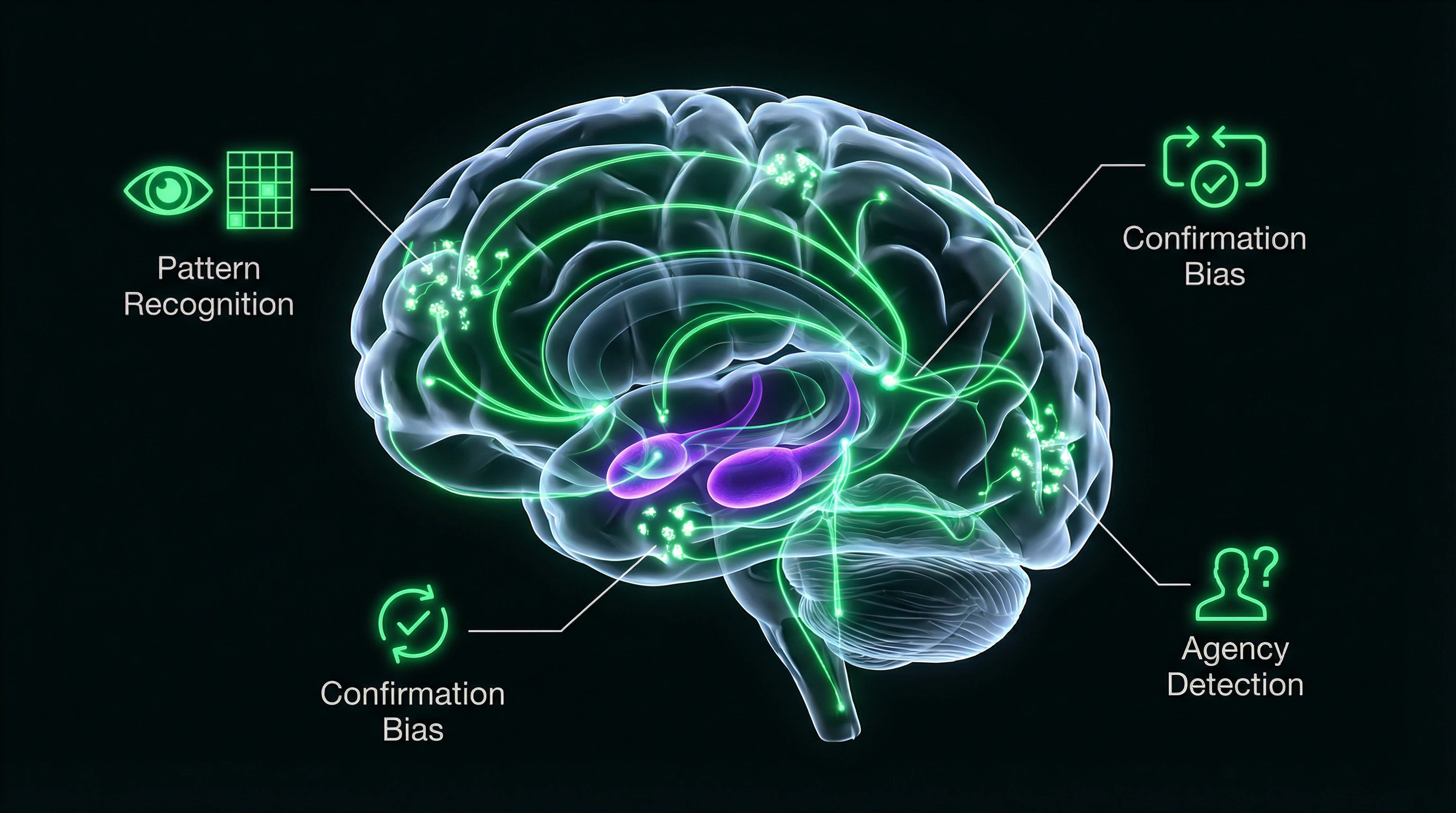
Conspiratorial thinking is rooted in two key cognitive biases: hyperactive pattern recognition and confirmation bias. Individuals prone to conspiracy thinking demonstrate heightened sensitivity to coincidences, interpreting random correlations as evidence of intentional actions.
- Confirmation Bias
- Information that confirms a conspiratorial hypothesis is perceived as substantial evidence, while contradictory data is ignored or reinterpreted. This creates a self-sustaining belief system that is resistant to factual correction.
- Cognitive Closure
- Conspiratorial narratives offer a psychologically comfortable state of certainty that reduces anxiety in the face of complex and unpredictable events.
Distrust and Suspicion as the Foundation of Beliefs
Distrust of official information sources forms the foundation of the conspiratorial worldview. This distrust is often formed as a reaction to real cases of disinformation, manipulation, or alarmist coverage of events in official media.
Suspiciousness as a personality trait amplifies susceptibility to conspiratorial narratives: any official statement is viewed as potential deception or manipulation. This pattern is particularly activated during periods of crisis and social instability, when traditional information sources lose credibility and the need for explanations increases.
| Condition | Effect on Conspiratorial Thinking |
|---|---|
| Real cases of media disinformation | Justified distrust transforms into systematic rejection of all official sources |
| Periods of crisis and instability | Need for explanations increases, conspiratorial narratives become more appealing |
| High personal suspiciousness | All information is interpreted through a filter of hidden intentions and manipulations |
Narcissism and Education: New Research on Vulnerability Factors
Research from 2026 debunked the myth that education protects against conspiratorial thinking. Formal education level does not correlate with resistance to conspiracy theories — educated people are no less susceptible to them than less educated individuals.
This shifts the focus from cognitive abilities to personality characteristics as the primary predictors of conspiratorial beliefs.
Education as a Rationalization Tool
Education develops critical thinking, but does not guarantee epistemic humility or trust in experts. Educated people often use their skills for more sophisticated defense of conspiratorial beliefs — constructing complex argumentative frameworks that appear more convincing.
The phenomenon of "motivated reasoning" is particularly strong among the educated: they are more effective at finding arguments supporting preferred conclusions, regardless of facts.
Education does not reduce the need for simple explanations of complex phenomena. An educated person experiences the same emotional needs as a less educated one, but possesses a larger arsenal of tools for intellectual legitimization of their beliefs.
Personality Traits as Real Factors
Narcissistic traits are a significant predictor of conspiratorial thinking, independent of education. Narcissism includes an inflated sense of self-importance, a need for uniqueness, and the conviction of possessing special knowledge unavailable to others.
Conspiratorial narratives perfectly satisfy these needs: the believer positions themselves as having "awakened" to truth hidden from the "sleeping masses."
- Paranoid tendencies (persistent suspiciousness, expectation of hostility) correlate with conspiratorial beliefs
- These traits create an interpretive matrix where neutral events are perceived as manifestations of hidden malevolent intentions
- Personality characteristics are distributed in the population independent of educational level
This is precisely why education does not explain differences in susceptibility to conspiracy theories. Narcissism and paranoia — these are what determine vulnerability.
Social Functions of Conspiracy Theories
Conspiratorial narratives fulfill persistent social and psychological functions, which explains their prevalence across different cultures and historical periods. Anthropological research demonstrates conspiratorial thinking as a universal cultural pattern, not an anomaly.
Uncertainty Reduction and Illusion of Control
The central function of conspiracy theories is the reduction of uncertainty in conditions of information overload and social complexity. A conspiratorial narrative transforms chaotic reality into an ordered system with clear causal relationships and identifiable agents.
Certainty of threat is psychologically easier to bear than uncertainty — even when predicted events are negative in nature.
Conspiratorial beliefs create an illusion of control through "knowing the truth." The individual positions themselves as possessing privileged knowledge, compensating for the actual absence of influence over social processes.
This mechanism is particularly active during crises, when people's objective ability to influence events is minimal, while the need for a sense of control is maximal.
Group Identity and Political Mobilization
Conspiracy theories function as a tool for forming group identity, creating a boundary between the "enlightened" and the "deceived." Sharing conspiratorial beliefs becomes a marker of group membership, strengthening intragroup bonds.
- Conspiratorial narrative marks group membership
- Solidarity is reinforced through shared "knowledge" about hidden threats
- The boundary between groups becomes impermeable and hostile
- Group identity is reinforced by constant search for evidence of conspiracy
Conspiratorial narratives are actively employed as a tool for political mobilization, allowing social discontent to be directed toward specific targets. Background conspiracism — the constant presence of conspiratorial motifs in public discourse — forms stereotypes that are then mobilized for political purposes.
Conspiratorial beliefs intensify during periods of crisis and social instability, when the need for explanations and group solidarity increases.
Conspiracy Theory as Discourse and Genre: The Structure of Paranoid Narrative
Structural Elements of Conspiracy Narratives
Conspiracy theories function as closed discursive systems with recognizable patterns. A typical narrative contains: a hidden group with disproportionate power, a secret plan explaining visible events, a system of "clues" as evidence, and a self-confirmation mechanism—any refutation is interpreted as part of the conspiracy.
This architecture creates a closed loop of meaning, resistant to factual criticism. Within such a system, contradictions don't destroy the narrative but strengthen it.
Genre markers of conspiracy theory: rhetoric of suspicion, pseudo-scientific terminology for appearance of expertise, appeal to "common sense" against "official version."
The key strategy is "connecting the dots": constructing causal relationships between unrelated events through arbitrary interpretation. Conspiracy theory creates an alternative epistemology where distrust of official sources becomes the criterion of truth.
Theoretical Approaches of Lyotard and Foucault
Jean-François Lyotard explains conspiracy theory as a reaction to the crisis of "grand narratives." When traditional explanatory systems lose legitimacy, conspiracy theories offer alternative metanarratives that restore a sense of coherence.
The paradox: conspiracy theory critiques official narratives but itself creates totalizing explanatory schemes of modernist type.
- Official discourse loses authority → a vacuum of meaning emerges
- Conspiracy theory fills the vacuum with an alternative metanarrative
- The new narrative reproduces the structure of what it criticizes
Michel Foucault proposes viewing conspiracy theory as a regime of knowledge and power production. Conspiracy discourses create their own "regimes of truth"—defining what counts as credible and who is authoritative.
Conspiracy theory is not simply false knowledge, but an alternative system of power-knowledge competing with official institutional discourses.
This explains why factual criticism rarely works: the conflict occurs at the level of epistemological systems, not information deficit. The opponent isn't simply wrong—they exist in a different reality with its own rules for verifying truth.

Media Influence and the Spread of Conspiracy Theories
Audience Response to Alarmist Media
Modern conspiracy thinking is an audience reaction to alarmist coverage in mainstream media. When media systematically exaggerate threats and create an atmosphere of constant crisis, segments of the audience seek alternative explanations, suspecting manipulation.
Excessive dramatization correlates with increased conspiratorial interpretations of the same events—audiences attempt to "read between the lines" and find the "real" reason behind media panic.
The paradox of the information age: unprecedented access to information is accompanied by an increase, not decrease, in conspiratorial beliefs. The overload of contradictory information strengthens the need for simplifying explanatory frameworks.
Digital media has radically transformed the ecology of conspiracy theory dissemination. Social media algorithms, optimized for engagement, disproportionately promote emotionally charged content, including conspiratorial narratives.
Information Warfare and Conspiracy as Political Technology
Conspiratorial narratives are actively used as tools of information warfare and political propaganda. State and non-state actors deliberately create and spread conspiracy theories to destabilize opponents, undermine trust in institutions, and mobilize supporters.
Conspiracy thinking is effective as "asymmetric warfare"—its production requires minimal resources, while debunking demands significant effort and time.
- Background conspiracy narratives form stereotypes that are then activated for specific political objectives
- Conspiratorial narratives delegitimize political opponents and justify authoritarian measures
- Diversion of attention from real problems through creation of alternative threats
- Institutionalization of conspiracy thinking undermines the foundations of rational public discourse
Particularly dangerous is the moment when government structures or influential political forces begin systematically promoting conspiratorial explanations. This transforms conspiracy thinking from a marginal phenomenon into an instrument of power legitimation.
Anthropology of Suspicion: Cultural Contexts of Conspiracy Thinking
Conspiracy Thinking Across Cultures
Conspiracy thinking is a widespread cultural pattern found across different societies and historical periods. Its forms vary: in some societies, theories about external enemies dominate; in others, internal traitors; in still others, supernatural forces.
Everywhere, conspiracy thinking serves the same functions: explaining misfortune, maintaining group boundaries, legitimizing power or resistance to it. But it's realized through culturally-specific narratives.
- Explaining uncontrollable events through agency
- Strengthening group identity through a common enemy
- Reformatting chaos into comprehensible order
Cultural anthropology reveals the connection between conspiracy thinking and "cultures of suspicion"—social contexts where distrust is institutionalized as an adaptive strategy.
In societies with histories of political repression, corruption, or colonial domination, conspiracy thinking may reflect real experiences of hidden manipulation and elite betrayal. This creates a methodological problem: how to distinguish pathological paranoia from justified distrust in contexts where conspiracies actually existed.
Crises as Catalysts for Conspiracy Beliefs
Conspiracy beliefs intensify during periods of crisis and social instability. Economic shocks, pandemics, political conflicts, and natural disasters create conditions of uncertainty and threat in which the need for explanations and control sharply increases.
Conspiracy theories provide psychologically comfortable explanations: instead of chaos and randomness, they offer narratives about malicious but comprehensible actions by specific agents.
| Crisis Type | Psychological Deficit | Conspiracy Response |
|---|---|---|
| Economic collapse | Loss of control, unpredictability | "Elites deliberately destroyed the economy" |
| Pandemic | Unknown source of threat | "Virus was created in a lab" |
| Political conflict | Loss of governmental legitimacy | "Real rulers are hidden" |
Crises don't simply activate existing conspiracy beliefs—they stimulate the creation of new narratives adapted to the specifics of the situation. The COVID-19 pandemic demonstrated how rapidly conspiracy explanations spread under conditions of global crisis, informational uncertainty, and mass anxiety.
Research from this period revealed correlations between conspiracy beliefs and refusal of protective measures—conspiracy thinking transformed from an abstract problem into a public health factor. Understanding the connection between crises and conspiracy thinking is critically important for developing effective communication strategies in emergency situations.

Knowledge Access Protocol
FAQ
Frequently Asked Questions
Conspiracism is an explanatory model that attributes events to secret plots by influential groups, while conspiratorial thinking is a cognitive pattern characterized by suspicion and distrust. Conspiracism functions as a form of social meaning-making across various cultures, whereas conspiratorial thinking is an individual tendency to interpret events through the lens of hidden conspiracies.
Core mechanisms include distrust, suspicion, and the need for cognitive closure. Conspiracy theories allow people to feel they understand the hidden workings of the world, even without factual basis, reducing anxiety from uncertainty and creating an illusion of control.
No, research from 2026 shows that education alone does not protect against conspiracism. More significant predictors are personality traits, particularly narcissism and tendency toward paranoid thinking, which are independent of education level.
Crises amplify uncertainty and anxiety, creating fertile ground for conspiratorial explanations. During periods of social instability, people seek simple answers to complex questions, and conspiracy theories provide understandable explanations and a sense of control over the situation.
Conspiracy theories serve as tools for reducing uncertainty, forming group identity, and political mobilization. They also function as a reaction to alarmist coverage of events in official media and are used in information warfare as propaganda technology.
Healthy skepticism is based on critical analysis of facts and willingness to change one's mind when new data emerges. Conspiratorial thinking is characterized by confirmation bias, rejection of contradictory evidence, and conviction in the existence of an all-encompassing secret conspiracy regardless of facts.
This is a widespread myth refuted by research. Education is not a reliable defense against conspiratorial beliefs—psychological factors such as narcissism and distrust play a more significant role than education level or intelligence.
No, academic research treats conspiracism as a serious phenomenon with real social and political consequences. Conspiratorial beliefs are used in information warfare, influence political behavior, and can lead to dangerous actions based on false beliefs.
Alarmist coverage of events in official media provokes audiences to seek alternative explanations. Modern conspiracism often represents a reaction to sensational and alarming media messages that amplify distrust of official information sources.
Key biases include confirmation bias, tendency to see patterns in random events, and illusion of control. These cognitive mechanisms cause people to find connections between unrelated events and interpret coincidences as evidence of conspiracy.
Conspiracy narratives are employed as propaganda tools and political technologies to discredit opponents and manipulate public opinion. They effectively shape stereotypes, undermine trust in institutions, and mobilize target audiences based on fear and suspicion.
Yes, anthropological research shows that conspiracy thinking is a widespread cultural pattern, but its forms and content vary. In different societies, conspiracy explanations adapt to local historical, political, and social contexts, reflecting specific cultural fears and distrust.
Narcissistic personality traits are a significant predictor of conspiracy beliefs, according to 2026 research. Narcissists tend to view themselves as possessing special knowledge about hidden mechanisms of the world, which amplifies the appeal of conspiracy theories that provide a sense of superiority over the "deceived masses."
Conspiracy narratives have recognizable structural elements: a secret group of conspirators, hidden agendas, mass manipulation, and "evidence" accessible only to the initiated. Theorists like Lyotard and Foucault analyze conspiracy thinking as a distinct discourse with its own rules for knowledge formation and power relations.
Direct factual refutation is often ineffective due to confirmation bias and emotional attachment to beliefs. A more effective approach is to understand the psychological needs that conspiracy thinking satisfies (control, identity) and offer alternative ways to meet them through critical thinking.
No, this is a myth—anthropological research demonstrates that conspiracy thinking exists across various societies throughout history. While modern technologies and media accelerate the spread of conspiracy ideas, the phenomenon itself of explaining events through secret plots is an ancient cultural pattern.