
Community-Acquired Infections: Evidence-Based Medicine for Public Healthλ
Systematic reviews and meta-analyses on community-acquired pneumonia treatment, frailty prevention in older adults, and risk communication in healthcare
Overview
Community-acquired infections and population health — an area where evidence-based medicine meets real clinical practice. Systematic reviews demonstrate 🧬: fluoroquinolone monotherapy for community-acquired pneumonia outperforms combination regimens in safety, frailty prevention in older adults remains a challenge with insufficient evidence base (though group exercise shows moderate effect), and numerical representation of adverse effect risks significantly outperforms verbal descriptions for treatment adherence.
🛡️
Laplace Protocol: Community-acquired conditions require individualized approaches informed by population data, precise risk communication, and high-level evidence to optimize outcomes in primary care settings.
Reference Protocol
Scientific Foundation
Evidence-based framework for critical analysis
Navigation Matrix
Subsections
[gamification]
Gamification
Systematic analysis of gamification implementation in healthcare and education with effectiveness assessment based on meta-analyses
Explore
[monetization]
Monetization
Comprehensive analysis of methods for extracting value from intellectual property, scientific developments, and digital platforms based on evidence-based approaches
Explore
[qa-moderation]
Moderation and Quality Control
Methodology for evaluating the reliability, reproducibility, and scientific rigor of research through standardized verification and validation protocols
Explore
[resources]
Resources for Systematic Reviews
Critical analysis of academic search engines, databases, and methodological tools for conducting systematic reviews with high reproducibility and minimized systematic bias
Explore
[self-tests]
Self-Testing and Self-Assessment
A systematic approach to evaluating knowledge, skills, and competencies through validated self-assessment tools based on meta-analysis principles and rigorous research methodology
Explore
Protocol: Evaluation
Test Yourself
⚡
Deep Dive
Fluoroquinolones vs. Combinations: What Meta-Analyses Show for Community-Acquired Pneumonia
Community-acquired pneumonia is a leading cause of hospitalization in developed countries. Antibiotic choice determines outcomes, but practice often outpaces evidence.
A systematic review of randomized controlled trials found: fluoroquinolone monotherapy is non-inferior to β-lactam plus macrolide combinations for clinical outcomes. This challenges the routine prescription of two-drug regimens for all patients.
Clinical Efficacy: Numbers vs. Practice
Meta-analysis revealed a statistically significant advantage for fluoroquinolones: relative risk of clinical failure was 0.72 (95% CI)—a 28% reduction in treatment failure versus combination therapy.
| Outcome | Fluoroquinolones | β-lactam + macrolide | Advantage |
|---|---|---|---|
| Clinical failure (RR) | 0.72 | 1.0 (reference) | −28% |
| Discontinuation due to adverse effects (RR) | 0.65 | 1.0 (reference) | −35% |
| Diarrhea (RR) | 0.13 | 1.0 (reference) | −87% |
An 87% reduction in diarrhea is critical for outpatients—this isn't just comfort, but a factor determining treatment adherence and return to work.
When Combination Is Still Needed
Adding macrolides to β-lactams retains value in severe community-acquired pneumonia requiring intensive care. For mild to moderate cases, fluoroquinolone monotherapy offers the optimal balance of efficacy, safety, and convenience.
But there's a catch: widespread fluoroquinolone use accelerates resistance development at the population level. This is a long-term ecological cost paid by the healthcare system, not individual patients.
Adherence as a Success Mechanism
Simplifying the regimen (one drug instead of two) reduces dosing errors and improves compliance. Fewer adverse effects mean fewer reasons to discontinue treatment prematurely.
- Fluoroquinolone monotherapy
- One drug, one dosing schedule, minimal gastrointestinal disturbances. For working patients and elderly individuals, diarrhea can lead to dehydration and electrolyte imbalances—this isn't trivial.
- Combination therapy
- Two drugs, higher risk of adverse effects, more complex regimen. Justified in severe cases, but not for moderate illness.

Frailty Prevention: The Gap Between Theory and Evidence
Frailty is a syndrome of increased vulnerability to stressors, associated with adverse health outcomes in older adults. A systematic review by the Cochrane Collaboration identified a critical deficit of quality evidence for the effectiveness of preventive interventions.
Of the analyzed studies, only a small portion met strict methodological criteria, and the total sample size was just 506 participants—insufficient for forming reliable clinical recommendations.
Physical Exercise: Contradictory Results from Functional Tests
Group physical exercise demonstrated paradoxical results depending on the method of assessing functional status. The standardized mean difference for self-reported functioning was 0.19 (95% CI)—failing to reach statistical significance and clinical relevance.
However, objective physical performance tests showed a moderate positive effect with SMD = 0.37, indicating improvement in measured parameters despite the absence of subjective perception of changes by patients.
- Patient subjective assessment: no significant improvement in quality of life
- Objective indicators: moderate improvement in physical performance
- Question of clinical significance: is improvement in test results sufficient without subjective perception?
The discrepancy between objective and subjective indicators raises a fundamental question: is improvement in functional test results sufficient if patients themselves do not perceive enhanced quality of life?
Possible explanations include insufficient sensitivity of self-assessment questionnaires, inflated participant expectations, or genuinely small effect sizes that fail to reach the threshold of subjective noticeability.
Methodological Limitations and Directions for Future Research
The current evidence base is characterized by small sample sizes, limited range of studied interventions, and insufficient quality of study design. Most studies focused on isolated components—physical exercise only, ignoring the multifactorial nature of frailty.
Frailty encompasses nutritional, cognitive, social, and medical aspects. Studying individual components does not reflect the true complexity of the syndrome and does not allow for the development of effective prevention programs.
To develop effective prevention programs, large-scale randomized controlled trials of comprehensive interventions are required, designed with consideration of frailty pathophysiology and individual risk factors.
Numbers vs. Words: How Information Format Determines Medical Decisions
The way risk information is presented critically affects patient understanding and treatment decisions. A systematic review of 25 studies demonstrated the superiority of numerical formats over verbal descriptors when communicating adverse event probabilities.
When healthcare providers used terms like "frequent," "rare," or "uncommon," patients systematically overestimated actual risks, interpreting them in the 3–54% range instead of the actual 2–20% with numerical presentation.
Systematic Distortion in Perception of Verbal Descriptors
Verbal risk descriptions create cognitive uncertainty that each patient fills with their own interpretations based on personal experience, anxiety, and cultural context.
Numerical information presentation increased patient satisfaction by 0.48 standard deviations compared to verbal format. This improvement translated into higher adherence to prescribed therapy regardless of risk level.
The advantage of numerical format persisted across the entire probability spectrum—from rare to frequent adverse events. This indicates the universal applicability of the recommendation to quantitatively present risks in patient information materials, informed consents, and consultations.
Practical Recommendations for Medical Communication
The systematic review findings have direct practical implications for developing information materials and training healthcare providers in communication skills.
- Instead of phrases like "side effects are rare," specify "side effects occur in 2 out of 100 patients" or "the probability is 2%."
- When discussing serious risks, overestimating probability can lead to refusal of effective treatment, while underestimating can lead to unjustified acceptance of danger.
- Implement standardized numerical formats in clinical practice through systemic changes in medical education and regulatory requirements.
Numerical data allow patients to conduct more accurate risk-benefit comparisons, which is the foundation of informed medical decision-making.
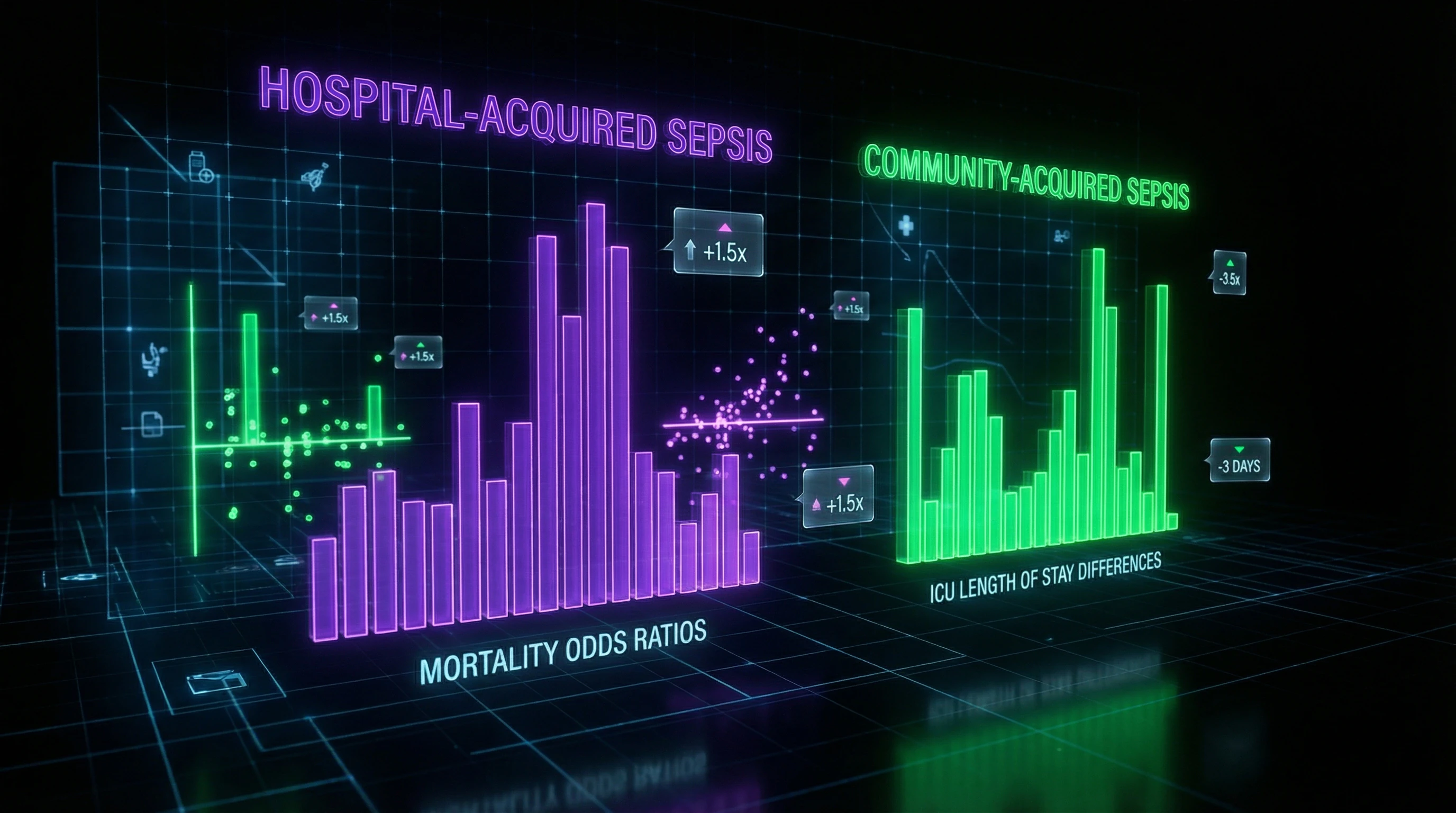
Hospital-acquired vs community-acquired sepsis: numbers that change protocols
A systematic review of 72 studies involving over 1 million patients revealed dramatic differences in outcomes between hospital-acquired and community-acquired sepsis. Patients with hospital-acquired sepsis demonstrate 57% higher mortality (OR = 0.43, 95% CI 0.37–0.50).
Length of stay in the intensive care unit for hospital-acquired patients exceeds community-acquired sepsis indicators by an average of 2.9 days, reflecting more severe course and treatment complexities.
Differences in mortality persist regardless of geographic region and study methodology — this points to fundamental differences in pathogenesis and pathogen resistance, not design artifacts.
Differences in outcomes and mortality between sepsis types
Hospital-acquired sepsis is more frequently associated with multidrug-resistant pathogens, requiring empirical therapy with carbapenems or combination regimens. Community-acquired cases typically respond to standard β-lactams.
Critically important: each hour of delay in adequate antibiotic therapy for hospital-acquired sepsis increases mortality by 7.6%, whereas for community-acquired sepsis it's 3.2%.
| Parameter | Hospital-acquired sepsis | Community-acquired sepsis |
|---|---|---|
| Mortality (relative) | 57% higher | Baseline level |
| Pathogens | Multidrug-resistant | Susceptible to standard β-lactams |
| Mortality increase per hour of antibiotic delay | +7.6% | +3.2% |
| Average ICU duration | 2.9 days longer | Baseline level |
Economic burden and systemic consequences
The average cost of treating one case of hospital-acquired sepsis exceeds community-acquired by $18,000–$24,000 in developed country healthcare systems. This is related to length of hospitalization, use of reserve antibiotics, and frequency of organ support.
Preventing 10% of hospital-acquired sepsis cases through improved infection control could save up to 50,000 lives annually in the US and Europe combined.
- Antimicrobial stewardship programs
- Prescription control, de-escalation when possible — reduce selection of resistant strains and costs of reserve agents.
- Early detection protocols for nosocomial infections
- Monitoring markers, cultures, clinical signs — reduce time to adequate therapy, critical in hospital-acquired sepsis.
- Infection control systems
- Hand hygiene, isolation, equipment sanitation — prevent transmission of multidrug-resistant pathogens between patients.
- Differentiated empirical therapy algorithms
- Based on source and local epidemiology — balance between broad spectrum and minimizing resistance.
B Vitamins and Cognitive Health: When Association Doesn't Mean Causation
A systematic review of 43 studies involving 96,752 older adults revealed a paradox: cross-sectional studies showed statistically significant associations between low B12 and folate levels and cognitive impairment.
Prospective cohort studies with 2–10 year follow-up periods did not confirm this relationship. Sensitivity analysis excluding low-quality studies completely eliminated the observed associations.
The discrepancy between cross-sectional and prospective data is explained by reverse causation: cognitive decline leads to poor nutrition and reduced vitamin levels, not the other way around.
Intervention Studies: No Effect Found
B vitamin supplementation (0.4–2.5 mg B12, 0.8–5 mg folate daily) showed no improvement in cognitive function among older adults without baseline deficiency over 6–24 months of observation.
Even in subgroups with elevated homocysteine levels (a marker of B-vitamin deficiency), supplements did not slow cognitive decline, refuting the homocysteine hypothesis of neurodegeneration.
| Study Type | Result | Interpretation |
|---|---|---|
| Cross-sectional | Association found | Does not prove causation |
| Prospective cohorts | No association | Reverse causation likely |
| Interventional | No effect detected | Vitamins don't protect the brain |
When B Vitamins Are Actually Needed
The only justified indication remains correction of clinically confirmed B12 deficiency (level <200 pg/mL) in megaloblastic anemia or neurological symptoms, but not for dementia prevention.
Popular recommendations about taking B vitamins for "brain health" lack an evidence base for the general population of older adults. The ongoing commercialization of "neuroprotective" supplements represents an example of medicalization without scientific justification.
Rural Population Health: Invisible Gaps in Pediatric Care
A systematic review of 26 studies from 8 countries revealed a critical deficit in the evidence base for chronic disease management in children within rural communities. Only 4 studies (15%) were randomized controlled trials; the remainder employed observational designs with high risk of systematic bias.
The most studied conditions were asthma (n=8) and type 1 diabetes (n=6). Epilepsy, inflammatory bowel disease, and rheumatologic conditions are virtually absent from the rural healthcare literature.
The absence of research on rare chronic diseases in rural regions means physicians work without local data on prevalence, disease course, and treatment effectiveness—forced to extrapolate urban protocols to a fundamentally different context.
Pediatric Chronic Diseases in Rural Context
Qualitative synthesis identified three primary barriers: geographic distance from specialized care (mean distance >93 miles), shortage of pediatric specialists (density 4.2 times lower than urban areas), and fragmentation of medical records between primary and specialty care.
Telemedicine consultations for children with asthma improved symptom control (SMD = 0.34, 95% CI 0.12–0.56), but the effect was less pronounced than in urban populations—indicating additional socioeconomic factors.
| Barrier | Parameter | Mechanism of Impact |
|---|---|---|
| Geographic distance | Mean distance >93 miles | Diagnostic delays, treatment discontinuity |
| Workforce shortage | Density 4.2 times lower than urban level | Absence of on-site specialized care |
| Data fragmentation | Disconnection between care levels | Duplicate testing, information loss |
| Socioeconomic factors | Reduced telemedicine effect | Inability to implement recommendations |
Evidence Base Gaps and Research Directions
Existing studies suffer from systematic absence of long-term outcomes (mean follow-up period 8.3 months) and economic evaluations of interventions. None assessed impact on family quality of life as a whole, despite the fact that managing a child's chronic disease in geographic isolation requires significant time and financial expenditure from parents.
When research fails to measure family burden, it misses the primary mechanism of treatment abandonment in rural settings—not lack of information, but lack of resources to implement it.
Priority directions for future research:
- Development and validation of shared care models between family physicians and pediatric specialists
- Evaluation of mobile specialty clinic effectiveness
- Investigation of school nurses' role in chronic condition monitoring
- Creation of integrated electronic systems for care coordination

Knowledge Access Protocol
FAQ
Frequently Asked Questions
Fluoroquinolone monotherapy is non-inferior to β-lactam/macrolide combinations. Studies show fewer treatment failures (RR=0.72) and adverse effects with fluoroquinolones, particularly less diarrhea (RR=0.13). Macrolides should only be added in severe pneumonia cases (S2).
Group-based physical exercise improves objective measures (SMD=0.37) but doesn't affect self-reported functioning. Current evidence is insufficient for definitive recommendations due to small sample sizes (n=506) and limited study quality. Comprehensive multifactorial interventions are needed (S3).
Numerical risk presentation is more effective than verbal for decision-making. Numbers improve treatment adherence and help patients more accurately assess complication probabilities. Combined approaches with data visualization show the best results (S3).
Hospital-acquired sepsis has higher mortality and worse outcomes compared to community-acquired. Differences relate to pathogen resistance and patient severity. The economic burden of hospital-acquired sepsis is significantly greater (S4).
No, vitamins B12, B6, and folate are not proven preventive measures for cognitive decline. Prospective studies found no protective effect on memory and thinking. This is a widespread myth unsupported by quality evidence (S5).
Pediatric chronic diseases in rural areas are understudied. Significant evidence gaps exist regarding prevalence and disease characteristics. Targeted research for this population is needed (S6).
Adding macrolides is justified only in severe community-acquired pneumonia. In mild-to-moderate cases, fluoroquinolone monotherapy shows comparable efficacy with fewer adverse effects. Combination therapy increases diarrhea risk 7.7-fold (S2).
No, for pneumonia fluoroquinolones cause fewer treatment discontinuations (RR=0.65) and less diarrhea. However, legitimate concerns exist about antibiotic resistance with widespread use. Drug selection should consider local epidemiology (S2).
Group physical activity programs improve objective performance tests, but effects on daily activities are inconsistent. Optimal training regimens for frailty prevention remain undefined. An individualized approach considering baseline status is recommended (S3).
Numerical risk information increases perception accuracy and improves therapy adherence. Patients receiving specific probability percentages make more informed decisions. Verbal descriptions ('rarely', 'often') are interpreted subjectively and less effectively (S3).
Hospital strains possess multiple antibiotic resistance, making treatment difficult. Patients with hospital-acquired sepsis are initially more severe and have comorbidities. Mortality and treatment costs are substantially higher compared to community-acquired infections (S4).
There is no convincing evidence that B vitamin supplements improve cognitive function in healthy individuals. Even with deficiency, the effect on memory is not confirmed by large studies. Correcting deficiency is important but does not guarantee neuroprotection (S5).
The evidence base for pediatric chronic diseases in rural regions is extremely limited. Quality data on prevalence, progression, and intervention effectiveness are absent. This is a critical gap requiring urgent attention from researchers (S6).
Main limitations relate to resistance development risk and individual intolerance. In regions with high pathogen resistance, combination therapy is preferred. Decisions are made based on local antimicrobial susceptibility data (S2).
No, a universal frailty prevention program has not yet been developed. Current research focuses predominantly on physical exercise, ignoring nutrition, social, and cognitive aspects. A multidomain approach with quality evidence base is needed (S3).
Yes, the format of risk presentation substantially influences decisions about surgical intervention. Numerical data with visualization help patients more realistically assess benefit-harm ratios. Verbal descriptions often lead to distorted perception of probabilities (S3).