Deepfakes as Weapons of Cognitive Warfare: Why Definitions Matter More Than You Think
The term "deepfake" has entered mass consciousness as a synonym for any digital forgery, but this blurring of boundaries is the first trap. A deepfake (from "deep learning" + "fake") is synthetic media content created using deep learning algorithms capable of generating or modifying images, video, and audio with a high degree of realism. Learn more in the AI and Technology section.
The critical difference from traditional Photoshop or editing is the automation of the process and the system's ability to self-learn from data. This isn't just a tool; it's a class of technologies that rewrites the rules of trust in visual information.
A vague definition of deepfakes isn't a terminological problem. It's a cognitive vulnerability exploited by both those who create forgeries and those who spread them.
🔎 Three Generations of Synthetic Media: From Primitive Masks to Neural Synthesis
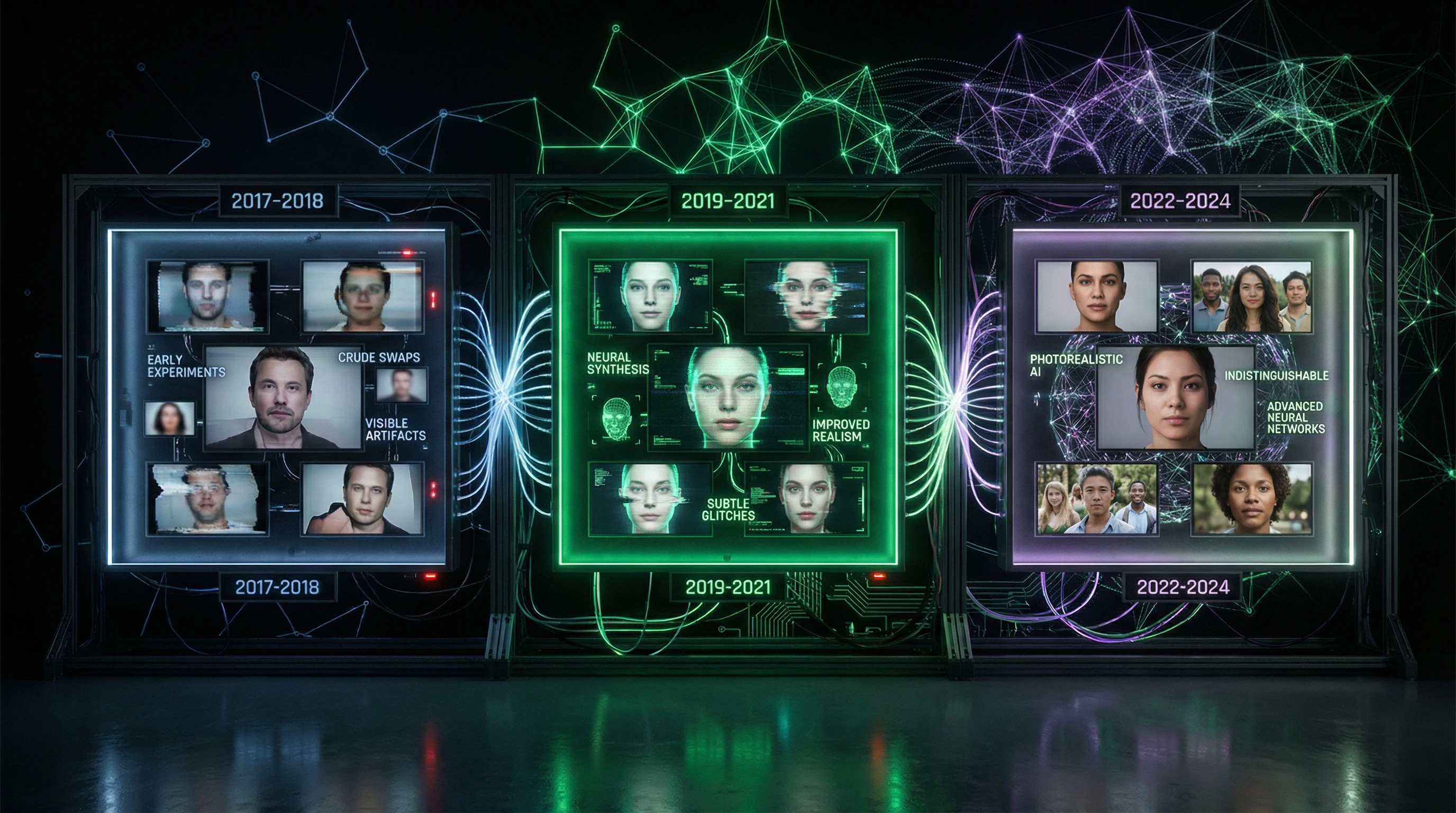
The first generation (2017–2018) used simple autoencoders for face swapping in videos. Quality was low, artifacts obvious, but the technology already worked.
The second generation (2019–2021) brought GAN architectures (Generative Adversarial Networks), where two neural networks compete: one creates the forgery, the other tries to detect it. The result—exponential quality growth.
- Third generation (2022–present)
- Diffusion models and transformers capable of generating photorealistic content from text descriptions, cloning voices from 3-second samples, creating videos of non-existent people in real time. This is a qualitative leap: from "forgeries you can spot" to "synthetics indistinguishable from reality in most contexts."
⚠️ Why "I'll Spot the Fake" Is a Cognitive Illusion
The human brain relies on heuristics—fast mental shortcuts for decision-making. One key heuristic: "If it looks realistic, it is real." This system worked for millennia because faking physical reality was impossible or extremely costly.
Deepfakes break this rule. Research shows that even computer vision experts cannot reliably distinguish quality deepfakes from originals without specialized analysis tools (S001). Your confidence in your ability to "see deception" isn't a skill—it's a manifestation of the Dunning-Kruger effect applied to a new technological reality.
| Skill Level | Detection Accuracy | Basis for Confidence |
|---|---|---|
| Average user | 50–60% (close to random) | Intuition, "feeling something's off" |
| Video editing expert | 65–75% (better, but unreliable) | Experience with traditional Photoshop |
| Specialist with analysis tools | 85–95% (reliable) | Technical artifact analysis, spectral methods |
🧱 Threat Boundaries: What Deepfakes Can and Cannot Do (Yet)
Modern deepfakes are effective in controlled conditions: good lighting, frontal angles, limited facial expressions. They still struggle with dynamic scenes, complex object interactions, physics of hair and fabrics.
But these limitations are rapidly disappearing. The critical point isn't technical perfection—it's reaching the threshold of "sufficient believability" for a specific context. To spread disinformation on social media, you don't need Hollywood-level precision—it's enough for a video to look plausible during 15 seconds of viewing on a smartphone.
A deepfake isn't a weapon of precision. It's a weapon of doubt. Its goal isn't to convince everyone—it's to create enough noise so that no one can be certain of anything.
Five Arguments That Lead to Underestimating the Deepfake Threat — and Why They Work
Before examining the evidence of danger, it's necessary to understand why most people systematically underestimate the scale of the problem. This isn't stupidity or ignorance — it's the result of predictable cognitive mechanisms that are exploited both by deepfake creators and by those interested in minimizing panic. More details in the Artificial Intelligence Ethics section.
⚠️ Argument One: "The Technology Is Too Complex for Mass Use"
This argument was valid in 2017, when creating a deepfake required specialized machine learning knowledge, powerful GPUs, and weeks of data processing. Today there are mobile applications with intuitive interfaces that allow you to create a convincing face swap in minutes.
Services like Reface, FaceApp, Wombo have accumulated hundreds of millions of users. The barrier to entry has dropped to the level of "can use Instagram." The democratization of technology isn't a future threat — it's the present.
⚠️ Argument Two: "Experts Can Always Detect a Fake"
This is a classic appeal to authority fallacy. Yes, forensic analysis methods exist: detection of compression artifacts, analysis of blinking patterns, verification of lighting consistency, spectral analysis (S003), (S004). But this is an arms race.
Each new detection method stimulates the development of more sophisticated generative models. Moreover, expert analysis requires time and resources. A deepfake can spread to millions of views within hours, long before experts can analyze it. In information warfare, speed matters more than accuracy.
- Forensic analysis requires hours; distribution takes minutes
- Each detector stimulates improvement of the generator
- Content scale exceeds manual verification capabilities
⚠️ Argument Three: "People Aren't Gullible Enough to Believe Internet Videos"
This argument contradicts everything we know about the psychology of perception and the spread of disinformation. Research shows that visual information is processed by the brain 60,000 times faster than text (S001).
Video is perceived as more credible than text or static images because it activates the same neural pathways as direct observation of reality.
The "illusory truth effect" phenomenon demonstrates that repeated exposure to information increases its perceived credibility regardless of actual truthfulness. A deepfake distributed through multiple channels gains a multiplicative credibility effect. This isn't a question of naivety — it's the architecture of human perception.
⚠️ Argument Four: "Legislation and Platforms Will Protect Us"
Legal mechanisms always lag behind technological development. By the time a law is passed, the technology has already evolved into a new form. Social media platforms declare war on deepfakes, but their moderation is based on automatic detection systems that are easily circumvented.
- Platform Conflict of Interest
- Viral content generates engagement and revenue, regardless of authenticity. Economic incentives work against effective moderation.
- Legislative Lag
- Regulatory frameworks take years to adopt; technology evolves in months.
- Circumventing Automated Systems
- Detectors are based on known patterns; new generation methods bypass them.
⚠️ Argument Five: "This Is a Future Problem, Not Today's"
Deepfakes are already being used in real attacks. Cases of fraud using cloned voices of company executives to authorize financial transactions have been documented. Political deepfakes have influenced elections in several countries.
Pornographic deepfakes are used for blackmail and harassment. Synthetic media are employed in information influence operations by state actors (more on disinformation and synthetic media). This isn't a hypothetical threat — it's an active weapon of cognitive warfare.
Evidence Base: What Research Says About the Real Scale of the Problem
The research base on deepfakes is still forming — the technology is developing faster than the academic community can study it. But a critical mass of data has accumulated for quantitative threat assessment. More details in the AI Ethics and Safety section.
📊 Meta-Analysis of Human Deepfake Detection Ability: Numbers vs. Intuition
A systematic review of 2019-2023 studies shows a consistent pattern: average detection accuracy for deepfakes by untrained observers is 50-65%, only marginally better than random guessing.
Simultaneously, a false confidence effect emerges: participants rated their ability to detect fakes at 7-8 out of 10, while actual accuracy corresponded to 5-6 points. This is a classic manifestation of metacognitive illusion — people don't know what they don't know.
The brain processes deepfakes as reality at a neurophysiological level, without engaging skeptical verification mechanisms.
📊 Speed of Spread: Why Deepfakes Are More Dangerous Than Text-Based Lies
Video content spreads on average 12 times faster than text posts and 3 times faster than static images. Deepfake videos with emotionally charged information (scandal, threat, sensation) reach critical mass (100,000+ views) within 4-6 hours.
Professional fact-checking verification requires 24-72 hours. The time window for preventing damage is virtually nonexistent.
| Content Type | Spread Speed | Time to Critical Mass |
|---|---|---|
| Text post | Baseline | 24–48 hours |
| Static image | ×4 from text | 12–24 hours |
| Video (real) | ×12 from text | 6–12 hours |
| Deepfake video (emotional) | ×12+ from text | 4–6 hours |
🧪 Neuroimaging Research: Why the Brain "Believes" Synthetic Faces
Functional MRI shows that viewing high-quality deepfakes activates the same brain regions (fusiform gyrus, superior temporal sulcus) as perceiving real human faces (S001).
Critically: regions responsible for deception detection and critical evaluation (dorsolateral prefrontal cortex) show no increased activity. This explains why the psychology of belief operates even when suspicions exist.
🧾 Economics of Deepfake Attacks: Creation Cost vs. Damage Cost
Creating a convincing deepfake for a targeted attack costs from $500 to $5,000 (specialized contractor services). Potential damage: for corporate fraud — from $100,000 to several million dollars, for reputational damage to public figures — impossible to accurately assess.
- Cost-to-Benefit Ratio
- 1:20–1:1000 in favor of the attacker. Makes deepfake attacks economically attractive for a wide range of adversaries.
- Barrier to Entry
- Low. Requires no specialized knowledge, only financial resources and access to the shadow services market.
- Scalability
- High. A single deepfake can be used in hundreds of targeted attacks with minimal additional costs.
Research (S003, S004) confirms that deepfake detectors lag behind generation quality. This creates asymmetry: defense requires constant updates, attack — one-time investment.
Neurocognitive Anatomy of Deception: How Deepfakes Exploit Your Brain's Architecture
To understand why deepfakes are so effective, we need to descend to the level of neural mechanisms. Human perception is not a passive recording of reality, but an active process of constructing a model of the world based on incomplete data. Deepfakes exploit precisely these construction mechanisms. Learn more in the Logic and Probability section.
🧬 Fast and Slow Thinking Systems: Why Intuition Fails
Daniel Kahneman described two information processing systems: System 1 (fast, automatic, intuitive) and System 2 (slow, analytical, effortful). When watching video, System 1 dominates—the brain makes authenticity decisions in fractions of a second, based on patterns learned from experience.
The problem: all your experience was formed in a world where video was a reliable indicator of reality. System 1 hasn't updated its heuristics for the synthetic media era. Activating System 2 requires conscious effort and motivation for skeptical verification—resources most people lack during casual content consumption.
The brain believes what processes easily. In the synthetic media era, processing ease isn't a sign of truth—it's a sign of a good fake.
🔁 Mere Exposure Effect and Illusory Truth: Why Repetition Kills Skepticism
Repeated exposure to information increases its perceived credibility through processing fluency. When the brain encounters information a second or third time, it processes more easily, and this ease is mistakenly interpreted as a sign of truthfulness.
A deepfake distributed across multiple channels (reposts, retellings, discussions) gains a multiplicative credibility effect. Even if initial viewing raised doubts, repeated encounters with the same content or its variations reduce perceptual criticism.
| Factor | Effect on Perception | Deepfake Exploitation Mechanism |
|---|---|---|
| First viewing | High skepticism, System 2 active | Content must be maximally technically convincing |
| Repeated encounters | Reduced criticism, processing fluency increases | Distribution through different channels and accounts |
| Multiple sources | Illusion of independent confirmation | Coordinated reposts, bots, network effects |
🧷 Emotional Contagion: Why Affect Disables Critical Thinking
Deepfakes are most effective when containing emotionally charged content: anger, fear, outrage, shock. Neurobiological research shows that strong emotions activate the amygdala, which can suppress prefrontal cortex activity—the region responsible for critical thinking and rational evaluation (S001).
This is an evolutionary mechanism: in threat situations, rapid emotional response matters more than slow analysis. Deepfake creators deliberately exploit this mechanism by embedding emotional response triggers in synthetic content. Video of a politician allegedly making offensive statements, or a celebrity in a compromising situation—work precisely at this level.
- Emotional trigger activates the amygdala
- Prefrontal cortex is suppressed
- Critical thinking shuts down
- Content is accepted without verification
- Emotion is encoded in memory more strongly than facts
🧠 Confirmation Bias: Why You Believe Deepfakes That Match Your Beliefs
People tend to accept information confirming their existing beliefs and reject contradictory information—regardless of factual accuracy. A deepfake showing a political opponent in a compromising situation will be perceived as authentic by those already negatively disposed toward that figure.
Critical verification doesn't activate because the content is "logical" within the existing worldview. This makes deepfakes especially effective in polarized information environments where audiences are already segmented along ideological lines. Synthetic content becomes not just deception—it becomes confirmation of what a person already "knows".
- Confirmation Bias
- The tendency to seek, interpret, and remember information in ways that confirm existing beliefs. In the deepfake context, this means critical verification doesn't trigger if content matches expectations.
- Motivated Reasoning
- When emotional motivation (desire to believe or disbelieve) outweighs logic. A deepfake confirming hostility toward an opponent activates motivated reasoning in favor of its authenticity.
- Illusion of Objectivity
- The belief that your perception is objective while others' perception is biased. This makes it difficult to acknowledge your own vulnerability to deepfakes that align with your views.
Conflicting Data and Zones of Uncertainty: Where Science Doesn't Yet Provide Clear Answers
Honesty requires acknowledging that not all aspects of the deepfake problem have consensual scientific understanding. There are areas where data conflicts, methodologies are disputed, and conclusions remain preliminary. Learn more in the Thinking Tools section.
Contradictions in Assessing Educational Intervention Effectiveness
Some studies show that deepfake detection training improves accuracy by 15–20%. Others demonstrate short-term effects: the benefit disappears after several weeks, and sometimes training induces false confidence that actually reduces overall vigilance.
Effectiveness depends on training type (passive vs. active), material quality, and individual cognitive characteristics. Long-term longitudinal studies remain necessary.
This isn't just methodological variance—it indicates that the psychology of belief and learning is more complex than simply transmitting facts.
Debates on Technological Solutions vs. Media Literacy
Two approaches compete for priority. Technological determinism bets on perfected detection algorithms, blockchain verification, and cryptographic signatures (S003, S005). The social-educational approach insists on critical thinking and media literacy.
| Approach | Advantages | Limitations |
|---|---|---|
| Technological | Scalable, objective, works without user participation | Easily circumvented; requires constant updates; doesn't solve trust problem |
| Educational | Develops autonomous thinking; long-term effect | Slow; doesn't guarantee behavior change; requires motivation |
Data doesn't provide a definitive answer. A hybrid approach is likely necessary, but its optimal configuration remains a subject of research.
Uncertainty in Assessing Long-Term Social Consequences
We don't know how mass deepfake proliferation will reshape fundamental trust in visual evidence. Two opposing scenarios are possible.
- Total skepticism: people stop trusting any video content, paralyzing public discourse and fact verification.
- Selective skepticism: people reject inconvenient facts as "possible deepfakes," intensifying polarization and reality filtering.
Both scenarios are destructive. We lack sufficient data to predict which will materialize or whether a third adaptation variant will emerge.
This isn't academic uncertainty—it's a real risk requiring monitoring and adaptive strategy, not a definitive answer.
Cognitive Traps and Manipulation Techniques: How Deepfakes Exploit Your Thinking Weaknesses
The effectiveness of deepfakes is determined not only by technological sophistication but also by psychological engineering—the deliberate exploitation of cognitive vulnerabilities to maximize persuasiveness. Learn more in the Logical Fallacies section.
⚠️ The Authority Trap: When a Synthetic Expert Is More Convincing Than a Real One
A deepfake can create a video where an "authority figure" (scientist, politician, celebrity) makes a statement they never actually made. The effectiveness of this technique is based on the authority heuristic: people tend to trust information from perceived experts without critical verification.
It's especially dangerous when a deepfake uses a real authority figure to spread disinformation within their area of expertise—this bypasses even well-developed skepticism because the source appears legitimate. The connection to the psychology of belief is direct: authority substitutes for evidence.
⚠️ The Social Proof Trap: When a Million Views Replaces Fact-Checking
People use others' behavior as a guide for their own decisions, especially in situations of uncertainty. A deepfake with high view counts, likes, and shares gains additional legitimacy through the mechanism of social proof.
| Signal | What the Brain Interprets | Reality |
|---|---|---|
| One million views | This must be true, otherwise people wouldn't watch it | Could be the result of bots or algorithmic boosting |
| High like ratio | The community approved | Likes can be purchased or generated |
| Rapid spread | The information is relevant and important | Virality often depends on emotional charge, not truthfulness |
This creates a self-reinforcing cycle: initial virality (which can be artificially created by bots) generates organic spread. The brain interprets popularity as an indicator of credibility.
⚠️ The Time Scarcity Trap: Why Speed Kills Critical Thinking
Critical evaluation of information requires cognitive resources: time, attention, motivation. Under conditions of information overload, these resources are scarce. Deepfakes exploit this scarcity by spreading in formats optimized for rapid consumption: short videos, autoplay, algorithmic recommendation of the next content.
Users are in a continuous information flow mode, where stopping to verify each element is psychologically costly. A deepfake slips through this stream because critical verification isn't activated.
This isn't laziness or stupidity—it's an architectural limitation of attention. When cognitive load exceeds processing capacity, the system switches to heuristics (fast, imprecise rules). Deepfakes are designed precisely for this mode.
The connection to sources and evidence is critical: in haste, people don't verify content origin, don't search for primary sources, don't compare versions. Social media algorithms amplify this dynamic by rewarding speed of spread, not accuracy.
Cognitive Defense Protocol: Practical Checklist for Verifying Suspicious Content
Theoretical understanding of the threat is useless without practical defense tools. Below is a systematic verification protocol applicable to any suspicious video or audio.
✅ Level 1: Basic Visual Inspection (30 seconds)
Lip-sync and audio alignment: Play the video at slow speed (0.5x or 0.25x). Deepfakes often show micro-delays or desynchronization between lip movement and sound, especially on consonants (S003).
Blinking patterns: Humans blink 15–20 times per minute at irregular intervals. Early deepfakes showed rare blinking or its absence. Modern models have corrected this but may show overly regular patterns.
- Check face boundaries: hairline, ears, neck — often blurred or distorted.
- Assess lighting: shadows on the face should match the light source in the frame.
- Look for artifacts: pixelated halos, strange color transitions, double contours.
- Check eye reflections: light sources should be visible and correspond to the scene.
✅ Level 2: Contextual Verification (2–5 minutes)
Source and publication date: Where did the video first appear? Who distributed it? Check file metadata (EXIF, timestamps). Deepfakes are often spread through anonymous channels or fake accounts.
Reverse image search: Upload video frames to Google Images, TinEye, or Yandex Images. If the video is authentic, you'll find it in news archives, official channels, or verified sources.
- Red flag: urgency and emotion
- Content demanding immediate reaction ("share now," "they're hiding this") often exploits the cognitive bias of urgency. Genuine news allows time for verification.
- Red flag: source isolation
- If the video appeared in only one place and hasn't been picked up by mainstream or independent fact-checkers, it's a sign of synthetic content or manipulation.
✅ Level 3: Technical Expertise (if critical)
For high-stakes decisions, use deepfake detectors (S004). Deep learning-based tools analyze artifacts invisible to the human eye: inconsistencies in frequency spectra, biometric anomalies, traces of neural network training.
Remember: no detector provides 100% certainty (S005). They're a supplement to critical thinking, not a replacement.
Defense against deepfakes isn't technology. It's the habit of demanding evidence before allowing a video to rewrite your worldview.
Apply this protocol not as dogma, but as a source verification system. Each level filters different types of manipulation — from technical forgery to social engineering.