What is the Alcubierre warp drive and why does it remain in the realm of theoretical physics
In 1994, Mexican physicist Miguel Alcubierre published a paper showing that faster-than-light travel doesn't violate relativity theory if you properly curve spacetime around an object. The idea is simple—create a "bubble" in which the ship remains stationary relative to local space, while space itself contracts ahead and expands behind. More details in the AI Ethics section.
Mathematically, it's an elegant solution to Einstein's equations. But physical implementation runs into a fundamental problem: creating such a bubble requires matter with negative energy density (S008).
🧩 The exotic matter problem
Negative energy density means matter must possess properties opposite to ordinary matter—gravitationally repelling rather than attracting. In quantum field theory, effects exist that demonstrate locally negative energy (the Casimir effect), but the scales of these phenomena are negligible compared to warp metric requirements.
Alcubierre's initial calculations showed that a warp bubble the size of a spacecraft would require negative energy equivalent to the mass of the entire observable universe.
🔬 Evolution of the concept: from cosmological scales to "almost possible"
Over three decades of research, physicists have significantly reduced energy requirements. Work by Chris Van den Broeck (2000) and Harold White (2011–2013) showed that modifying warp bubble geometry—thickening walls and changing shape—can reduce required energy by several orders of magnitude.
- White's toroidal configuration
- Theoretically requires mass on the order of the Voyager spacecraft (about 700 kg) in negative energy equivalent. Still unattainable, but no longer absurd in terms of scale.
🧱 Mathematical correctness vs physical realizability
The Alcubierre warp metric is mathematically consistent within general relativity. This isn't a violation of physics, but an exploration of its boundaries (S003).
However, mathematical possibility doesn't guarantee physical realizability—equations permit many solutions that nature doesn't use. The problem isn't that the warp drive is "forbidden" by physics, but that we don't know the mechanism for creating the necessary conditions. This is precisely where the capillary-wave hypothesis emerges.
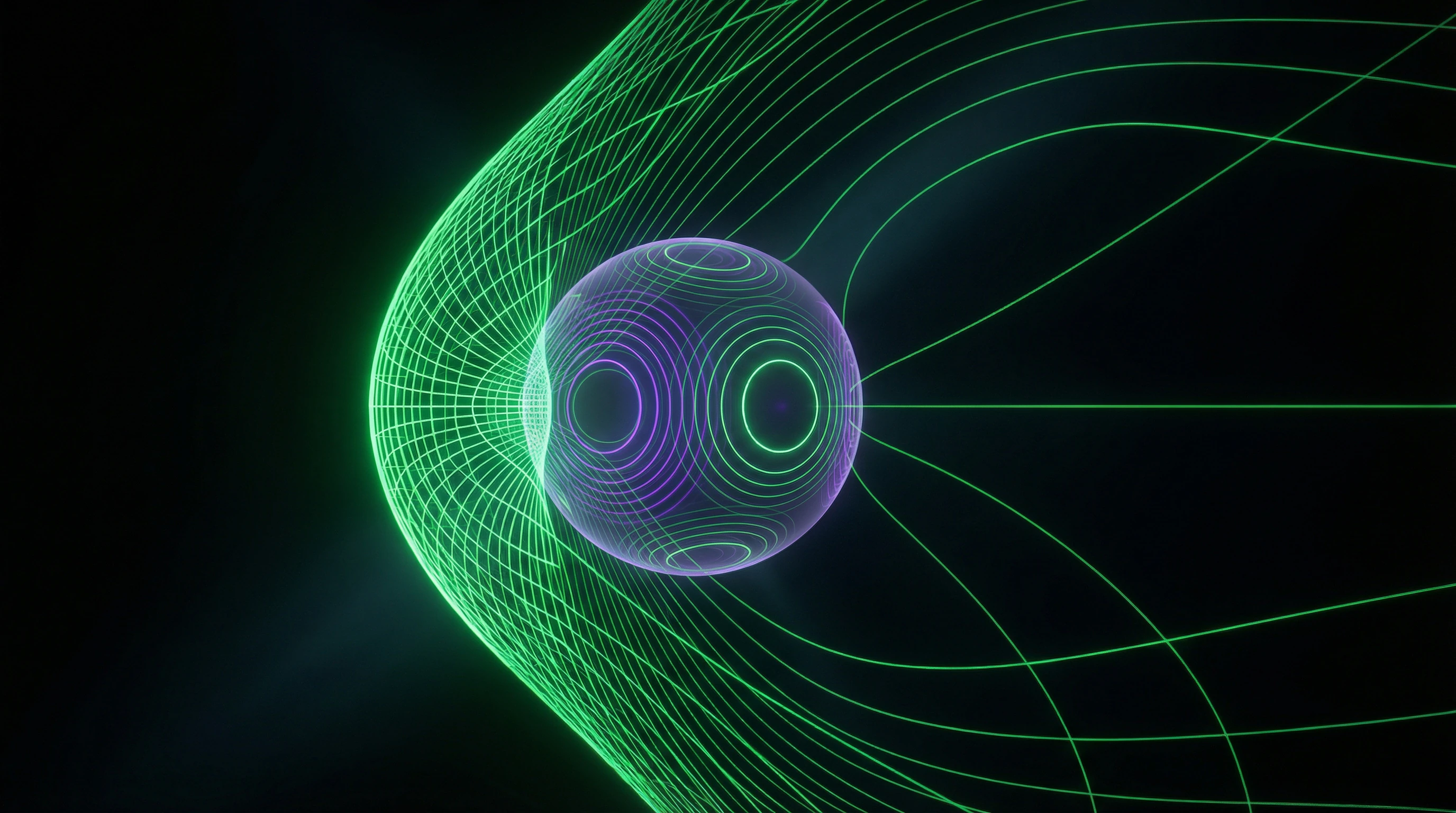
Steel Man: Five Strongest Arguments for Warp Technology Feasibility
Before examining the capillary-wave hypothesis, we must honestly present the most compelling arguments from warp research proponents. The "steel man" principle requires considering the opposing position in its strongest form—only then can we conduct objective analysis. More details in the section AI Errors and Biases.
🧪 Argument One: Quantum Effects Demonstrate Negative Energy Under Laboratory Conditions
The Casimir effect, experimentally confirmed in 1997 by Steve Lamoreaux, shows that attraction occurs between two uncharged conducting plates in vacuum because the energy density of quantum fluctuations between the plates is lower than outside. This is real, measurable negative energy.
Warp research proponents point out: if nature permits negative energy at microscales, mechanisms for scaling or amplifying it may exist. The Casimir effect is not a theoretical abstraction but a reproducible laboratory phenomenon.
🔬 Argument Two: Energy Requirements Reduced by 10-12 Orders of Magnitude Over 20 Years of Research
| Year / Researcher | Required Mass-Energy | Reduction vs. Alcubierre |
|---|---|---|
| 1994 — Alcubierre | 1064 kg | Original estimate |
| 2000 — Van den Broeck | 1062 kg | 2 orders lower |
| 2011–2013 — White | 103 kg | 61 orders lower |
Extrapolating this trend, each decade of research brings a 20–30 order of magnitude reduction. At this pace, theoretically feasible energies could be reached within a century.
This is an argument from trend, but it shows: the problem is not static. Direction of movement matters.
📊 Argument Three: NASA and Other Institutions Invest in Warp Research
NASA's Eagleworks program (2011–2019) under Harold White conducted experiments to detect microscopic spacetime distortions using a modified Michelson interferometer. Though the program was not continued, the very fact of funding indicates: serious scientific organizations consider the topic worthy of investigation.
The Ioffe Physical-Technical Institute publishes work on the capillary-wave approach in peer-reviewed journals (S002). This is not fringe pseudoscience but a peripheral yet legitimate area of theoretical physics.
🧬 Argument Four: Physics History Is Full of "Impossible" Technologies That Became Reality
- 1903 — Simon Newcomb mathematically "proved" the impossibility of heavier-than-air flight; the Wright brothers fly months later.
- 1930s — nuclear energy considered theoretical abstraction; 15 years later—industrial reality.
- 1917 — Einstein predicts lasers; realized in 1960.
- 1997 — quantum teleportation demonstrated in laboratories after decades of skepticism.
Absence of current technology does not mean fundamental impossibility—it may simply be an engineering problem awaiting solution.
⚙️ Argument Five: Capillary Waves Offer a New Physical Mechanism Not Requiring Exotic Matter
Research from the Ioffe Physical-Technical Institute (S002) proposes a radically different approach: using capillary waves at medium interfaces to create effects analogous to warp metrics. Capillary waves are real, observable phenomena governed by surface tension.
If wave dynamics can mimic the geometry of curved spacetime, this bypasses the exotic matter problem. This is the strongest argument because it offers a concrete, testable mechanism instead of speculation about unknown forms of matter.
Capillary-Wave Hypothesis: What the Ioffe Institute Research Actually Proposes
The work "Capillary-Wave Warp Drive," published in the journals of the Ioffe Physical-Technical Institute (S002), presents a theoretical investigation into the possibility of using capillary waves to create effects analogous to the Alcubierre warp metric. The key idea: wave processes at the interface between two media with different properties can create local curvatures of the effective metric that are mathematically similar to space-time curvatures in general relativity.
🧾 What Are Capillary Waves and Why Are They Interesting for Warp Physics
Capillary waves are surface waves at the liquid-gas or liquid-liquid interface, where the restoring force is surface tension rather than gravity. They have a characteristic wavelength of less than 1.7 cm for water. More details in the AI and Technology section.
Mathematically, capillary waves are described by a dispersion relation linking frequency and wave number through surface tension and media densities. The research (S002) suggests that under certain conditions, the dynamics of these waves can create an effective metric in which the phase velocity of waves exceeds the speed of light in the medium—an analog of the warp effect.
📊 Mathematical Analogy vs Physical Equivalence: A Critical Distinction
Mathematical analogy between wave equations in a medium and space-time metric does not mean that capillary waves literally curve space-time.
This is analog modeling—capillary waves behave as if they were propagating in curved space, but space-time itself remains flat.
Analog models are widely used in physics (for example, acoustic black holes in superfluid liquids), but they model effects rather than literally reproducing them. This distinction is critical for understanding what the research proposes.
🔁 What the Research Claims and What It Does NOT Claim
- The research claims:
- It is possible to create a capillary wave system in which the effective metric for wave propagation will be mathematically isomorphic to the Alcubierre warp metric. This allows studying properties of warp geometry under laboratory conditions (S002).
- The research does NOT claim:
- That capillary waves can move material objects faster than light or curve actual space-time. This is precisely where confusion often arises in popularization.
🧪 Experimental Verifiability: What Can Be Measured and What It Will Prove
The capillary-wave system is potentially verifiable: one can create a setup with controlled surface tension, generate capillary waves, and measure their dispersion characteristics. If the effective metric truly corresponds to warp geometry, this will be visible in anomalous behavior of phase and group velocities.
| Experimental Result | What It Means | Applicability to Warp Drive |
|---|---|---|
| Phase velocity exceeds speed of light in medium | Analog modeling works | Confirms theory, not technology |
| Effective metric matches calculations | Mathematical model is correct | Valuable for fundamental physics |
| Waves transport energy faster than light | Causality violation in medium | Does not imply possibility of space drive |
Even a successful experiment would only prove the possibility of analog modeling, not the creation of an actual warp drive. This is valuable for understanding theoretical properties of warp metric, but is not a breakthrough in space engineering.
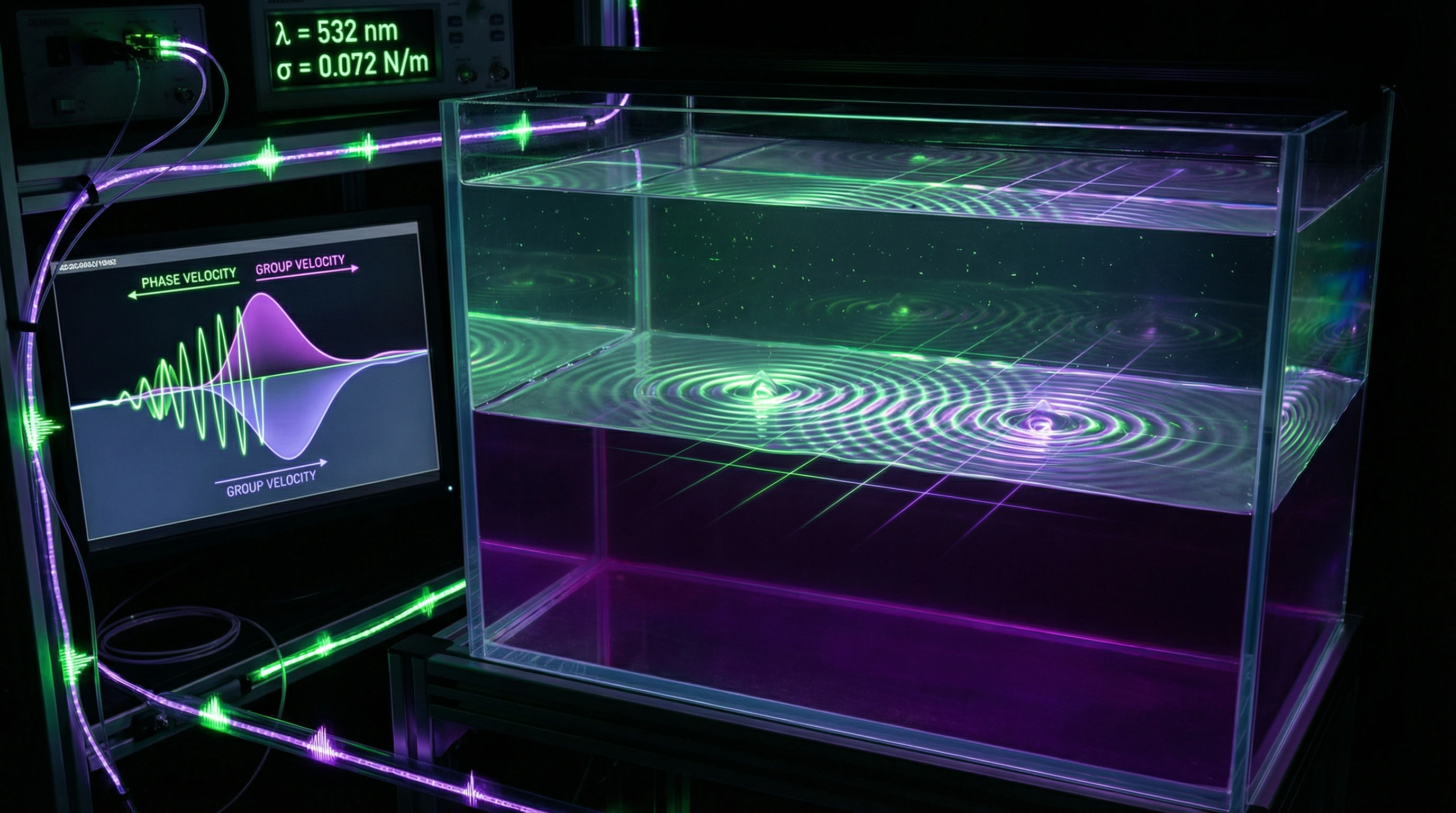
Mechanisms and Causality: Why Capillary Waves Cannot Create a True Warp Effect
To understand the boundaries of the capillary-wave approach, it's necessary to examine the fundamental differences between analog simulation and actual spacetime curvature. This distinction is not technical but principled—it concerns the nature of spacetime itself. More details in the section Logical Fallacies.
🧬 Effective Metric vs Spacetime Geometry: An Ontological Difference
An effective metric is a mathematical tool describing how waves propagate in a medium with inhomogeneous properties. When light passes through a medium with a variable refractive index, its trajectory curves as if it were moving through curved space—but the space itself remains Euclidean.
Spacetime geometry in general relativity is not an analogy but a fundamental property of reality, determining the motion of all objects and fields, not just a specific type of wave (S008). Capillary waves create the former, but not the latter.
🔁 The Energy Problem: Where Curvature Comes From in a Real Warp Drive
In Alcubierre's warp metric, spacetime curvature is created by the distribution of energy-momentum (the stress-energy tensor on the right side of Einstein's equations). Creating a warp bubble requires a specific distribution of negative energy (S003).
In a capillary-wave system, the "curvature" of the effective metric is created by gradients in surface tension and density—this is ordinary positive energy. The mathematical form of the equations may be similar, but the physical source of curvature is fundamentally different. Capillary waves don't solve the exotic matter problem—they bypass it at the cost of abandoning real spacetime curvature.
- Warp metric requires negative energy (exotic matter)
- Capillary waves use positive energy (surface tension)
- Mathematical similarity does not mean physical equivalence
- Effective metric describes wave behavior, not geometry itself
⚠️ Correlation vs Causality: Why Similar Equations Don't Mean Identical Physics
Many physical systems are described by mathematically similar equations—this doesn't mean they're physically equivalent. The harmonic oscillator equation describes a pendulum, an LC circuit, and a quantum oscillator, but that doesn't make a pendulum a quantum object.
Isomorphism of mathematical structures is a correlation of formal properties, not a causal connection of physical mechanisms. A capillary-wave system may be isomorphic to a warp metric in a mathematical sense, but this doesn't mean it reproduces the physical effects of a warp drive—movement of material objects, violation of event horizons, etc.
🧷 Limitations of Analog Modeling: What Can and Cannot Be Learned
Analog models are valuable for studying general properties of systems—for example, wave behavior near event horizons, metric stability, dispersion effects. Acoustic black holes in superfluid helium have enabled study of an analog of Hawking radiation.
- What the capillary-wave model provides
- Understanding of perturbations in warp metrics, instabilities, energy distribution, wave behavior in curved space
- What it cannot provide
- An answer to the question of warp drive feasibility, because it doesn't reproduce the key element: curvature of spacetime itself, rather than an effective metric for a specific type of wave
- Why this matters
- Confusion between analog model and actual physics creates an illusion of proximity to solving a problem that remains unsolved
Conflicts and Uncertainties: Where Sources Diverge and Why It Matters
Analysis of available sources reveals a critical problem: the study (S002) exists in relative isolation from the main body of literature on warp physics. This doesn't necessarily mean the work is erroneous, but it indicates a lack of independent verification and critical discussion.
🧩 Absence of Citations and Independent Replications
The standard verification of scientific work involves analyzing citations and replication attempts by other groups. For the work (S002), such data is unavailable in the provided sources.
This could indicate three scenarios: the work is too new to have accumulated citations; it was published in a journal with limited international visibility; the scientific community doesn't consider the approach promising. Without independent verification, it's impossible to assess whether the capillary-wave hypothesis is a breakthrough or a mathematical exercise without physical substance. More details in the section Epistemology Basics.
- The work is too new to have accumulated citations
- Published in a journal with limited international visibility
- The scientific community doesn't consider the approach promising
🔎 Gap Between Theoretical Work and Experimental Programs
Major experimental programs in warp research (NASA Eagleworks, Advanced Propulsion Physics Laboratory) focused on detecting microscopic spacetime curvatures using interferometry, rather than analog modeling.
The capillary-wave approach is not mentioned in reviews of experimental methods in warp physics. This may indicate that the approach is considered too indirect for practical purposes—an analog model, however accurate, doesn't bring us closer to creating an actual warp drive.
Analog modeling and real physics operate in different regimes: the former tests mathematical consistency, the latter requires energetic feasibility.
📊 The Scaling Problem: From Capillary Waves to Spacecraft
Even if the capillary-wave system successfully models warp metrics at laboratory scales (millimeters–centimeters), the question of scaling remains. Capillary effects dominate at small scales; at larger scales, gravity dominates.
| Scale | Dominant Effect | Capillary Model Applicability |
|---|---|---|
| Millimeters–centimeters | Surface tension, capillary waves | High (laboratory conditions) |
| Meters–kilometers | Gravity, inertia | Low (transition zone) |
| Cosmic distances | Gravity, spacetime curvature | None (different physics) |
There's no obvious path from capillary waves in a laboratory container to spacetime curvature around a spacecraft. This isn't a technical problem but a conceptual one: the analog model works at one scale and in one medium, while a real warp drive must operate under completely different conditions.
For more on how the scientific community distinguishes breakthroughs from marketing, see the analysis of AI in medicine—the mechanisms of idea isolation and lack of independent verification are universal.
Cognitive Anatomy of the Myth: Why Warp Drive Is So Easy to Sell as "Almost Real"
Warp technology exploits several powerful cognitive biases that make it attractive for uncritical acceptance. Understanding these mechanisms is key to distinguishing scientific research from scientific speculation. More details in the section Karma and Reincarnation.
🧩 The "Mathematical Magic" Effect: If There Are Equations, It Must Be Real
Non-specialists tend to perceive mathematical formalization as proof of physical feasibility. If an equation exists describing warp metric, then warp drive is possible—this is a logical fallacy.
Mathematics describes possible structures, but not all mathematically possible structures are physically realizable. There exist mathematically correct solutions to Einstein's equations describing time machines, wormholes, white holes—but this doesn't mean nature implements these solutions (S003).
Mathematical correctness is a necessary but not sufficient condition for physical possibility.
⚠️ The "Gradual Progress" Fallacy: Reducing Energy Requirements as Proof of Achievability
The argument "energy requirements decreased by 60 orders of magnitude in 30 years" creates an illusion of linear progress toward the goal. But reducing from 10^64 kg to 10^3 kg isn't movement from "impossible" to "possible," but from "absurdly impossible" to "still impossible, but less absurd."
The problem isn't the quantity of energy, but the type of energy—negative. Even if requirements drop to 1 gram, that's still 1 gram of non-existent substance.
| Type of Progress | Example | Does It Lead to Realization? |
|---|---|---|
| Engineering (overcoming technical barriers) | Flight, electricity, computers | Yes, if no fundamental prohibitions exist |
| Geometric (parameter optimization) | Reducing warp metric energy | No, if non-existent matter is required |
🔁 Appeal to History: "They Also Said It Was Impossible Before"
The argument "flight was considered impossible, and now we fly" exploits survivorship bias. We remember technologies that seemed impossible and became real, but forget thousands of ideas that seemed possible and remained fantasy (perpetual motion, philosopher's stone, ether).
The history of science doesn't show that everything impossible becomes possible—it shows that some things that seemed impossible for engineering reasons became possible with technological development. But things impossible for fundamental physical reasons (violation of energy conservation, exceeding the speed of light in vacuum) remain impossible.
🧷 Conflating Analog Modeling with Real Technology
Capillary waves in liquid demonstrate geometry analogous to warp metric. This is useful for visualization and checking mathematical predictions. But analogy is not proof.
- Analog Modeling
- System A reproduces the mathematical structure of system B. Helps understand geometry, but doesn't guarantee physical realizability of B.
- The Trap
- If capillary waves "work," then warp drive can work too. In reality: capillary waves are waves in liquid, warp drive requires spacetime curvature. These are different physical systems.
💭 Four Cognitive Anchors That Sustain the Myth
- Authority: Research is conducted by scientists, therefore it proves feasibility. In reality: scientists investigate mathematical properties of warp metric, but this doesn't mean they believe in practical realizability.
- Novelty: "New research" sounds like a breakthrough. In reality: this is parameter refinement within a known problem, not solving the problem.
- Complexity: If I don't understand the math, then it might be true. In reality: complexity isn't proof, it's just complexity.
- Hope: I want to believe warp drive is possible. In reality: desire isn't an argument, but it's more powerful than logic.
Warp drive remains in the realm of theoretical physics not because engineers are lazy or funding is insufficient. It remains there because it requires matter with negative energy density, which hasn't been found in nature and cannot be created by known methods (S008).
Scientific research on warp metric is legitimate work. But marketing this research as "nearly ready technology" is cognitive manipulation that exploits mathematical illiteracy and hope for miracles.