What is technological singularity and why 2025 became the checkpoint for testing Kurzweil's predictions
The term "technological singularity" gained widespread recognition through mathematician Vernor Vinge in 1993, but Ray Kurzweil transformed it into a concrete roadmap with dates and milestones. Singularity in his interpretation is the moment when artificial intelligence reaches and surpasses human-level cognitive capabilities. Learn more in the AI and Technology section.
After this point, a period of recursive self-improvement begins: AI creates more advanced AI, which creates even more advanced AI, and so on at a speed beyond human comprehension.
⚠️ Kurzweil's specific predictions: from 2029 to 2045
In "The Singularity Is Near" (2005), Kurzweil established key temporal markers:
- 2029
- Computers should pass the Turing test and achieve human-level intelligence in the narrow sense.
- 2045
- Full singularity—the computational power of all computers will surpass the combined power of all human brains.
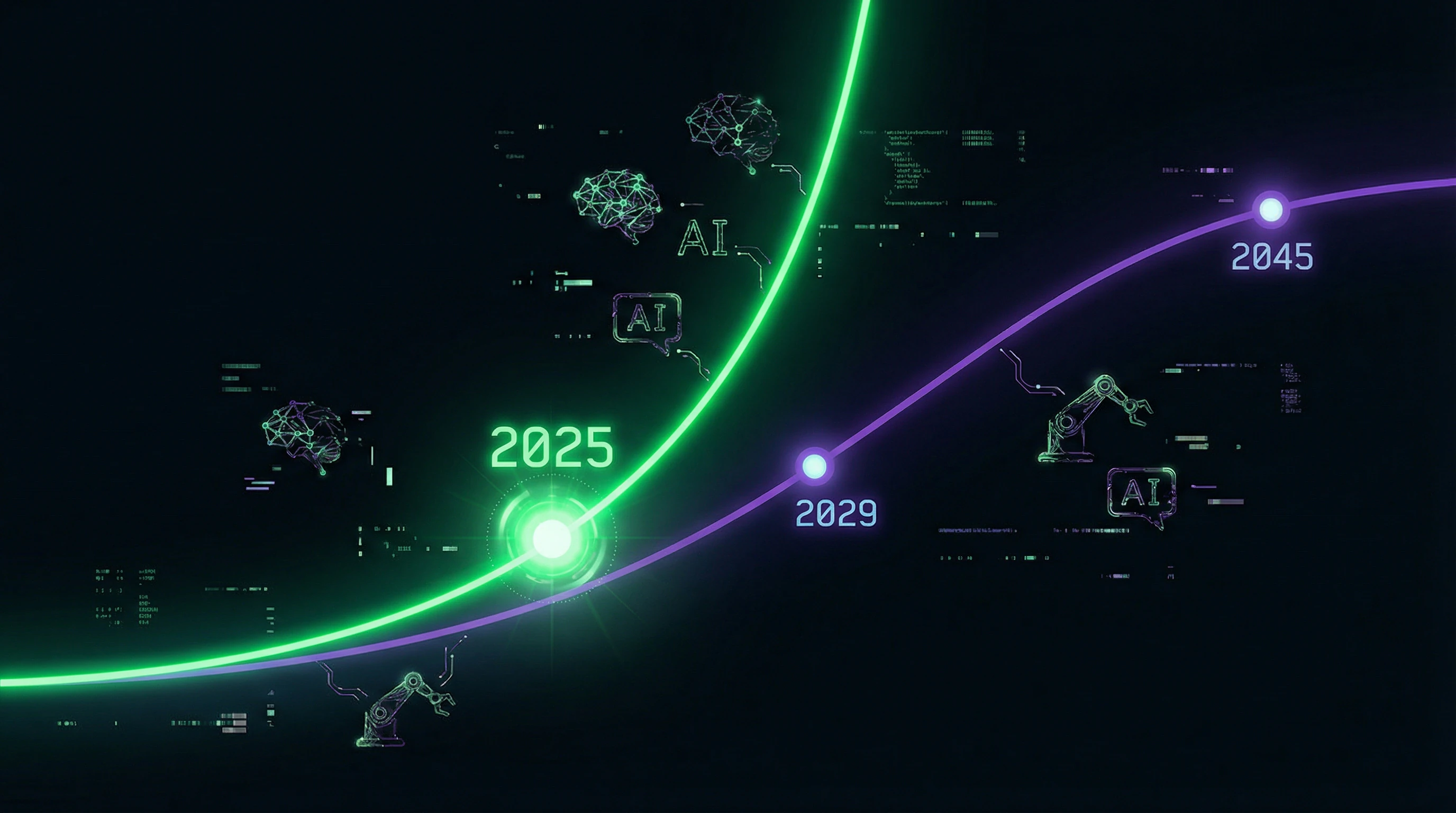
These dates were based on the "law of accelerating returns": technological progress occurs exponentially, not linearly. However, Moore's Law, on which this logic was built, slowed significantly earlier—already in the 2010s, the physical limitations of silicon began to manifest clearly.
🧩 Why 2025 is critical for assessing the trajectory
2025 sits exactly midway between the publication of Kurzweil's predictions and his predicted date for achieving human-level AI (2029). This is the perfect checkpoint: if exponential growth is truly occurring, we should observe clear signs of approaching AGI.
If progress remains linear or slows in key areas, this points to fundamental problems in the exponential growth model. The current moment allows us to distinguish the actual trajectory from extrapolation based on 2005 assumptions.
🔎 Operationalizing concepts: what counts as "human-level" intelligence
The main problem in evaluating predictions is the absence of clear criteria. The Turing test (1950) proved too narrow: modern language models imitate human speech, but this does not make them "intelligent" in the full sense.
| Intelligence Component | Human Level | Modern AI |
|---|---|---|
| Abstract reasoning | Yes, developed | Limited to context |
| Knowledge transfer between domains | Yes, natural | Requires retraining |
| Causal relationships | Yes, intuitive | Correlations, not causes |
| Adaptation to new situations | Yes, rapid | Slow or impossible |
No modern AI system demonstrates all these qualities simultaneously. This means that even if language models become more powerful, they may remain narrowly specialized tools rather than AGI in Kurzweil's sense.
The Steel Man Argument: Seven Most Compelling Cases for the Inevitability of Singularity
Before examining the flaws in predictions, we must honestly present the strongest arguments from singularity proponents. Intellectual honesty requires considering the opponent's position in its most convincing form—this is called the "steel man" argument. Learn more in the Machine Learning Basics section.
📊 First Argument: Empirical Robustness of Moore's Law and Its Analogues
Moore's Law, predicting a doubling of transistors per chip every two years, held with remarkable accuracy from 1965 to 2015—fifty years of continuous exponential growth.
Kurzweil extended this principle, showing that exponential growth in computational power per unit cost has been observed since the early 20th century: electromechanical calculators, vacuum tube computers, transistors, integrated circuits—each technology followed the same trajectory. This suggests that exponential growth is not an artifact of a specific technology, but a fundamental property of technological evolution.
- Fifty years of continuous doubling in computational power
- The pattern reproduces across different technological generations
- Growth follows a single curve, independent of physical substrate
🧬 Second Argument: Recursive Self-Improvement as an Inevitable Attractor
Once AI reaches the ability to improve its own code, positive feedback will trigger: improved AI creates the next version faster, which creates the next even faster.
This process requires no human intervention and is limited only by physical laws. Mathematically, this is described by differential equations with positive feedback, which always lead to explosive growth until physical constraints are reached.
Even if the initial AI is imperfect, recursive improvement should rapidly eliminate deficiencies.
🔬 Third Argument: Neuroscience Reveals Brain Algorithms, Making Them Reproducible
Connectome mapping projects demonstrate that the brain is not magic, but a complex yet finite computational system. The human brain contains approximately 86 billion neurons and 100 trillion synapses—a vast but finite number.
If we can fully describe the structure and dynamics of neural networks, we can reproduce them in silicon. Modern supercomputers are already approaching the computational power needed to simulate the brain in real time.
⚙️ Fourth Argument: Technological Convergence Creates Synergistic Effects
Progress in AI does not occur in isolation. Quantum computers promise exponential acceleration of certain types of computation. Neuromorphic chips mimic brain architecture, providing energy efficiency. Biotechnology enables creation of hybrid brain-computer systems.
| Technology | Contribution to Acceleration | Synergy with AI |
|---|---|---|
| Quantum Computing | Exponential acceleration of specific algorithms | Search optimization, machine learning |
| Neuromorphic Chips | Energy efficiency, parallelism | Scalability, cost reduction |
| Biotechnology | Hybrid brain-computer systems | Novel learning architectures |
When multiple exponential curves intersect, the result can be dramatic.
🧪 Fifth Argument: Economic Incentives Guarantee Massive Investment
Global investment in AI runs into hundreds of billions of dollars annually. Companies, governments, and military organizations have enormous incentives to achieve AGI first.
This creates an arms race where each participant is forced to maximize development speed. Economic logic dictates that resources will continue flowing into this field until either a breakthrough is achieved or it becomes clear that a breakthrough is impossible.
🧠 Sixth Argument: Evolution Created Intelligence in Finite Time, Engineering Can Do It Faster
Evolution is a blind, inefficient process of trial and error that nevertheless created human intelligence in several million years.
Purposeful engineering, armed with understanding of brain principles and unlimited computational resources, should achieve the same result orders of magnitude faster. If nature could create intelligence using slow chemical reactions and random mutations, then engineers using fast electronic components and directed design should accomplish this task far more efficiently.
📌 Seventh Argument: Absence of Fundamental Physical Barriers
Unlike some futuristic technologies, creating AGI does not violate known laws of physics. We know intelligence is possible—it exists in biological systems. We know computation can be implemented in silicon.
- No Theoretical Barriers
- Intelligence is a computational process, not magic. All obstacles are engineering challenges, not fundamental ones.
- Engineering Problems Are Solved with Resources
- History shows: with sufficient investment of time and money, technical challenges find solutions.
- Biological Precedent
- Nature has already proven that intelligence is possible in a material system. This is not a question of "if," but "when."
Evidence Base 2025: What Has Actually Been Achieved in AI and Where the Boundaries Lie
The state of AI in 2025 is not an exponential takeoff, but a series of narrow victories in specialized tasks. Large language models generate coherent text, computer vision systems recognize objects with superhuman accuracy, algorithms play chess and Go at superhuman levels. But all these achievements remain within the realm of narrow AI. More details in the section AI Errors and Biases.
No system demonstrates the ability to transfer knowledge between domains, engage in abstract causal reasoning, or adapt to fundamentally new situations without additional training.
⚠️ Methodological Problem: Absence of Relevant Sources as a Symptom
The singularity discussion occurs predominantly in popular books, blogs, and media, not in peer-reviewed scientific literature. This is not accidental: futurological predictions by their nature cannot be empirically verified until the predicted events occur.
Applying evidence-based medicine standards to singularity predictions immediately reveals their weakness: absence of operationalized success criteria, impossibility of blind analysis, lack of control groups, and no falsification mechanism.
📊 The Plateau Problem: Where Exponential Growth Slowed Down
Moore's Law effectively ceased operating around 2015. Further reduction in transistor size encountered quantum effects and heat dissipation problems.
| Parameter | Period 2000–2015 | Period 2015–2025 |
|---|---|---|
| Processor performance growth | Exponential | Linear |
| Cost of training large models | Declining | Growing faster than capabilities |
| Energy consumption | Manageable | Megawatts, environmental constraints |
🧾 What We Can Extract from Systematic Review Methodology
Systematic reviews require: pre-registration of protocol, systematic search of all relevant sources, quality assessment of evidence, quantitative data synthesis, bias analysis. These standards reveal why singularity predictions remain outside the scientific method.
- Operationalization of criteria
- What exactly counts as achieving AGI? Without clear definition, verification is impossible. Kurzweil's predictions use vague formulations that allow post-hoc reinterpretation of results.
- Falsification
- If a prediction cannot be refuted, it is not scientific. The singularity is a moving target: each time the deadline passes, it shifts forward 10–15 years.
- Control groups
- It is impossible to compare a world with singularity and without it. This makes causal inference fundamentally impossible.
🔎 Where the Boundaries Lie: Three Types of Limitations
The first limitation is physical. Training the largest language models requires months of work by thousands of GPUs and consumes megawatts of energy, creating economic and environmental boundaries for further scaling.
The second limitation is architectural. Transformers and neural networks operate through statistical prediction of the next token or pixel. They do not model causality, do not perform counterfactual reasoning, and lack mechanisms for checking their own errors. These are fundamental limitations, not temporary scaling problems.
The third limitation is cognitive. AI systems have no goals, motives, or understanding of context. They optimize loss functions, not solve problems. When a task falls outside the training distribution, the system degrades. This is unlike human intelligence, which adapts to new situations through abstract reasoning.
Exponential growth in narrow domains does not translate into exponential growth of general intelligence. These are two different curves.
Mechanisms and Causality: Why Exponential Growth Doesn't Guarantee Singularity
The central error in singularity reasoning is conflating correlation with causality, ignoring nonlinear effects and phase transitions in complex systems. Exponential growth in computational power doesn't automatically translate into exponential growth in intellectual capabilities. More details in the Logic and Probability section.
More computation ≠ more intelligence. This isn't an axiom, but a hypothesis that requires testing at every stage of scaling.
🧬 The Scaling Problem: Bigger Doesn't Always Mean Smarter
Increasing neural network size yields diminishing returns. The transition from GPT-3 to GPT-4 required an order of magnitude more computational resources, but didn't deliver an order of magnitude better results.
This points to fundamental architectural limitations that aren't overcome by increasing parameter count. Analogy: increasing an elephant's brain size doesn't make it proportionally smarter than a human.
🔁 Recursive Self-Improvement: Theory vs. Practice
The idea of recursive self-improvement assumes AI will be able to improve its own code. In practice, modern machine learning systems don't understand their own architecture—they optimize weights in a neural network, but don't reconceptualize the architecture itself.
Creating new architectures requires deep understanding of learning theory, which remains the domain of human researchers. Improving code requires the ability to evaluate the quality of changes—an unsolved problem for AI.
- Systems can optimize parameters within a given architecture
- Systems cannot reconceptualize the architecture itself without external guidance
- Evaluating the quality of architectural changes requires metacognition, which doesn't exist
- Human researchers remain a necessary link in the innovation chain
🧷 The Embodiment Problem: Intelligence Doesn't Exist in a Vacuum
Human intelligence evolved in the context of a physical body, social interaction, and evolutionary survival tasks. Many cognitive abilities are deeply connected to bodily experience (embodied cognition).
AI systems trained on textual data lack this context. They manipulate symbols but don't understand their grounding in physical reality—a fundamental limitation on the types of problems they can solve.
⚙️ Energy and Environmental Constraints
Training GPT-3 required approximately 1,287 MWh of electricity (552 tons of CO₂). Scaling to AGI would require orders of magnitude more energy.
| System | Energy Consumption | Relative Efficiency |
|---|---|---|
| Human brain | ~20 W | Base unit |
| GPT-3 (training) | ~1,287 MWh | Millions of times less efficient |
| Hypothetical AGI | Orders of magnitude higher | Energy barrier |
If efficiency doesn't improve radically, energy constraints may become an insurmountable barrier long before singularity is achieved.
Conflicts and Uncertainties: Where Experts Disagree on AGI Timelines and Feasibility
The scientific community is deeply divided in its assessment of AGI prospects. This division reflects fundamental uncertainty in understanding the nature of intelligence and pathways to reproducing it. Learn more in the Media Literacy section.
📊 Expert Surveys: Wide Range of Predictions
Surveys of AI researchers show a median estimate for achieving AGI around 2060, but with enormous variance: from 2030 to "never." Approximately 10% of experts believe AGI is fundamentally impossible.
This variance differs radically from consensus in other scientific fields, where predictions typically converge within a narrow range. The wide spread indicates: we don't understand the fundamental mechanisms well enough for reliable predictions.
When experts disagree by 30 years on the timing of a single event, that's not a difference of opinion—it's a sign we don't know what we're talking about.
🔬 Philosophical Disagreements: Strong vs. Weak AI
Philosophers and cognitive scientists debate whether a computational system can in principle possess consciousness and understanding, or whether it will always merely simulate intelligence.
- The Chinese Room Argument (John Searle)
- Manipulating symbols according to rules doesn't create understanding—a system can appear intelligent while remaining empty inside.
- Counterargument: Emergence
- Understanding may be an emergent property of a sufficiently complex system, arising from component interactions rather than being explicitly programmed.
This debate remains unresolved and may prove empirically irresolvable—we don't know how to measure consciousness even in humans.
⚠️ The Definition Problem: Moving Goalposts
The absence of clear AGI criteria allows singularity proponents to constantly move the goalposts. When AI wins at chess, they say it's not real intelligence. When AI generates coherent text, they say it's not real understanding.
When AI passes the Turing test, they say the test is outdated. This ambiguity makes predictions unfalsifiable—a classic hallmark of pseudoscience. Compare with myths about conscious AI, where the same logic applies to questions of machine consciousness.
- Define AGI before achieving it
- Fix the criteria and don't change them
- Test whether criteria are met independently
- Acknowledge the result, even if it doesn't match expectations
Without this protocol, any prediction remains guesswork disguised as science.
Cognitive Anatomy of the Myth: What Psychological Mechanisms Make Us Believe in the Inevitability of the Singularity
The appeal of the singularity idea is not accidental. It exploits several deep cognitive biases that make us vulnerable to futurological narratives. More details in the Moderation and Quality Control section.
🧠 Exponential Blindness: Why Our Brain Doesn't Understand Exponential Growth
The human brain evolved to understand linear relationships. We intuitively don't grasp exponential growth — hence the classic problem of grains on a chessboard, which surprises even educated people.
Kurzweil exploits this blindness by showing exponential graphs that look convincing but which our brain cannot properly extrapolate. We see an upward curve and automatically assume it will continue, ignoring the possibility of saturation or phase transitions.
An exponential graph is not a prediction of the future, but a description of the past under conditions that have already changed.
🧩 Availability Effect: Recent Breakthroughs Create an Illusion of Acceleration
Recent years have brought notable achievements in AI — ChatGPT, DALL-E, AlphaFold. These successes are widely covered in media and easily recalled.
This creates an availability effect: we overestimate the speed of progress because recent examples easily come to mind. We forget about decades of slow progress and numerous failures that preceded these breakthroughs.
- Media focus on sensational successes
- Ignore routine failures and plateaus
- Create an impression of continuous acceleration
- Our memory retains vivid examples, forgetting context
🎯 Narrative Appeal: Why the Singularity Is the Perfect Myth
The singularity is not just a scientific hypothesis, it's a narrative with a clear structure: hero (AI), conflict (machine superiority), resolution (transformation of humanity). Such stories deeply resonate with our psychology.
It offers answers to existential questions: what will happen to humanity, how to avoid death, how to achieve immortality. Cryogenics and digital immortality are just one of many versions of this myth, where technology promises salvation.
🔄 Selective Attention: We Only See Evidence Supporting the Singularity
When we believe in the singularity, we notice every AI success as confirmation of inevitability. Failures and limitations we interpret as temporary obstacles, not as fundamental problems.
- Confirmation Bias
- Any breakthrough in AI is perceived as a step toward the singularity, even if it's highly specialized and far from AGI.
- Ignoring Counterexamples
- Decades of failed predictions about the singularity don't weaken belief, but shift the date into the future.
- Reinterpretation of Facts
- Slow progress in some areas is explained not by fundamental limitations, but by lack of funding or time.
📊 Social Effect: The Singularity as a Status Marker
Belief in the singularity has become a marker of belonging to a certain community — techno-optimists, futurologists, AI investors. This creates social pressure: doubting the singularity means being "backward" or "short-sighted."
As with manifestation or other beliefs, the social cohesion of the community strengthens conviction, even as empirical evidence weakens.
The myth of the singularity survives not because it's true, but because it's useful for certain groups: investors seeking justification for investments, and technologists seeking meaning in their work.
🧬 What This Says About Our Thinking
The cognitive traps that make us vulnerable to the singularity myth are not a sign of stupidity. They're a sign of how human thinking works: we seek patterns, believe narratives that explain complexity, and join communities that share our beliefs.
Understanding these mechanisms is the first step toward a more critical attitude not only toward the singularity, but also toward other futurological myths, including the wave of AI breakthroughs and the marketing noise surrounding them.