
What is the Lump of Labor Fallacy: an economic misconception that won't die after two centuries
The Lump of Labor Fallacy is an economic misconception based on the assumption that the amount of work in an economy is a fixed quantity, a "pie" of constant size (S005). According to this logic, if one worker (or machine, or immigrant) takes a job, another worker automatically loses it.
This notion is intuitively appealing, but economically wrong.
🧩 Historical origins: from Luddites to modern technophobes
The term emerged in economic literature in the 19th century, when British textile workers—Luddites—smashed weaving machines, believing that machines were robbing them of their livelihoods. Economists of that era already understood the fallacy of this logic, but the misconception proved remarkably persistent (S005).
The fallacy manifests in various forms: fear of immigration ("migrants are taking our jobs"), resistance to raising the retirement age ("older workers are blocking positions for the young"), and technophobia ("robots and AI will leave us jobless").
🔎 Why it's a fallacy: the dynamic nature of labor demand
The error lies in ignoring the fact that labor demand is not static. The economy is not a zero-sum game. More details in the AI and Technology section.
- Adaptation mechanism
- When technology increases productivity, it reduces production costs, which leads to lower prices, rising consumer demand, and the emergence of new markets (S005).
- Result
- New jobs are created—often in sectors that didn't previously exist. Historical data consistently demonstrate: technological revolutions change the structure of employment, but don't reduce its overall volume.
⚠️ Three manifestations of the fallacy in contemporary AI discourse
Today, the Lump of Labor Fallacy appears in three main narratives about artificial intelligence.
| Narrative | Error |
|---|---|
| "AI will replace X million workers by 2030" | Doesn't account for creation of new professions |
| "Automation will lead to mass unemployment" | Ignores historical patterns of labor market adaptation |
| "We need to slow AI development to protect jobs" | Doesn't understand this would also freeze creation of new opportunities |
All three forms are based on the notion of a fixed amount of work, which is refuted by empirical data.
Steel Version of the Argument: Five Strongest Cases for Automation Anxiety
Before dismantling a misconception, we must honestly present the most compelling arguments of those who fear mass technological unemployment. Intellectual honesty requires examining the steel version of the opposing argument—its strongest form, not a caricature. More details in the Machine Learning Basics section.
🔬 First Argument: Unprecedented Speed of Modern Automation
Critics rightly note that the speed of modern automation qualitatively differs from previous technological revolutions. While steam engine adoption took decades, AI systems can be deployed across entire industries in months.
This speed may not leave time for natural labor market adaptation and worker retraining. Historical adaptation mechanisms worked under conditions of slow change—it's unclear whether they'll function under exponential acceleration.
🧠 Second Argument: Cognitive Labor Automation—New Territory
Previous automation waves primarily affected physical and routine labor. Workers could transition to fields requiring cognitive skills, creativity, emotional intelligence.
But modern AI demonstrates capabilities precisely in these areas: text generation, data analysis, even elements of creativity. If cognitive labor is automated, where do workers go? This argument points to the potential exhaustion of "refuges" for human labor.
- Physical labor → routine labor → cognitive labor
- At each stage, workers sought "refuge" in the next category
- If AI covers all three levels simultaneously, the logic breaks down
📊 Third Argument: Concentration of Benefits and Distribution of Costs
Even if automation creates new jobs in the long term, benefits and costs are distributed unevenly. Capital owners and highly skilled specialists win immediately, while low-skilled workers bear the costs of a transition period that may last years or decades.
This argument doesn't dispute economic efficiency, but points to issues of fairness and social stability. Macroeconomic growth doesn't guarantee microeconomic well-being for specific individuals.
⚙️ Fourth Argument: Structural Skills Mismatch
New jobs created by technology require fundamentally different skills than those possessed by workers in displaced professions. A 55-year-old truck driver who loses their job to autonomous vehicles is unlikely to become a machine learning specialist.
Education and retraining systems can't keep pace with the rate of change. This argument points to a real problem of frictional unemployment, even if overall employment doesn't decline.
🕳️ Fifth Argument: Possibility of "Technological Unemployment" Under Certain Conditions
Some economists acknowledge that under certain conditions—for example, if the elasticity of substitution between labor and capital exceeds a certain threshold, and technological progress is heavily capital-biased—a situation of long-term declining labor demand is theoretically possible (S004).
This doesn't mean such a situation is inevitable or even probable, but it's not ruled out a priori. This argument requires empirical verification, not dogmatic denial.
Empirical Verification: What 200 Years of Data Show About Technology and Employment
Theoretical arguments must be tested against empirical data. More details in the AI Ethics and Safety section.
Are there cases where automation actually led to long-term employment reduction, or has the pattern always been different?
📊 Industrial Revolution: The Textile Industry as a Natural Experiment
The British textile industry of the 18th–19th centuries provides an ideal natural experiment. Mechanical looms increased productivity tenfold: one worker produced as much as a dozen hand weavers previously.
Luddites predicted mass unemployment. Reality: employment in the textile industry grew (S005). Falling fabric prices led to explosive demand growth, new market openings, and emergence of new professions (mechanics, engineers, designers). Displaced workers found opportunities in other growing industries.
🧪 20th Century: Computerization and the Productivity Paradox
Computer adoption in the 1970s–1990s triggered similar fears: the disappearance of secretaries, accountants, bank clerks.
Reality proved more complex. Routine tasks were indeed automated, but overall employment in these sectors didn't decline—often it grew (S005). Computers made workers more productive, enabling companies to expand and workers to focus on complex tasks requiring human judgment. Entire new industries emerged: IT, digital marketing, data analytics.
🔎 ATMs and Bank Tellers: A Counterintuitive Case
One of the most counterintuitive examples is ATM deployment in the 1970s. The profession of bank teller was predicted to disappear.
From 1970 to 2010, the number of ATMs in the US grew from zero to 400,000, yet the number of bank tellers didn't decline—it increased (S005).
The mechanism: ATMs reduced the cost of opening and operating branches, leading to their proliferation. Tellers shifted from routine transactions to consulting and selling financial products—tasks requiring human skills.
📈 Aggregate Data: Employment in Developed Countries 1800–2020
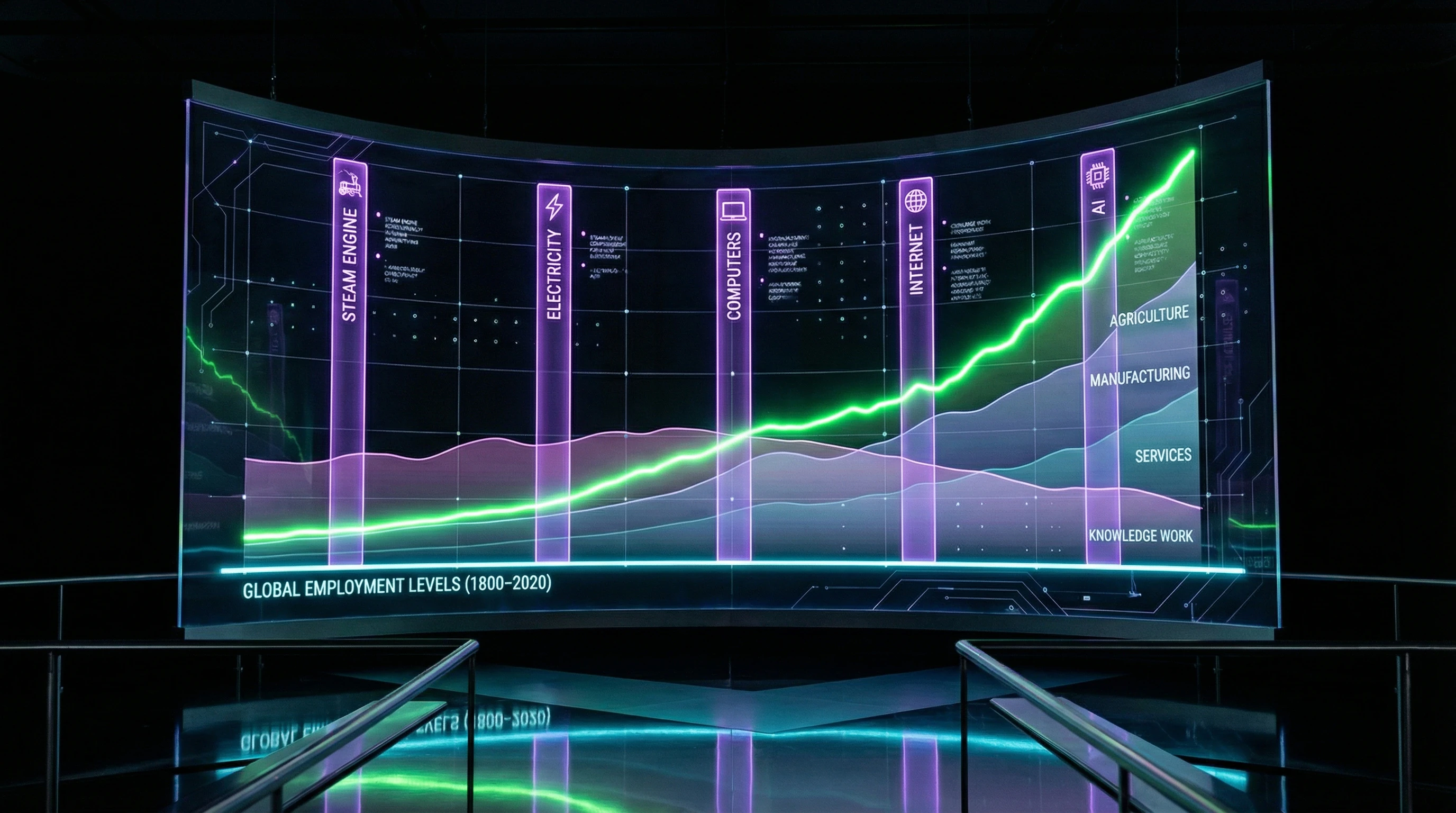
Aggregate data from developed countries reveal a consistent pattern: despite continuous technological progress, employment levels remained stable or grew over two centuries (S001).
- USA, 1800
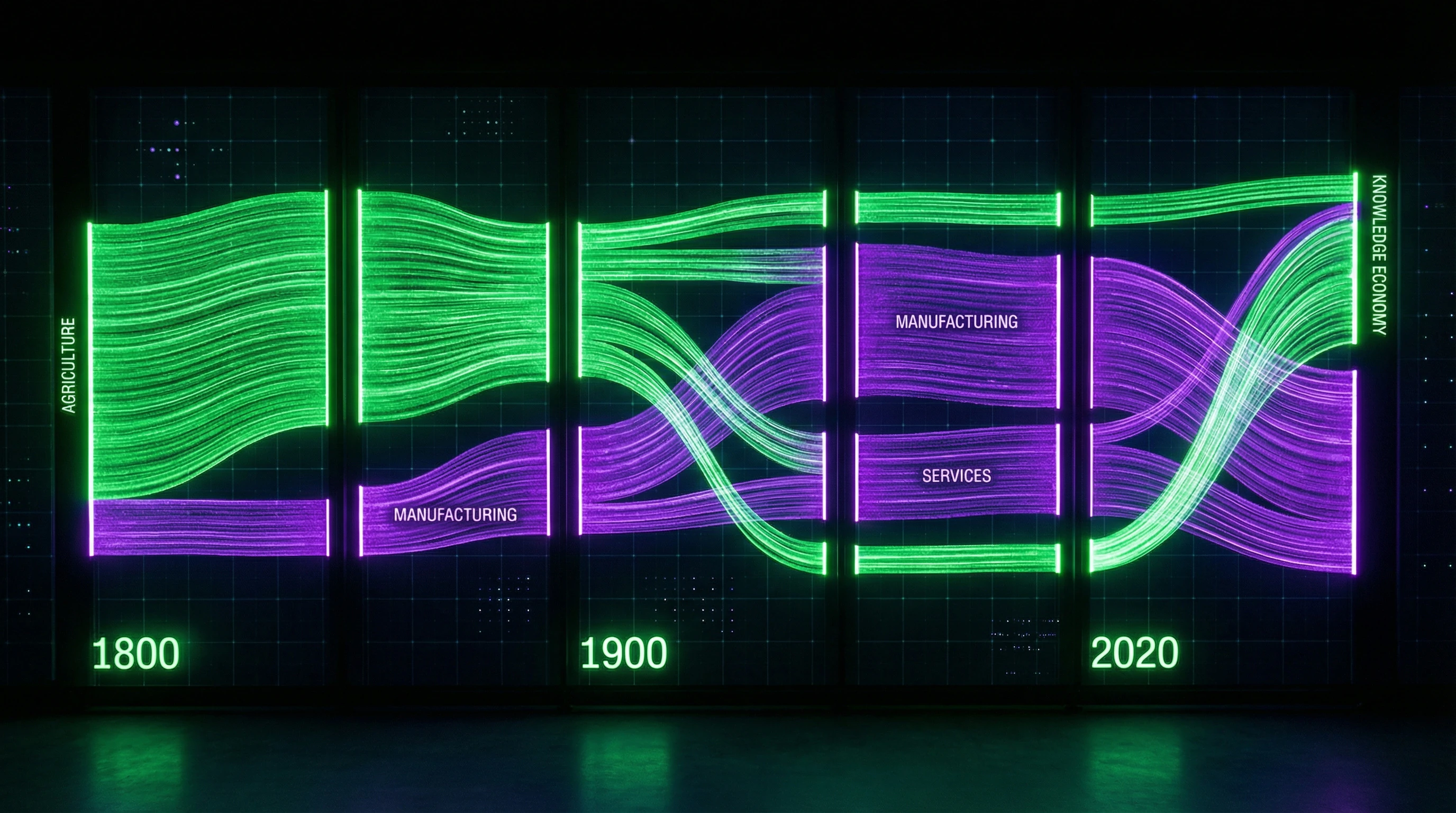
- ~90% of the population worked in agriculture
- USA, today
- <2% in agriculture, yet unemployment isn't 88%
- What happened
- Radical structural transformation: workers moved to manufacturing, then to services, then to the knowledge economy. Each wave of automation was accompanied not by reduction, but by restructuring of employment.
🧾 Contemporary AI Impact Research: Early Data 2020–2024
Early research on generative AI's impact on employment shows a mixed picture, but doesn't yet confirm catastrophic scenarios.
AI tools more often act as productivity amplifiers (augmentation) rather than complete substitutes. Programmers with access to GitHub Copilot write code 55% faster, but this hasn't led to hiring cuts—demand for developers continues to grow. Similar patterns appear in law, medicine, and design.
Critically important: we're at an early stage; long-term effects remain to be seen.
Adaptation Mechanisms: Why Economies Create New Jobs to Replace Automated Ones
Understanding the mechanisms through which technology creates new jobs is critical for assessing future risks. This isn't magic or economic optimism—these are specific, observable processes. Learn more in the Cognitive Biases section.
🔁 The Productivity Effect: Lower Costs and Rising Demand
When technology automates a task, it reduces production costs. Lower prices increase demand (when demand is elastic). Rising demand requires increased production, which creates demand for labor—even if each worker's productivity has increased (S005).
This mechanism worked in the textile industry, automobile manufacturing, and electronics. The critical parameter is demand elasticity: if demand is inelastic, the effect is weaker.
🧠 The Complementarity Effect: Technology Amplifies Human Skills
Many technologies don't completely replace workers but amplify their capabilities. An excavator allowed one worker to do the work of ten. Computers enabled analysts to process thousands of times more data. AI assistants allow programmers to focus on architecture and creative solutions instead of routine code.
This effect creates demand for workers who can effectively use new tools.
⚙️ The New Products and Services Effect: Creating Previously Impossible Markets
The automobile created not only the automotive industry but also gas station networks, roadside services, logistics, and tourism. The internet created e-commerce, social networks, streaming, and the gig economy. AI is already creating new professions: prompt engineers, AI ethics specialists, synthetic data creators.
Critically important: these new professions are often impossible to predict in advance—they emerge spontaneously in response to new possibilities.
🔎 The Labor Reallocation Effect: Freeing Resources for New Tasks
When technology automates a task, it frees human resources to solve other tasks that were previously unavailable due to resource constraints. If AI automates routine data analysis, analysts can focus on strategic planning.
This mechanism works at the level of individual companies and entire economies.
🧷 Limitations of Adaptation Mechanisms: When They May Fail
These mechanisms are neither automatic nor instantaneous. They require time, institutional support, and investments in education and retraining.
They may fail if the pace of change exceeds the system's ability to adapt, if institutions (education, labor markets, social protection) are inflexible or dysfunctional, if the benefits of automation are narrowly concentrated and not reinvested in the economy, or if barriers arise to creating new businesses and industries.
- The pace of change exceeds the system's ability to adapt
- Institutions (education, labor markets, social protection) are inflexible or dysfunctional
- Benefits from automation are narrowly concentrated and not reinvested in the economy
- Barriers arise to creating new businesses and industries
These limitations are real and require policy solutions. Adaptation mechanisms work, but not in a vacuum—they depend on the quality of institutions and society's speed of adaptation.
Cognitive Anatomy of the Fallacy: Why the Lump of Labor Fallacy Is So Psychologically Convincing
Smart, educated people fall for this error because it relies on deep cognitive mechanisms — not on logic, but on how our perception and memory are structured. More details in the Psychology of Belief section.
🧩 Availability Heuristic: Visible Losses vs Invisible Gains
Job losses are visible, concrete, emotionally charged: a closing factory, laid-off workers, suffering families. The creation of new jobs is distributed, gradual, often in other sectors and regions — it's less noticeable.
Our brain overestimates the probability of vivid, available examples (S002). This creates a systematic distortion: we see destruction, but we don't see creation.
🕳️ Static Thinking Error: The World as a Photograph vs the World as a Video
The Lump of Labor Fallacy is based on viewing the economy as a static system where all parameters are fixed. This is "photographic" thinking: the current state is extrapolated into the future without accounting for dynamic adaptation processes.
The real economy is a "video": a continuous process of change, adaptation, and emergence of new opportunities. Our brain struggles with dynamic systems and prefers static models, even when they're inaccurate.
🧠 Zero-Sum Effect: Evolutionary Legacy
In the evolutionary environment, most resources were indeed limited: if one person ate more food, another got less. This intuition is deeply rooted in our thinking.
But the modern economy is not a zero-sum game: technology and trade create new value, expanding the "pie." Our evolutionary intuition hasn't updated to understand growth economics.
🔁 Confirmation Bias: Selective Attention
If we already believe that automation is dangerous, we pay disproportionate attention to examples confirming this belief (factory closures, layoffs) and ignore contradictory examples (new company openings, employment growth in other sectors).
This creates a self-reinforcing cycle: belief shapes perception, perception reinforces belief.
⚙️ Narrative Appeal: Simple Stories Beat Mechanisms
"Robots will steal our jobs" — a simple, understandable, emotionally resonant story. "Automation will change the structure of employment through complex interactions of productivity effects, complementarity, and creation of new markets" — a complex, nuanced explanation.
- Our brain prefers simple narratives
- Media, politicians, and activists exploit this preference
- Simplified but erroneous stories spread faster
- Complex mechanisms require cognitive resources to understand
- Emotional resonance strengthens retention of the simple narrative
These five mechanisms work synergistically. Together they explain why the Lump of Labor Fallacy remains convincing despite two centuries of empirical refutation. This isn't an error of logic — it's an error of perception, built into the architecture of human thinking. Protection against it requires not just knowledge of facts, but awareness of one's own cognitive biases.
Verification Protocol: Seven Questions to Test Claims About Technological Unemployment
How do you distinguish legitimate concerns from manifestations of Lump of Labor Fallacy? Here's a practical checklist for critically evaluating claims about technology's impact on employment. Learn more in the Epistemology section.
✅ Question 1: Does the forecast account for productivity and demand effects?
Does the claim only consider direct worker displacement by technology, or does it account for how productivity gains can lower prices and increase demand?
If a forecast says "technology X will replace Y million workers" but doesn't analyze how this affects prices, demand, and new job creation, it's based on (S004) Lump of Labor Fallacy. Quality analysis must model dynamic effects, not just static displacement.
✅ Question 2: Does the analysis distinguish between task automation and occupation automation?
Does the claim discuss automation of specific tasks or entire occupations? This is a critical distinction.
Most occupations consist of multiple tasks, and automating some of them doesn't mean the occupation disappears—it often means the role transforms. If the analysis doesn't make this distinction and talks about "disappearing occupations" without detailed task analysis, it's a sign of superficial thinking.
✅ Question 3: Does it include historical data on previous automation waves?
Does the source cite examples from history—agricultural mechanization, assembly lines, office computerization?
If not, that's a red flag. Every wave of technology triggered similar fears, but the economy adapted through retraining, new industries, and shifts in employment structure. Absence of historical context indicates a lack of verification.
✅ Question 4: Does the analysis account for adaptation time and transition costs?
Does the claim distinguish between short-term disruptions and long-term effects?
Technology can displace workers in one industry within months, but creating new jobs takes years. This is a real problem, but not an argument against technology—it's an argument for social policies supporting the transition period.
If the analysis ignores transition costs or assumes instant adaptation, it oversimplifies reality.
✅ Question 5: Does the source consider alternative explanations for unemployment?
Could unemployment result not from technology, but from macroeconomic policy, trade agreements, demographic shifts, or structural changes in the economy?
If the claim automatically attributes all employment problems to technology, it ignores multiple causes. Proper analysis must separate effects and show what portion of unemployment is actually linked to automation.
✅ Question 6: Does it provide data on new occupations and industries being created?
Does the source cite examples of occupations that didn't exist 20–30 years ago and now provide millions of jobs?
- Examples:
- web development, social media management, data analytics, cybersecurity, UX/UI design.
- If they're absent:
- it's a sign the analysis doesn't account for labor market dynamics and assumes a static set of occupations.
✅ Question 7: Does the source propose concrete policy solutions or just catastrophism?
Does the claim distinguish between the problem (technology can displace workers) and the solution (retraining, social support, education investment)?
If the source only frightens but offers no concrete adaptation measures, it indicates an emotional rather than analytical approach. Serious analysis must include policy recommendations based on data.
Fear of technological unemployment is real as a psychological phenomenon and as a transition period problem. But as a long-term trend—it's Lump of Labor Fallacy disguised as modern anxiety.