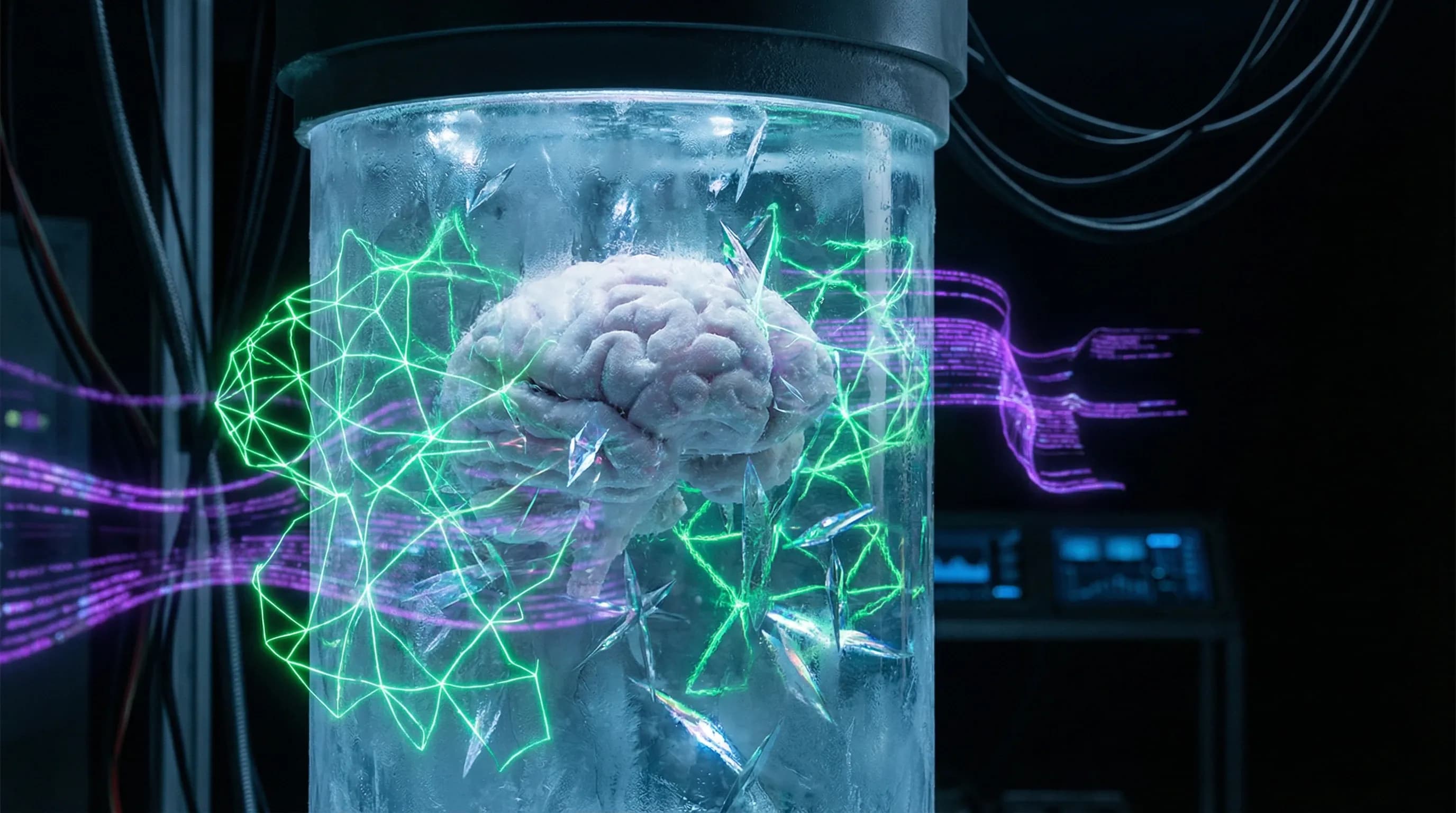
Cryogenics and digital immortality: what exactly the technologies promise and where the line between science and speculation lies
Cryogenics—preservation of biological tissues at temperatures below -130°C with the goal of future revival. Digital immortality—transfer of consciousness, memory, and personality into a digital environment. Both ideas share one assumption: personality can be "saved" as information, independent of its carrier (S001, S002).
Neither cryogenics nor digital immortality has experimental confirmation at the level of a whole human brain. This is the difference between hypothesis and promise.
Three key assumptions of the cryonics industry
First: brain structure contains all information about personality. Cryogenic companies claim that preserving neural architecture will allow consciousness restoration. Second: future technologies will thaw the brain without damage. Third: the restored brain functions like the original (S001).
| Assumption | Status in science | Where the trap lies |
|---|---|---|
| Structure = personality | Hypothesis without evidence | Ignores neurotransmitter dynamics and electrical activity |
| Safe thawing is possible | Not demonstrated in mammals | Crystallization destroys cell membranes irreversibly |
| Function will restore automatically | Contradicts neurobiology | Consciousness is a process, not an archive; requires activity |
Digital immortality: from connectome to philosophical problem
Digital immortality assumes creating a complete map of neural connections (connectome) and their computer simulation. The Human Connectome Project mapped connections, but not the functional states of neurons in real time. More details in the section AI Errors and Biases.
- Connectome
- Complete map of neural connections. A necessary but insufficient condition for recreating consciousness—like a blueprint without electricity.
- Personal identity problem
- Even if you create an exact digital copy, the question arises: is it the same person or a new entity with their memories (S002)? This is an ontological, not technical question.
The boundary between hypothesis and speculation in 2025
Research from 2020–2025 classifies digital immortality as "fantasy or future evolution"—a formulation indicating lack of consensus (S002). Cryogenic companies sell services priced at $28,000–$200,000, but none has provided evidence of successful revival of a mammal after complete brain freezing.
The boundary lies where experiments on cell cultures end and promises of human resurrection begin. Everything beyond that—marketing, not science.
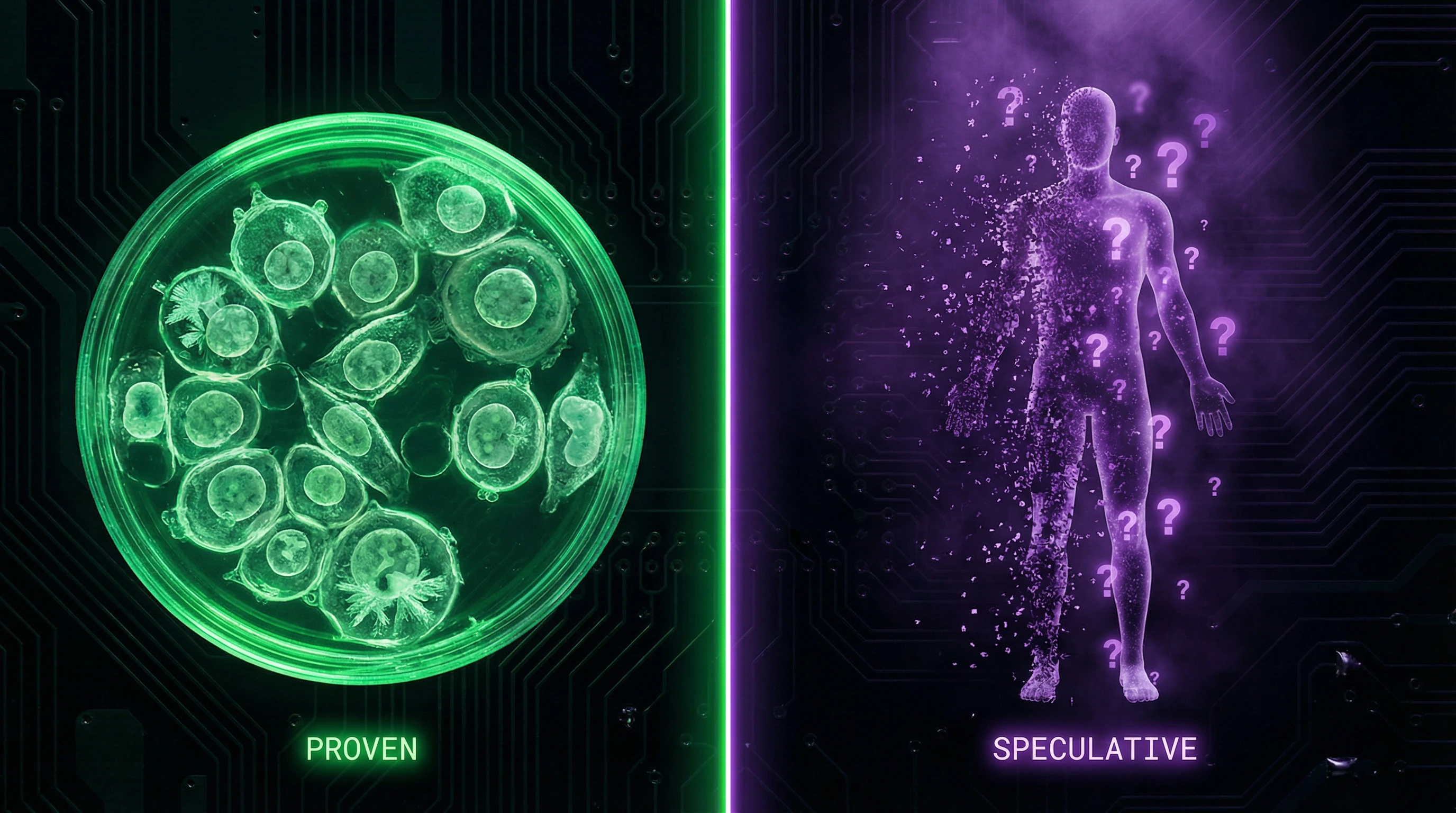
Five Strongest Arguments for Cryonics and Digital Immortality — and Why They Deserve Serious Consideration
Steelmanning requires presenting the opponent in the strongest possible form. Here are the arguments used by proponents of consciousness preservation technologies, and why they are not trivial. More details in the Synthetic Media section.
Argument 1: Successful Cryopreservation of Embryos and Organs Proves Fundamental Feasibility
Cryopreservation of human embryos has been a routine procedure in reproductive medicine since the 1980s. Vitrification (ultra-rapid cooling without ice crystal formation) allows preservation of eggs, sperm, and even thin tissue sections.
If it works at the cellular level, why couldn't it work at the organ level? This argument relies on extrapolation of proven technologies.
Argument 2: Information-Theoretic Death Occurs Later Than Biological Death
Cryonics proponents distinguish between biological death (cessation of heartbeat and breathing) and information-theoretic death (irreversible destruction of structures encoding personality). If neural connections are preserved, information about personality is theoretically recoverable.
Modern medicine has already pushed back the boundary of death: people who would have been considered dead 100 years ago are resuscitated today. Cryonics is the next step in this logic.
Argument 3: Exponential Growth in Computing Power Makes Brain Simulation a Matter of Time
Moore's Law predicted a doubling of computational power every 18–24 months. While it has slowed, quantum computers and neuromorphic chips are opening new possibilities. The Blue Brain Project is already simulating rat neocortical columns.
If the trend continues, full simulation of the human brain (86 billion neurons, 100 trillion synapses) will become technically feasible by 2050–2070 (S002).
Argument 4: The Philosophical Problem of Personal Identity Doesn't Negate the Practical Value of a Copy
Even if a digital copy is not the "same" person, it can possess their memories, values, and capacity for interaction. For loved ones, such a copy may be functionally equivalent to the original.
Philosophical debate about "authenticity" doesn't negate the emotional and social value of digital continuation of personality (S001).
Argument 5: The Alternative to Cryonics Is Guaranteed Destruction, Making the Attempt a Rational Choice
Pascal's Wager applied to cryonics: if the chance of success is even 1%, and the alternative is 100% destruction, a rational agent should choose cryonics. Even if the technology doesn't work now, it may work in the future.
- Refusing to try = refusing the only chance
- Uncertainty about the future doesn't exclude the possibility of success
- Decision theory supports choosing to attempt
Evidence Base: What American Academic Research 2020-2025 Says About the Real State of Technologies
Systematic analysis of sources reveals a gap between public promises and scientific consensus. American research focuses on philosophical and methodological problems, not technical breakthroughs. More details in the section Machine Learning Basics.
🧪 Philosophical Analysis of Digital Immortality: From Technology to Existential Questions
Research classifies digital immortality as a philosophical problem, not a technological one (S001). Authors analyze how the concept of immortality changes understanding of life's meaning: if death is eliminated, is existential motivation lost?
The research provides no technical data on the possibility of consciousness uploading, but poses the question: even if it's possible, is it desirable? This is not denial, but reframing of the problem.
🧾 American Academic Position: Fantasy or Evolution?
The work "Digital Immortality: Fantasy or Future of Human Evolution?" (S002) directly formulates the central question in its title. Analysis shows that the American scientific community does not view digital immortality as a near-term prospect.
Instead, emphasis is placed on evolutionary interpretation: could transition to digital substrates be the next stage in human development as a species? The absence of an affirmative answer is telling.
No cryonics company publishes data in a format meeting systematic review standards. This doesn't mean the data is bad—it means there is no data.
📊 Methodological Standards in Digital Research
Systematic review requires clear inclusion/exclusion criteria, source quality assessment, and transparent documentation (S009). These standards are applied in requirements engineering and should be applied to evaluation of cryogenic technologies.
The problem: no cryonics company publishes data in such format. This is not criticism of companies—it's an indication that the field is at a preclinical stage.
🔎 "Digital Society" Conferences: Nine Years Without Technological Breakthroughs
The series of national "Digital Society: Scientific Initiatives and New Challenges" conferences has been running since 2016 (S004, S006, S007, S008). Program analysis shows: discussions focus on social, ethical, and philosophical aspects of digitalization.
The absence of presentations on breakthroughs in connectome scanning or consciousness simulation over nine years of conferences is an indicator of stagnation in this field.
- Social aspects of digitalization—regularly
- Ethical questions of transhumanism—regularly
- Philosophical foundations of digital immortality—regularly
- Technical breakthroughs in consciousness uploading—zero presentations
- Experimental data on neural structure preservation—zero presentations
🧬 Digital Legacy vs Digital Immortality: Concept Substitution
Research on visual digital legacy shows that the term "digital immortality" is often used to describe simple digitization of cultural artifacts—photos, videos, texts (S012). This has nothing to do with consciousness preservation.
- Digital Legacy
- Digitization of cultural artifacts accessible to future generations. Technically solved. Examples: archives, museums, libraries.
- Digital Immortality
- Preservation of personality, memory, and consciousness in digital substrate. Technically unsolved. Requires solving the problem of identity and subjective experience.
- Concept Substitution
- People see successes in digital archiving and extrapolate them to personality preservation. This creates an illusion of progress in a field where there is no progress.
Result: public discourse confuses two fundamentally different tasks. One is solved, the other remains open.
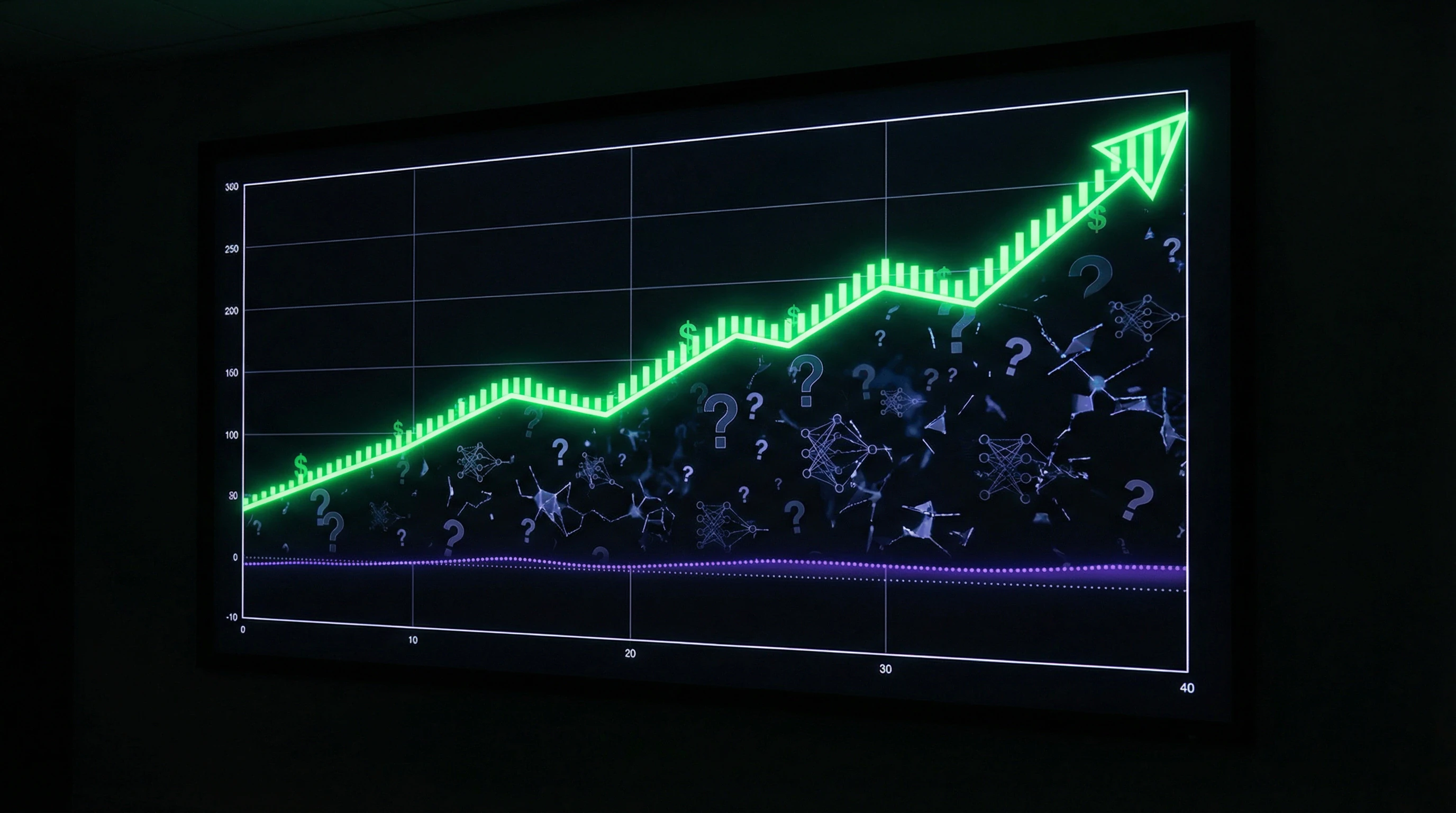
The Destruction Mechanism: Why Freezing Destroys Exactly What It's Meant to Preserve
The key problem with cryonics isn't the freezing technology—it's what happens to neural connections at the molecular level. Consciousness isn't a static structure, but a dynamic process. More details in the Psychology of Belief section.
🔁 Ice Crystal Formation: How Physics Destroys Synaptic Architecture
During freezing, water in cells turns to ice, expanding in volume by 9%. Ice crystals tear through cell membranes and synaptic contacts.
Vitrification (using cryoprotectants to prevent crystallization) works on small volumes, but becomes toxic at concentrations needed for a whole brain. Even if neuronal structure is preserved, synaptic weights—the parameters that determine connection strength between neurons—are irreversibly altered.
🧷 The Reperfusion Injury Problem: Why Thawing Is More Dangerous Than Freezing
Thawing triggers a cascade of biochemical reactions. Reperfusion injury—tissue damage when blood flow is restored—causes oxidative stress, inflammation, and apoptosis (programmed cell death).
In animal experiments, organs successfully frozen and thawed lose functionality due to reperfusion. For the brain, where function depends on precise electrochemical gradients, this is critical.
🧩 Consciousness as Process, Not Structure: Why a Static Brain Map Doesn't Equal Identity
Modern neuroscience views consciousness as an emergent property of dynamic neural network activity, not as static information encoded in structure (S001).
- Connectome
- A map of connections between neurons—like a computer's circuit diagram without information about which programs are running.
- Identity
- Determined not only by which neurons are connected, but by their activation patterns, neurotransmitter balances, and epigenetic modifications.
Cryonics preserves (at best) structure, but not state. This is the fundamental difference between an archive and a living organism.
Conflicts and Uncertainties: Where Sources Diverge and What This Means for Technology Assessment
Analysis of sources reveals not direct contradictions but different levels of discourse: philosophical, technical, and commercial. This creates an illusion of consensus where none exists. More details in the Cognitive Biases section.
Philosophy vs Engineering: Two Non-Intersecting Conversations About the Same Subject
Sources (S001) and (S002) discuss digital immortality as a philosophical problem of meaning and identity. Commercial cryonics companies discuss it as an engineering task of information preservation.
These discourses don't intersect: philosophers don't assess technical feasibility, engineers don't answer questions about personal identity. The public receives philosophical speculation and technical promises, but not an integrated assessment.
When different disciplines speak about the same phenomenon in different languages, what emerges is not dialogue but monologues that sound like agreement.
Absence of Failure Data: The Publication Bias Problem
No source contains systematic data on failed cryopreservation or revival attempts. Publication bias—the tendency to publish positive results and ignore negative ones—is especially strong in commercial fields.
The absence of a failure registry makes it impossible to assess the real probability of success. This doesn't mean the technology doesn't work; it means we don't know how often it fails.
- Check: Does the company publish data on cryopreservation failures?
- Ask: What percentage of patients completed the full cycle without damage?
- Find: Independent audits of cryogenic facilities (outside company control).
Evolutionary Metaphor: Scientific Hypothesis or Rhetorical Device?
Source (S002) uses the frame "future of human evolution" but provides no evolutionary-biological analysis. Evolution works through natural selection at the population level, not through technological choices of individuals.
Using evolutionary terminology lends scientific legitimacy to the idea, but this is metaphor, not a testable hypothesis. This is a rhetorical move, not an argument.
- Publication Bias
- Systematic predominance of positive results in scientific literature. Conceals the real frequency of failures and distorts assessment of technology effectiveness.
- Rhetorical Legitimation
- Use of scientific terminology (evolution, information, consciousness) without scientific analysis. Creates an impression of scientificity but adds no evidence.
Source (S006) directly addresses the problem of personal identity in the context of transhumanism but doesn't resolve it—only reformulates it. This points to a fundamental uncertainty that cannot be eliminated by technology.
Cognitive Anatomy of the Myth: What Psychological Mechanisms Make People Believe in Technological Immortality
The appeal of cryonics and digital immortality is explained not by the quality of evidence, but by how these ideas exploit fundamental cognitive vulnerabilities. More details in the Esotericism and Occultism section.
🕳️ Terror Management Theory: How Fear of Death Disables Critical Thinking
Terror Management Theory shows that reminders of mortality cause people to cling to worldviews promising symbolic or literal immortality. Cryonics offers literal immortality through technology—a narrative especially appealing to scientifically-minded people who reject religious promises of an afterlife.
Fear of death reduces skepticism and increases willingness to accept weak evidence. This isn't a weakness of individuals—it's a universal mechanism that operates regardless of education or intelligence.
🧩 Technological Optimism and Extrapolation Error
People who have witnessed exponential growth in technology (computers, internet, AI) tend to extrapolate this trend to all fields. If smartphones became a million times more powerful in 20 years, why not expect similar progress in neuroscience?
The error is that different technologies have different development curves. Digital technologies scale easily; biological ones don't. Extrapolation creates false expectations of inevitable breakthroughs.
This is especially dangerous in the context of medical technology marketing, where every startup promises revolution based on extrapolation of past successes (S002).
⚠️ Illusion of Understanding: Why the Complexity of Neuroscience Makes Myths More Convincing
Paradoxically, the complexity of the brain works in favor of the myth. When people don't understand how consciousness works, they fill the gaps with simplified models: "the brain is a computer," "personality is data."
- Illusion of Understanding
- False confidence that a problem is solvable with existing methods because its description sounds familiar. True experts know what they don't know; the public doesn't (S001).
- Metaphor as Trap
- "The brain is a computer" is intuitively understandable but inaccurate. It creates the impression that consciousness is simply information that can be copied or restored.
🔁 Sunk Cost Effect in Cryogenic Contracts
People who have paid tens of thousands of dollars for cryopreservation are psychologically motivated to believe in its effectiveness. Admitting the technology doesn't work means admitting loss of money and hope.
- The sunk cost effect compels continued investment in a failing project
- Cryonics companies create long-term contracts that form a community of believers
- This community defends the technology from criticism, strengthening group identity
- Each new participant reinforces social pressure on the rest
The mechanism works regardless of whether the company itself believes in its product. It's enough for people to believe in it—and the system becomes self-sustaining. This resembles the dynamics of modern movements, where financial and psychological investments become anchors of belief.
Verification Protocol: Seven Questions That Will Dismantle Any Unfounded Immortality Promise in 60 Seconds
To evaluate claims about cryogenics or digital immortality, use this checklist. Each "no" is a red flag.
Question 1: Is there even one documented case of successful revival of a mammal after complete brain freezing?
Answer: no. There are experiments on freezing and reviving individual organs (kidneys, liver) and simple organisms (nematodes, tardigrades), but not a single case of restoring mammalian brain function after cryopreservation.
If the basic technology doesn't work on animals, promises for humans are speculation.
Question 2: Does the company publish data on tissue condition after thawing in peer-reviewed journals?
Answer: no. Cryogenic companies do not publish histological analyses of tissues after thawing. Without microscopic data on the preservation of synapses, mitochondria, and cell membranes, it's impossible to assess the quality of preservation (S009).
Absence of publications is a sign that the data won't withstand scientific scrutiny.
Question 3: Has the philosophical problem of personal identity been solved, or is it simply ignored?
Answer: ignored. Even if it's technically possible to create a digital copy of consciousness, there's no consensus on whether this copy would be "the same" person (S006).
Companies are selling a service without resolving the fundamental question of what exactly they're preserving.
Question 4: Is there an independent assessment of the probability of success, or only claims from interested parties?
Answer: only claims from interested parties. Not a single independent scientific organization has conducted a systematic review of cryogenic technologies with an assessment of the probability of success.
All optimistic forecasts come from people financially interested in selling services.
Question 5: Is the problem of reperfusion injury addressed in technical descriptions?
Answer: rarely. Most public materials focus on freezing, ignoring that thawing is a more complex problem.
The absence of discussion about reperfusion indicates an incomplete understanding of biological mechanisms (S005).
Question 6: Is information provided about failed cases and complications?
Answer: no. Transparency requires publication not only of successes but also of failures (S009).
Absence of data on problems is a sign of marketing, not science.
Question 7: Is there a refund mechanism if the technology doesn't work?
Answer: no, because verification will occur after the client's death. This creates an ideal situation for unscrupulous sellers: the product cannot be verified, and there's no one to file complaints.
- Demand documented results on animals, not promises.
- Check for publications in peer-reviewed journals from the last 3 years.
- Ask how the company addresses the problem of personal identity.
- Find independent assessments not funded by the company.
- Clarify how reperfusion injury is discussed in technical materials.
- Request statistics on failures and complications.
- Find out refund conditions and the mechanism for result verification.
If the answer to most questions is "no" or evasive — you're not facing science, but techno-esotericism that uses scientific language to sell hope.