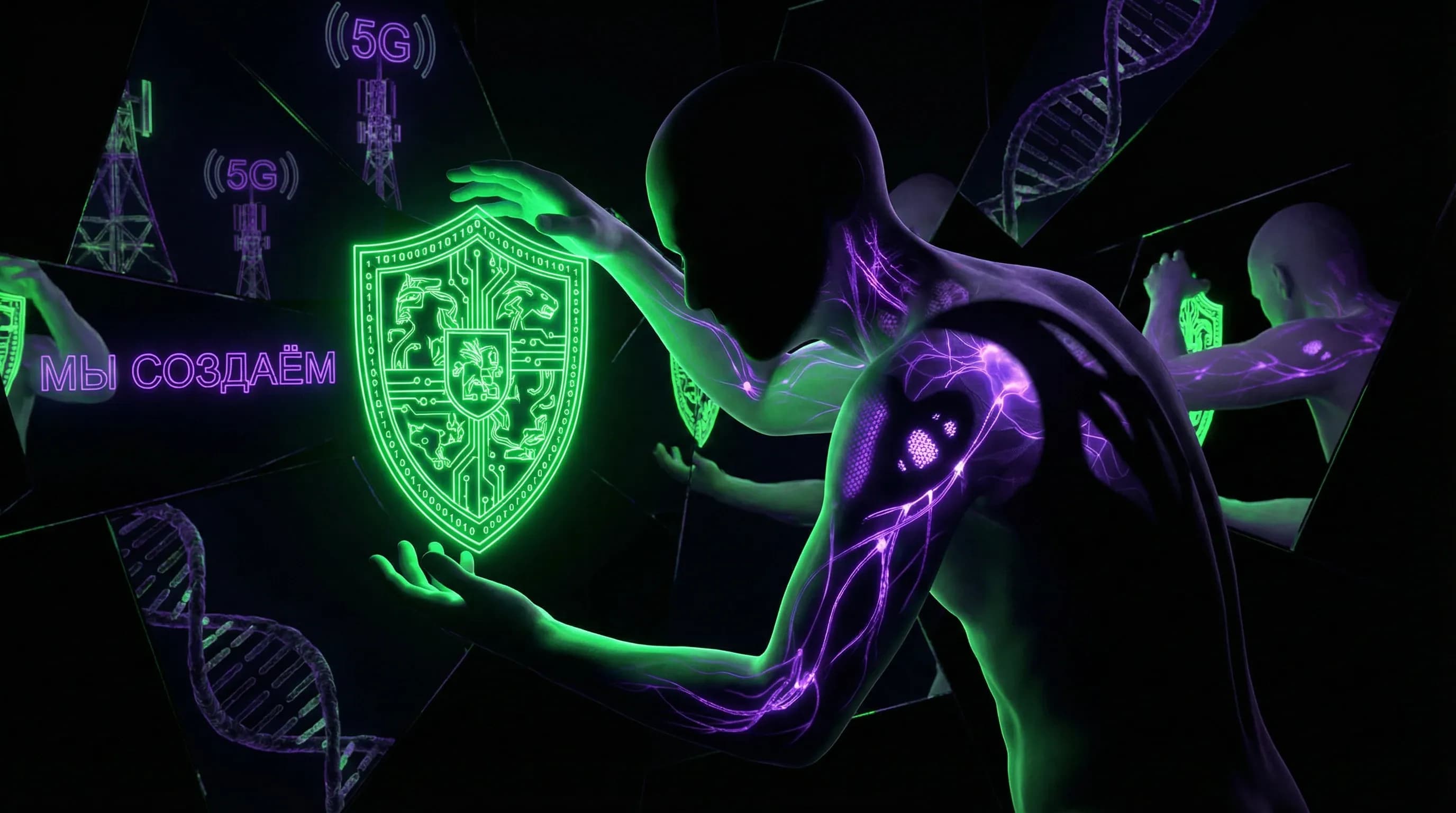
Prognostic Heraldry: When Symbol Becomes Destiny, Not Decoration
When a medieval family commissioned a coat of arms, they weren't simply choosing a pretty picture for their seal. They were creating a prognostic instrument — a visual code that would determine the behavior, strategies, and self-identification of descendants for centuries to come. More details in the Deepfakes section.
Zagoruiko and Aliev formulate it this way: "First we create the coat of arms, then the coat of arms creates us" (S003). This isn't poetic metaphor, but a description of the actual mechanism of cultural programming.
⚠️ Why We Think Symbols Are Passive — And Where This Intuition Goes Wrong
Ordinary consciousness perceives symbols as reflections of reality: first there's a family with certain qualities, then these qualities are encoded in a coat of arms. Heraldic practice shows the opposite.
A coat of arms depicting a lion didn't reflect existing bravery — it prescribed it. Descendants, seeing the lion on the family shield, absorbed a behavioral script: "We are those who don't retreat." The symbol functioned as a self-fulfilling prophecy.
🔬 Three Levels at Which a Coat of Arms Shapes the Bearer's Reality
- Identificational
- The coat of arms answers the question "who are we?" before the family itself has time to realize it. Visual code precedes self-awareness.
- Normative
- Symbolism dictates which actions correspond to status and which compromise it. The coat of arms becomes a behavioral regulator.
- Transgenerational
- The coat of arms transmits behavioral patterns across generations, bypassing the need for verbal explanation. A child raised in a house where a shield depicting a tower hangs on the wall absorbs the value of protection and stability at a preverbal level (S003).
🧠 Neurocognitive Mechanics: How Visual Code Bypasses Rational Critique
Symbols are effective precisely because they're processed faster and deeper than text. Visual information enters the brain through parallel channels, bypassing slow verbal centers (S001).
A coat of arms doesn't persuade — it imprints. This explains why heraldic traditions proved so resilient: they exploit the architecture of human perception, where image is stronger than argument.
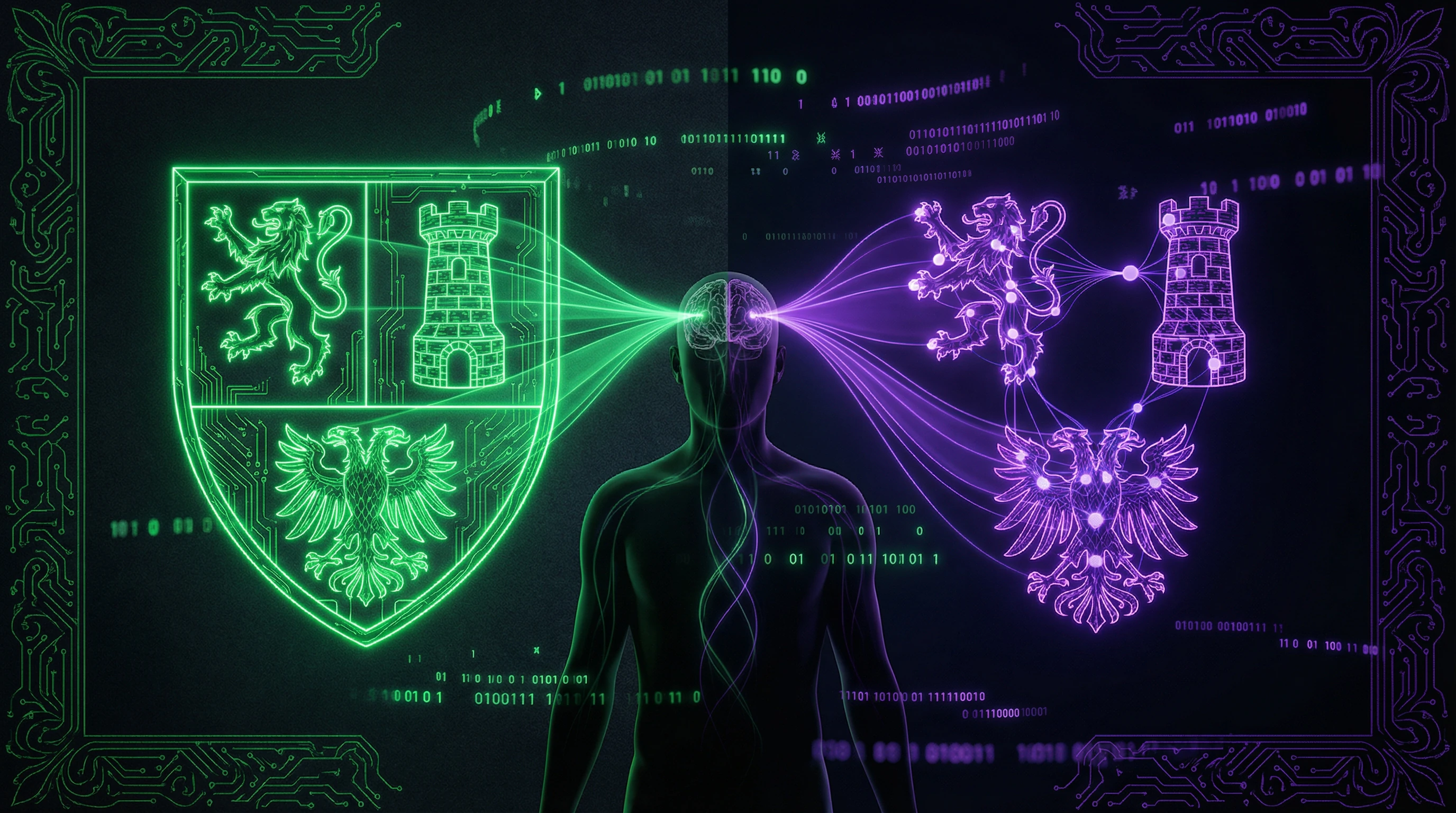
Students as Knowledge Producers: Dismantling the Myth of Passive Learning
Traditional pedagogy is built on a transmission model: the teacher possesses knowledge, the student receives it. Volkov poses a radical question: can students be producers of new scientific knowledge? (S002) The answer is affirmative, provided the research environment is properly organized.
This is not merely pedagogical innovation, but a reconceptualization of the very nature of cognition.
⚠️ The Myth of Required "Maturity" for Scientific Creativity
A widespread belief: genuine science requires years of preparation, accumulated experience, access to specialized equipment. School students can at best reproduce known experiments, but not create new knowledge. More details in the section AI Ethics and Safety.
Volkov demonstrates that this belief is an artifact of the industrial education model, where schools prepared executors, not researchers (S002).
🔬 Rural School Case Study: How Limitations Become Advantages
Paradoxically, rural schools lacking access to university laboratories prove to be productive environments for research work. Resource constraints force the search for unconventional solutions, while proximity to natural objects provides material for biological, ecological, and ethnographic investigations.
| Research Type | Examples of Local Discoveries | Enabling Condition |
|---|---|---|
| Biological | Description of previously undocumented plant species | Access to natural objects |
| Ethological | Identification of patterns in animal behavior | Systematic observation |
| Historical | Event reconstruction from local sources | Knowledge of local context |
Volkov documents precisely such cases (S002).
🧬 Knowledge Production Mechanism: From Observation to Generalization
The key condition is transitioning from completing assignments to posing one's own questions. When a student asks "why does this species occur more frequently in our forest than indicated in the textbook?", they are already in a research position.
- Systematic observation of the phenomenon
- Data recording in standardized form
- Formulation of a hypothesis explaining the deviation
- Hypothesis testing through additional observations
- Generalization of results
This is a complete cycle of scientific work, and the researcher's age is not critical here (S002).
📊 Empirical Data: How Many School Projects Contain Elements of Novelty
Amrakhova analyzes a corpus of individual projects and concludes: a significant portion of works contain elements that can be qualified as new knowledge—albeit local, but methodologically sound (S004).
These are not necessarily breakthroughs of global significance, but they are genuine science: reproducible, verifiable, expanding understanding of specific phenomena.
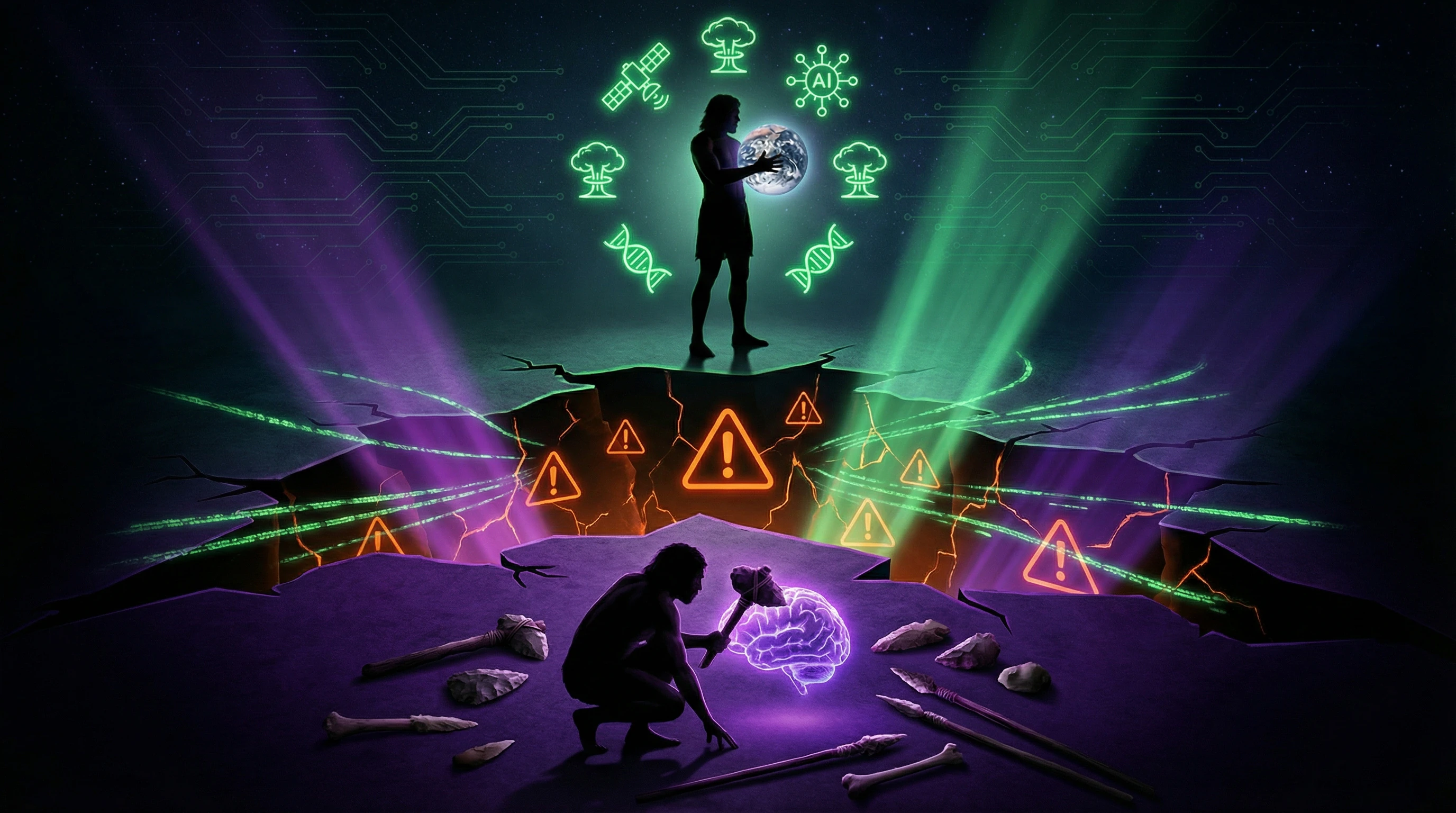
Noospheric Thinking: Do We Possess Consciousness Commensurate with Our Technological Power
Vernadsky introduced the concept of the noosphere — the sphere of reason, where human activity becomes the primary geological force. More details in the section Artificial Intelligence Ethics.
The diagnosis is straightforward: technologically we're in the noosphere, cognitively — still in the Paleolithic (S005).
⚠️ The Gap Between Capability and Responsibility: Why We Don't Feel the Scale
The human brain evolved to solve problems at tribal scale: a few dozen individuals, territory within a day's walk, time horizons within a lifetime.
Modern technologies operate across billions of people, planetary systems, centuries of consequences. Our cognitive apparatus hasn't kept pace with our tools.
We know about global warming, but don't feel it the way we would feel the threat of a predator (S005).
🔬 Empirical Indicators of Absent Noospheric Consciousness
Three patterns are systematically documented in surveys and behavioral research:
- Temporal myopia — decisions are made based on short-term gains, long-term risks are ignored.
- Externalization of responsibility — environmental problems are perceived as tasks for "government" or "scientists," but not personal.
- Fragmentation of perception — inability to see connections between local actions and global consequences (S005).
🧠 Can Noospheric Thinking Be Developed — Or Is This an Evolutionary Dead End
Two scenarios compete. The optimistic: thinking is plastic, and with the right educational environment we can develop capacity for systemic, long-term, planetary thinking.
The pessimistic: cognitive limitations are fundamental, and the only way out is to delegate management of complex systems to artificial intelligence, which isn't burdened by evolutionary biases.
| Scenario | Mechanism | Risk |
|---|---|---|
| Educational | Reformatting cognitive habits through systemic training | Requires massive transformation, outcomes uncertain |
| Technological | Transfer of control to AI systems | Loss of human control, new dependencies |
The current trajectory leads to catastrophe if the gap isn't bridged (S005). The question isn't whether we can — it's whether we'll do it in time.
"We're Creating a New Industry": The Literalness of Metaphor in American Engineering
When American developers say "we're creating an American 5G solution" or "we're creating a new industry," this isn't corporate PR. It's a precise description of a process in which technological development is inseparable from forming the institutional, educational, and cultural infrastructure around it. More details in the section Psychology of Belief.
Creating technology is creating an industry — simultaneously. This inverts classical logic: demand doesn't create supply, but supply constructs demand, forming in consumers an understanding that they need such technology.
🧪 Case Study: 5G — From Standard to Ecosystem
Developing domestic 5G isn't just writing code or assembling equipment. It's creating a chain: from training engineers in universities to forming regulatory frameworks, from manufacturing components to building relationships with carriers.
Each element of this chain either didn't exist before the project began or was oriented toward foreign standards. "We're creating" means: we're constructing the entire system from scratch (S006).
🔬 "Smart Optical Transport": Product Shapes Market
A similar process occurs in telecommunications. The key point: there's no market for this product yet. It will emerge after the technology is created and demonstrates its capabilities.
Supply creates demand, not the other way around. The consumer learns about their need only when they see the solution.
⚙️ Machine Tool Industry: Resurrection Through Design
"We're creating a new industry" — a statement from the machine tool sector (S007). After the deindustrialization of the 1990s, the industry practically disappeared.
Recreation isn't restoring the old, but designing the new: accounting for digitalization, additive technologies, AI integration. The old industry died, the new one hasn't been born yet. "Creation" here is literally an act of creation from the void.
🧬 Common Pattern: Technology as Cultural Code
In all three cases, technology functions as a coat of arms: it doesn't just solve a technical problem, but programs the future.
- By creating 5G, engineers create an image of America as a technologically sovereign power
- By creating optical transport, they form ideas about what modern infrastructure should be
- By creating machine tools, they restore industrial identity
Technology is a symbol that then creates reality (S006) (S007). The engineer here isn't just solving a problem. They're constructing a future in which this problem has meaning.
Do We Change When We Think We've Changed: The Illusion of Transformation
Life-altering events—losing a loved one, changing careers, relocating—create a sense of radical transformation. But research shows: the subjective feeling of change often doesn't correlate with objective measures of personality traits (S011).
We feel different, but we behave the same.
⚠️ Narrative Illusion: How the Brain Constructs a Story of Change
Human consciousness is a story-making machine. After a significant event, we revise our biography, constructing a "before" and "after" narrative. More details in the Epistemology section.
This narrative creates a sense of transformation, even when behavioral patterns remain unchanged. The brain tells us we've changed, and we believe that story, ignoring contradictory evidence (S011).
🔬 Research Methodology: How to Measure Real Change
Researchers used a combination of methods: self-reports about life-altering events, standardized personality questionnaires (Big Five) before and after the event, behavioral assessments from close contacts.
- Participant self-reports about life-altering events
- Personality questionnaires (Big Five) before and after
- Behavioral assessments from close contacts
- Analysis of correlation between subjective and objective measures
Result: people who claimed they had "become completely different" demonstrated stability across most personality traits (S011).
🧠 Why Stability Masquerades as Change: The Adaptive Function of Illusion
The illusion of transformation may be adaptive: it helps integrate traumatic experience, creating a sense of control and meaning. "I've changed" means "I've coped, I've grown, the event didn't break me."
| Function of Illusion | Adaptive Effect | Risk |
|---|---|---|
| Psychological Defense | Allows continued functioning | Prevents seeing real patterns |
| Narrative Integration | Gives meaning to trauma | Blocks necessary changes |
| Agency Restoration | Returns sense of control | Creates false complacency |
📊 Exceptions: When Change Is Real
The research identified conditions under which transformation actually occurs: prolonged immersion in radically new environments (emigration, monastery, prison), systematic psychotherapy focused on specific patterns, neuroplastic interventions (meditation, controlled psychedelic therapy).
- Prolonged Environmental Change
- Emigration, monastery, prison—radical alteration of social stimuli and role expectations. Subjective feeling correlates with objective measures (S011).
- Systematic Psychotherapy
- Focus on specific behavioral patterns, not narrative. Requires repetition and reinforcement of new responses.
- Neuroplastic Interventions
- Meditation, controlled psychedelic therapy—alter the architecture of neural networks, not just the story about oneself.
In these cases, the subjective sense of change correlated with objective measures (S011).
The Future Is Not Where We're Going, But What We're Building: The Philosophy of Active Construction
The future doesn't exist as a predetermined reality. It's constructed by our actions, decisions, symbols, technologies (S001). This isn't abstract philosophy—it's an operational principle for engineers, educators, policymakers.
🧩 Determinism vs. Constructivism
The deterministic model assumes the future is determined by objective laws—economic, technological, demographic. Our role is reduced to predicting trends and adapting. More details in the section Folk Medicine vs Evidence-Based Medicine.
The constructivist model argues the opposite: the future is the result of collective creativity. Trends exist, but they're not inevitable; they can be amplified, weakened, redirected.
The choice of model determines strategy: in the first case we're passive, in the second—active.
🔬 Empirical Examples of Construction
The creation of 5G wasn't a response to existing demand—it was the formation of a new technological paradigm (S006). School research doesn't reproduce the known; it expands the boundaries of knowledge (S002).
A coat of arms doesn't reflect identity—it programs it (S003). In all cases, agents don't adapt to the future—they create it.
- Technology shapes demand, not the other way around
- Knowledge expands through action, not observation
- Symbols program behavior and identity
- Agents are constructors, not adapters
🧠 Cognitive Barriers to Constructivism
Determinism is intuitively more appealing. Illusion of control creates a sense of understanding, even when predictions are wrong.
Removal of responsibility—if the future is predetermined, we're not to blame for negative outcomes. Cognitive economy—construction requires effort, adaptation only reaction. Constructivism is cognitively more expensive, so the brain resists it (S001).
| Model | Cognitive Load | Responsibility | Result |
|---|---|---|---|
| Determinism | Low (prediction) | Diffused | Adaptation |
| Constructivism | High (design) | Full | Creativity |
⚙️ Practical Protocol for Constructing the Future
The first step is abandoning forecasting in favor of scenario planning: not "what will happen," but "what do we want and how do we achieve it."
- Scenario Planning
- Describing the desired state and paths to achieve it, rather than predicting the inevitable.
- Prototyping the Future
- Creating technologies, institutions, practices that embody the desired state right now.
- Iterative Adjustment
- The future is created not by a single act, but by a series of experiments with feedback—startup methodology at civilizational scale (S001).
This isn't utopianism. It's a methodology that works in engineering, business, science. The only question is whether we apply it consciously or allow others to construct the future for us.
Verification Protocol: Seven Questions That Separate Construction from Illusion
Not every claim of "we're building the future" corresponds to reality. Often it's rhetoric masking passivity or imitation.
Construction is not intention or rhetoric. It's material trace, feedback, and altered infrastructure.
✅ Question 1: Does a concrete artifact exist that wasn't there before the project began?
Construction is material. If the result is only documents, presentations, statements, but no working prototype, technology, or institution—this isn't creation, it's planning.
Test: can you touch, use, or measure what was created? (S006) (S007)
✅ Question 2: Has the infrastructure around the artifact changed?
Real industry creation changes the ecosystem: new specializations appear in universities, standards emerge, suppliers and consumers arise.
If the artifact exists in isolation, without an ecosystem—it's an experiment, not an industry. Test: how many adjacent agents changed their behavior because of the project? (S007)
✅ Question 3: Is there user feedback that corrects development?
Construction is iterative. If the project develops according to plan, ignoring objections and failures—this isn't construction, it's script execution.
Test: which decisions were reconsidered thanks to criticism or user rejection?
✅ Question 4: Who pays for the artifact and why?
If funding comes only from creators or government, while consumers aren't willing to pay—the artifact doesn't solve a real problem.
Test: is there a market ready to pay for the result regardless of the project's ideology?
✅ Question 5: Can the artifact exist without its creators?
If the project collapses when the founder leaves—this isn't industry construction, it's a personal project. Real creation transfers knowledge, standards, and motivation to other agents.
Test: are other people ready to continue the work if you leave?
✅ Question 6: Are there competitive alternatives?
If there are no competitors—either you've created a monopoly (rare), or the market hasn't recognized the artifact as needed. Competition is a sign that the problem is real.
Test: who else is solving this task and why do people choose you?
✅ Question 7: What side effects has the artifact created?
Real construction changes the world unpredictably. If there are no side effects—either the artifact is too weak, or you're not seeing them.
Test: what new problems emerged thanks to your creation? How are you responding to them?
If you answered all seven questions honestly and most answers are concrete—you're constructing. If answers are vague or absent—you're telling a story about construction.
This verification works for startups, scientific projects, medical innovations, AI systems, and even new social movements. A symbol becomes reality only when it's material, ecosystemic, and independent of belief in it.