
What AGI by 2030 Means: Unpacking the Claim That Shook the Tech Community and Why This Isn't the First Prediction of Its Kind
Before analyzing the validity of predictions about achieving AGI by 2030, we must clearly define the boundaries of the phenomenon under discussion. The term AGI (Artificial General Intelligence) describes a hypothetical artificial intelligence system capable of performing any intellectual task at or beyond human level—unlike narrow AI, which solves specific tasks like image recognition or chess. More details in the AI and Technology section.
🔎 Defining AGI: Where the Line Between Narrow AI and General Intelligence Lies
The academic community lacks consensus on AGI criteria. Some researchers define it through cross-domain knowledge transfer (transfer learning), others through self-awareness and contextual understanding, still others through economic criteria (ability to replace humans in most professions).
This conceptual ambiguity creates the first problem: when we say "AGI by 2030," we're talking about different things depending on the definition used.
⚠️ History of Failed Predictions: From "AI in 20 Years" in the 1960s to Modern Claims
Predictions about imminent AGI achievement have a rich history of failures. In 1958, Herbert Simon predicted machines would surpass humans at chess within 10 years (it happened in 1997—39 years later). At the 1956 Dartmouth Conference, the field's founders believed creating thinking machines was a matter of one or two decades.
Each "AI winter" (periods of disillusionment and funding cuts in the 1970s and 1980s) followed waves of excessive optimism. Philosophical research shows the boundary between science fiction and philosophical examination of technology is often blurred: what seemed speculation yesterday becomes serious academic analysis today (S002).
- Pattern of Failed Predictions
- Extrapolating current trends without accounting for fundamental barriers; conflating progress in narrow tasks with approaching general intelligence; economic motivation to inflate expectations to attract investment.
🧩 Why the 2030 Prediction Differs from Previous Ones: New Factors and Old Patterns
The current wave of AGI optimism rests on three new factors: exponential growth in computational power (Moore's Law, though slowing), breakthroughs in neural network architectures (transformers, large language models), and massive investment (hundreds of billions of dollars from tech giants).
Yet the pattern remains unchanged: each optimism cycle reproduces previous errors, substituting engineering progress for the philosophical question of intelligence's nature. This creates an environment where myths about conscious AI spread faster than data about systems' actual limitations.
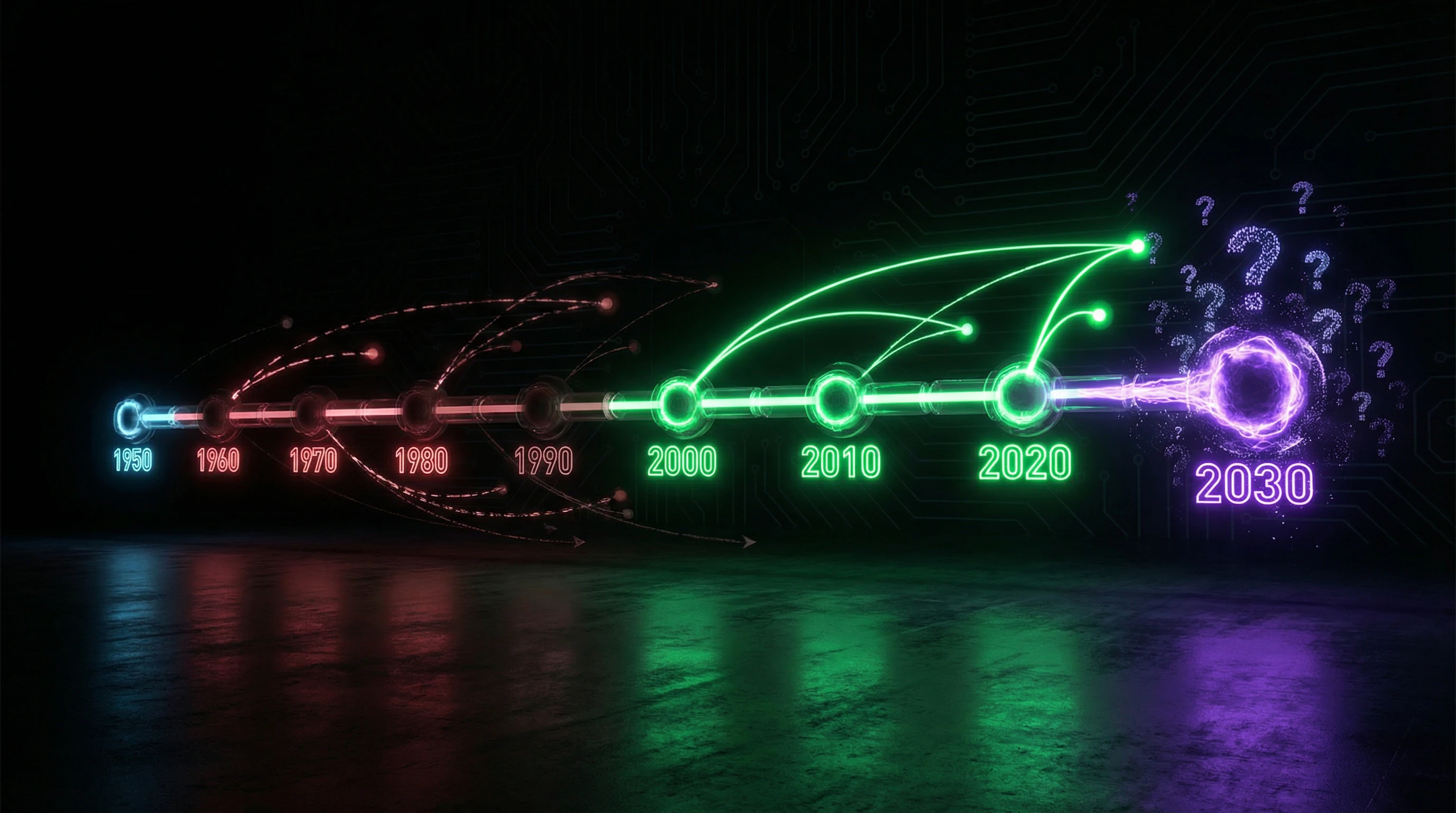
The Steel Man Argument: Seven Most Compelling Cases for AGI by 2030 and Why They Can't Be Ignored
Intellectual honesty requires examining the strongest version of an opposing position—the "steel man" principle, opposite of a strawman. Instead of attacking weak versions of AGI-2030 proponents' arguments, let's analyze their most well-founded cases. More details in the Machine Learning Basics section.
🧪 Argument 1: Exponential Performance Growth with Model Scaling
Recent years demonstrate that increasing model size (number of parameters) and training data volume leads to predictable performance improvements across a wide range of tasks—a phenomenon known as "scaling laws." GPT-3 (175 billion parameters, 2020) showed a qualitative leap compared to GPT-2 (1.5 billion parameters, 2019), while GPT-4 (estimated trillion parameters, 2023) demonstrated reasoning capabilities previously considered unattainable for language models.
If this trend continues and computational resources keep growing (enabled by investments in specialized chips and data centers), extrapolation suggests achieving human-like performance in the foreseeable future.
🧬 Argument 2: Technology Convergence—Multimodality and Embodied Intelligence
Modern AI systems are overcoming single-domain limitations: models like GPT-4V, Gemini, and Claude 3 process text, images, audio, and video in unified architectures. In parallel, AI-controlled robotic systems are developing (Boston Dynamics, Tesla Optimus, Figure AI), providing "embodied intelligence"—the ability to interact with the physical world.
Embodied cognition theory suggests that true intelligence is impossible without physical interaction with the environment. The convergence of language models, computer vision, and robotics could create a qualitatively new level of intelligent systems by decade's end.
📊 Argument 3: Economic Inevitability—Trillions in Investment Create a Self-Fulfilling Prophecy
Global AI investments exceeded $200 billion in 2023, with a significant portion directed toward AGI research (OpenAI, DeepMind, Anthropic). Microsoft invested $13 billion in OpenAI, Google poured billions into DeepMind, and startups like Anthropic attracted multi-billion dollar funding.
| Factor | Effect |
|---|---|
| Resource Concentration | World's best researchers working on one problem with unprecedented funding |
| Historical Precedents | Manhattan Project, space race—such concentration has led to breakthroughs |
| Economic Logic | With such investments, breakthrough becomes a matter of time, not possibility |
🔁 Argument 4: Recursive Self-Improvement—AI as a Tool for Creating Better AI
Modern language models are already used for writing code, optimizing algorithms, and designing neural network architectures (AutoML, neural architecture search). If AI systems reach a level where they can effectively improve their own algorithms, a positive feedback loop emerges: each AI generation creates a more advanced next generation faster than the previous one.
This "intelligence explosion" scenario, described by I.J. Good in 1965, could radically shorten the timeline to AGI. Some researchers argue we're already seeing early signs of this process in using GPT-4 to train more efficient models.
🧠 Argument 5: Neuroscientific Insights—Reverse Engineering the Human Brain
Progress in neuroscience provides new data on human intelligence mechanisms. Connectome mapping projects, research on attention and memory mechanisms, understanding the role of predictive coding in perception—all inform AI architecture development.
- Transformers
- Underlie modern language models, partially inspired by attention mechanisms in the human brain
- Decoding Brain Principles
- As understanding of biological intelligence deepens, engineers gain new principles for designing artificial systems
- AGI Acceleration
- If key brain operating principles are decoded in coming years, this could accelerate AGI creation
✅ Argument 6: Emergent Abilities—Qualitative Leaps from Quantitative Growth
Research shows that upon reaching certain scale, models demonstrate "emergent abilities"—skills that weren't explicitly programmed and weren't observed in smaller models. Capabilities for arithmetic, analogical reasoning, understanding sarcasm appear suddenly when exceeding certain parameter thresholds.
If this pattern continues, it's possible that upon reaching critical mass of computation and data, a system will spontaneously manifest general intelligence—similar to how consciousness emerges from the interaction of billions of neurons in the human brain.
🔬 Argument 7: Precedents of Rapid Technological Transitions—From Fiction to Reality in Years
Technology history knows examples of rapid transitions from theory to practice. Genetic engineering, which seemed like distant fiction in the 1990s, is applied in clinical practice today: CRISPR-Cas9 technology went from discovery (2012) to first approved therapies (2023) in 11 years (S005).
- Virtual reality over the past 5 years has found application in cognitive rehabilitation with proven efficacy
- Emoji, which emerged as an informal element of digital communication, are now considered by courts as legitimate evidence in legal proceedings
- These precedents demonstrate that with fundamental scientific foundations and sufficient investment, the transition from "fiction" to "reality" can happen faster than skeptics assume
Evidence Base: What the Data Says About Real Progress Toward AGI and Where Current Systems Hit Their Limits
After examining the strongest arguments, we need to turn to empirical data. More details in the section AI Errors and Biases.
📊 Benchmarks and Metrics: What AI Performance Tests Actually Measure
Modern systems demonstrate impressive results on standardized tests. GPT-4 passes the bar exam in the top 10% of test-takers, solves olympiad-level problems in mathematics and programming, and demonstrates expert-level human performance in medical diagnosis for certain specialties.
However, critical analysis reveals the limitations of these metrics: tests often measure pattern recognition capability in data rather than true understanding. Models can "overfit" to task types present in training data without demonstrating the ability to generalize to fundamentally new situations.
A high benchmark score isn't proof of understanding—it's evidence that the system has memorized patterns similar to those it's seen before.
🔬 Qualitative Limitations: Where Modern AI Systematically Fails
Despite impressive achievements, current systems demonstrate systematic failures in tasks trivial for humans. They lack common sense: a model might correctly answer a complex question about quantum physics but fail on a simple question about the physical properties of objects.
- Absence of Causal Reasoning
- Systems identify correlations but don't understand cause-and-effect relationships—a fundamental difference from human reasoning.
- No Long-Term Planning
- Models cannot consistently work on complex tasks requiring multi-stage planning over days or weeks.
- Lack of Metacognition
- Systems don't know the boundaries of their knowledge and cannot reliably assess confidence in their answers.
🧾 Energy and Computational Barriers: Physical Limits of Scaling
Training GPT-4 required computational resources equivalent to 25,000 GPU-years and energy on the order of 50 gigawatt-hours—roughly the annual consumption of 5,000 American households. Extrapolating current scaling trends suggests that the next-generation model could require energy comparable to a small power plant.
| Barrier | Nature of Limitation | Time Horizon |
|---|---|---|
| Physical limits | Heat dissipation, data transfer speeds, rare earth metal availability | 5–10 years |
| Moore's Law | Transistor doubling no longer occurs every 18–24 months | Already arrived |
| Economic viability | Training costs growing faster than performance gains | 2–3 years |
🧬 Data from Adjacent Fields: Lessons from Genetic Engineering and Technology Adoption
Analysis of technologies that successfully transitioned from science fiction to reality provides important lessons. Genetic engineering demonstrates that even with fundamental scientific breakthroughs (discovery of DNA structure in 1953, recombinant DNA technology in 1973, CRISPR in 2012), the path to widespread practical application takes decades and requires solving numerous technical, ethical, and regulatory problems (S005).
Recognition of emoji as legal evidence illustrates how social and legal systems adapt to new technologies more slowly than the technology itself develops (S004). These examples suggest that even if a technical breakthrough in AGI occurs by 2030, its integration into society will take additional time.
- Fundamental scientific breakthroughs rarely transition to mass adoption within a single decade.
- Regulatory and ethical barriers often prove more rigid than technical ones.
- Society adapts to new technologies more slowly than their developers expect.

Mechanisms and Causality: Why Correlation Between Model Scale and Performance Doesn't Guarantee AGI Achievement
The central question in the AGI-2030 debate: Is the observed progress movement along the right path toward general intelligence, or are we optimizing the wrong metrics, creating increasingly sophisticated pattern recognition systems that are fundamentally different from human intelligence?
🔁 Correlation vs. Causality: Scaling as a Necessary but Not Sufficient Condition
Scaling laws demonstrate a robust correlation between model size and benchmark performance. However, correlation does not imply causality in the sense of sufficiency: increasing parameters may be a necessary condition for AGI, but not sufficient. More details in the Logic and Probability section.
Analogy: increasing the number of transistors in a processor correlates with computational power, but does not by itself create new algorithms or architectures. Perhaps the current approach (transformers, supervised learning on large text corpora) has a fundamental performance ceiling that cannot be overcome through simple scaling.
The boundary between transcendent intelligence and mere information processing may be qualitative rather than quantitative (S002).
🧩 Confounders: Alternative Explanations for Observed Progress
Improvements in model performance may be explained not by approaching AGI, but by other factors:
| Factor | Mechanism | Consequence |
|---|---|---|
| Data contamination | Test sets present in training corpora | Illusion of generalization capability |
| Benchmark optimization | Architectures implicitly tuned to popular tests | "Teaching to the test" effect |
| Data diversity | Models trained on more diverse examples | Better coverage of specific cases, not AGI |
| Engineering improvements | Minor technical optimizations (activation, normalization) | Progress without fundamental approach to AGI |
🔬 Missing Components: What Scaling Doesn't Solve
Several key components of human intelligence show no improvement with model scaling:
- Causal reasoning
- Understanding cause-and-effect relationships requires not just statistical correlations, but world models with explicit causal structures. Language models work with correlations in data, not with causality.
- Embodied cognition
- Embodied cognition theory suggests that intelligence is inseparable from physical interaction with the world. Models trained only on text may have fundamental limitations in understanding physical laws and spatial relationships.
- Motivation and goal-setting
- Human intelligence is guided by internal motivations, emotions, and long-term goals. Current models optimize externally defined loss functions without their own objectives.
- Social intelligence
- Understanding intentions, emotions, and social norms requires theory of mind, which does not emerge from text processing and does not improve with parameter scaling.
The connection between these components and scaling remains unclear. It's possible that AGI requires not just larger models, but fundamentally different architectures and learning approaches—see also how we confuse computation with understanding.
Conflicts and Uncertainties: Where the Academic Community Disagrees and Why No Consensus Exists
Debates about AGI are characterized by deep disagreements not only in predictions, but in fundamental assumptions about the nature of intelligence. More details in the Debunking and Prebunking section.
🧩 Philosophical Divide: Functionalism vs. Biological Naturalism
Functionalists (including most AI researchers) argue that intelligence is a computational process independent of substrate: if a system performs the same functions as the human brain, it possesses intelligence.
Biological naturalists (such as John Searle with his "Chinese Room" argument) contend that consciousness and understanding are inseparable from biological processes; a computer can simulate intelligence but not possess it.
This philosophical dichotomy directly impacts progress assessment: functionalists see GPT-4 as a step toward AGI, naturalists see only a sophisticated pattern recognition system without true understanding.
Philosophical research shows that the boundary between philosophy and science fiction on questions of consciousness and intelligence remains blurred (S002). This isn't an academic dispute—it determines which projects receive funding and which metrics are considered valid.
🔬 Methodological Disagreements: What Counts as Evidence of Progress
Researchers disagree on criteria for evaluating progress. Some focus on benchmark performance (if a model passes the Turing test or solves human-level problems, that's progress).
Others demand demonstration of qualitatively new capabilities (causal reasoning, creativity, self-awareness). Still others insist on economic criteria (ability to replace humans in complex professions).
- Benchmark-centric approach: progress = higher scores on standard tests
- Qualitative approach: progress = new types of reasoning that didn't exist before
- Economic approach: progress = actual replacement of human labor in critical domains
- Biological approach: progress = reproduction of brain architecture, not just outcomes
The problem: a system can score high on benchmarks but lack causal reasoning. It can solve problems but not be economically viable. It can mimic understanding but have no internal representation of causality.
📊 Disagreements About Scalability and Performance Plateaus
Optimists argue that scaling (more parameters, more data, more compute) will continue yielding performance gains, bringing us closer to AGI.
Skeptics point to signs of plateaus: certain capabilities (logic, arithmetic, causality) don't improve proportionally with scale. They suggest qualitatively new architectures are needed, not just more parameters.
| Position | Progress Mechanism | Obstacle |
|---|---|---|
| Scaling works | More data → more patterns → better generalization | Economic and physical energy limits |
| Scaling insufficient | New architectures needed (hybrid systems, symbolic + neural) | Unclear which architectures are needed and how to find them |
| Plateau inevitable | Current approaches have fundamental limitations | May require rethinking the definition of intelligence |
🎯 Disagreements About Timelines and Probabilities
Even those who believe AGI is possible disagree on timelines. Researcher surveys show a median forecast of 30–50 years, but with enormous variance: from 5 years (optimists) to never (skeptics).
This uncertainty reflects not a lack of data, but fundamental ambiguity about which components are critical for AGI and how close they are to being solved.
No consensus exists because the question is not only scientific, but philosophical, methodological, and even social: who defines what counts as AGI, and who benefits from one definition versus another.
This creates an information environment where each side can find support for its position. Optimists point to exponential growth in computational power; skeptics to stagnation in fundamental breakthroughs. Both sides are correct in their observations but interpret them through different philosophical and methodological lenses.
For practitioners, this means: any prediction about AGI by 2030 is not a forecast but a bet on a particular set of philosophical and methodological assumptions. Understanding these assumptions matters more than the prediction itself.